
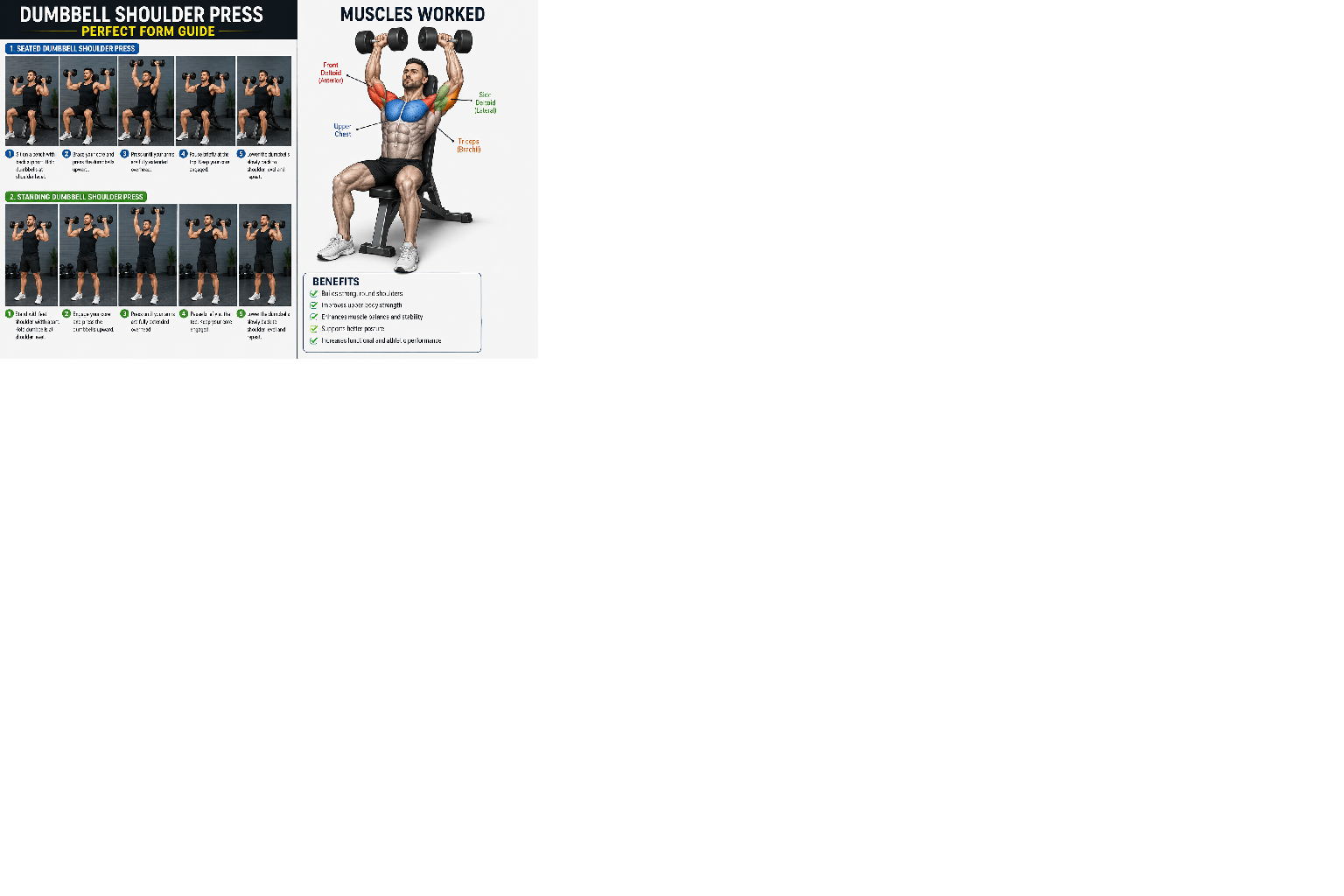
Dumbbell shoulder press is one of the most effective exercises for building strong, round, and powerful shoulders. Whether your goal is muscle growth, strength, better posture, athletic performance, or overall fitness, this exercise deserves a place in your workout routine.
Many people spend most of their time training their chest and arms. However, strong shoulders are equally important. Your shoulders help you lift, push, throw, carry, and reach overhead every day. Therefore, improving shoulder strength can make daily tasks easier while also enhancing gym performance.
Unlike machines, the dumbbell shoulder press forces each arm to work independently. As a result, it improves muscle balance, coordination, and stability while helping you build impressive shoulders.
In this complete guide, you’ll learn:
- What the dumbbell shoulder press is
- Muscles worked
- Benefits
- Proper form
- Common mistakes
- Best variations
- Weight recommendations
- Workout programs
- Nutrition and recovery tips
- Real-life examples
- Frequently asked questions
By the end of this article, you’ll know exactly how to perform the dumbbell shoulder press safely and effectively.
What Is the Dumbbell Shoulder Press?
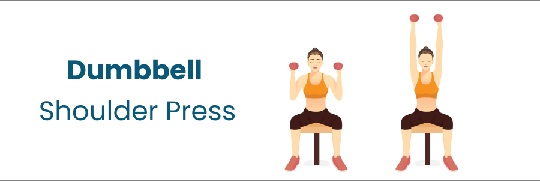
The dumbbell shoulder press is a compound upper-body exercise where you press a pair of dumbbells from shoulder height to an overhead position.
You can perform the exercise while seated or standing. Both variations build strength and muscle, although each offers unique benefits.
The movement primarily targets the shoulder muscles while also recruiting the triceps, upper chest, and stabilizing muscles throughout the upper body.
Because of its effectiveness, the dumbbell shoulder press is a staple exercise in many strength-training and bodybuilding programs.
Quick Dumbbell Shoulder Press Overview
| Category | Details |
| Exercise Name | Dumbbell Shoulder Press |
| Exercise Type | Compound |
| Primary Muscle | Deltoids |
| Secondary Muscles | Triceps, Upper Chest |
| Equipment | Dumbbells |
| Difficulty | Beginner to Advanced |
| Movement Pattern | Push |
| Goal | Strength and Muscle Growth |
| Position | Seated or Standing |
| Best For | Shoulder Development |
Why the Dumbbell Shoulder Press Is So Effective
Many exercises work the shoulders, but few deliver as many benefits as the dumbbell shoulder press.
Builds Bigger Shoulders
The exercise directly targets the deltoids, which are responsible for shoulder size and shape.
As you progressively increase resistance, your muscles adapt by growing stronger and larger.
Improves Muscle Balance
Since each arm presses its own dumbbell, one side cannot easily compensate for the other.
Consequently, muscle imbalances become easier to identify and correct.
Enhances Functional Strength
Many daily activities involve overhead movements.
For example:
- Putting luggage in an overhead compartment
- Placing items on shelves
- Carrying heavy objects
- Lifting children
The dumbbell shoulder press helps prepare your body for these tasks.
Supports Better Posture
Strong shoulders and upper-back muscles contribute to improved posture.
As a result, many people experience less slouching and greater upper-body stability.
Improves Athletic Performance
Athletes in sports such as tennis, volleyball, basketball, football, and swimming often benefit from stronger shoulders.
Overhead pressing strength frequently transfers to improved performance.
Muscles Worked During the Dumbbell Shoulder Press
Understanding which muscles work during the exercise helps you maximize results.
Primary Muscle: Deltoids
The deltoid consists of three sections.
Anterior Deltoid (Front Shoulder)
This portion performs most of the pressing movement.
Lateral Deltoid (Side Shoulder)
The lateral deltoid helps create wider shoulders and contributes to overall shoulder size.
Posterior Deltoid (Rear Shoulder)
Although less active, the rear deltoid helps stabilize the shoulder joint.
Secondary Muscles
Triceps
The triceps extend the elbows during the press.
Upper Chest
The clavicular portion of the chest assists the movement.
Trapezius
The traps help stabilize the shoulder girdle.
Serratus Anterior
This important muscle supports healthy shoulder movement.
Rotator Cuff
The rotator cuff muscles help stabilize and protect the shoulder joint.
Dumbbell Shoulder Press Benefits for Different Goals
For Muscle Growth
The dumbbell shoulder press allows a large range of motion and significant muscle tension.
Both factors support hypertrophy, which is the process of building muscle.
For Strength
Heavy dumbbell presses improve pressing power and upper-body strength.
Over time, this can improve performance in other exercises.
For Fat Loss
Although it is not a cardio exercise, the dumbbell shoulder press burns calories and helps preserve muscle mass while dieting.
More muscle can support a higher metabolism.
For Athletes
Athletes frequently need explosive upper-body power.
Stronger shoulders may help with:
- Throwing
- Serving
- Blocking
- Tackling
- Swimming
For Older Adults
Maintaining shoulder strength becomes increasingly important with age.
Strong shoulders help older adults:
- Carry groceries
- Lift household items
- Maintain independence
- Improve quality of life
Dumbbell Shoulder Press vs Barbell Shoulder Press
Many lifters wonder which exercise is better.
The answer depends on your goals.
| Feature | Dumbbell Shoulder Press | Barbell Shoulder Press |
| Range of Motion | Greater | Smaller |
| Muscle Balance | Excellent | Moderate |
| Stability Demand | High | Lower |
| Weight Potential | Moderate | High |
| Shoulder Comfort | Often Better | Varies |
| Coordination | Higher | Lower |
Choose Dumbbells If You Want
- Better muscle balance
- Greater range of motion
- More shoulder-friendly movement
- Improved stability
Choose Barbells If You Want
- Maximum strength development
- Heavier loads
- Competitive lifting benefits
Many successful lifters include both exercises in their routines.
Dumbbell Shoulder Press vs Machine Shoulder Press
Another common question involves machine presses.
| Feature | Dumbbells | Machine |
| Stability Training | High | Low |
| Muscle Activation | High | Moderate |
| Balance Development | Excellent | Limited |
| Ease of Use | Moderate | Easy |
| Beginner Friendly | Good | Very Good |
Machines can be useful for beginners, but dumbbells generally provide more overall benefits.
Best Warm-Up Before the Dumbbell Shoulder Press
A proper warm-up prepares your muscles and joints for training.
Spend 5 to 10 minutes performing:
Arm Circles
Perform 20 forward and 20 backward circles.
Shoulder Rolls
Roll your shoulders slowly in both directions.
Band Pull-Aparts
Use a resistance band to activate the upper back.
Light Dumbbell Presses
Perform one or two light sets before your working sets.
A good warm-up reduces injury risk and improves performance.
Mobility Exercises to Improve Your Shoulder Press
Poor shoulder mobility can limit progress.
Try these exercises regularly.
Wall Slides
Improve shoulder movement and posture.
Thoracic Extensions
Increase upper-back mobility.
Band Shoulder Stretch
Improve flexibility and range of motion.
Doorway Chest Stretch
Reduce chest tightness that can restrict overhead movement.
How to Perform the Dumbbell Shoulder Press Correctly
Proper technique is critical.
Follow these steps carefully.
Step 1: Starting Position
Sit on a bench with back support or stand upright.
Hold a dumbbell in each hand.
Position the dumbbells at shoulder height.
Keep your palms facing forward.
Step 2: Brace Your Core
Tighten your abdominal muscles.
This helps protect your lower back.
Step 3: Press the Dumbbells Overhead
Push the dumbbells upward in a controlled motion.
Continue until your arms are nearly straight.
Avoid forcefully locking your elbows.
Step 4: Pause Briefly
Hold the top position for one second.
Maintain control.
Step 5: Lower Slowly
Lower the dumbbells back to shoulder level.
Control the descent rather than letting gravity take over.
Step 6: Repeat
Complete your desired number of repetitions.
How to Breathe During the Dumbbell Shoulder Press
Proper breathing improves performance and stability.
Follow this simple rule:
- Inhale while lowering the weights.
- Exhale while pressing upward.
Breathing correctly helps maintain core stability throughout the movement.
Perfect Dumbbell Shoulder Press Form Checklist
✔ Chest up
✔ Core engaged
✔ Feet firmly planted
✔ Neutral spine
✔ Controlled movement
✔ Full range of motion
✔ Wrists straight
✔ No excessive back arch
✔ Smooth breathing
How Much Weight Should You Use?
Choosing the right weight is important.
| Experience Level | Men | Women |
| Beginner | 10–20 lbs | 5–10 lbs |
| Intermediate | 25–50 lbs | 10–25 lbs |
| Advanced | 50+ lbs | 25+ lbs |
These numbers are only guidelines.
Always prioritize proper technique over heavy weights.
Common Dumbbell Shoulder Press Mistakes
Using Too Much Weight
This is the most common mistake.
Heavy weights often cause poor form and increase injury risk.
Arching the Lower Back
Excessive arching places stress on the spine.
Keep your core tight throughout the movement.
Rushing Repetitions
Fast reps reduce muscle tension.
Move slowly and deliberately.
Using Partial Range of Motion
Full range of motion generally produces better results.
Flaring the Elbows Excessively
Keep the elbows slightly in front of the body.
This position is often more shoulder-friendly.
Best Dumbbell Shoulder Press Variations
Arnold Press
Named after Arnold Schwarzenegger.
Benefits:
- Increased range of motion
- More front deltoid activation
Neutral-Grip Shoulder Press
Palms face each other.
Benefits:
- Greater comfort
- Reduced shoulder stress
Single-Arm Dumbbell Press
Benefits:
- Better core activation
- Improved balance
Alternating Dumbbell Press
Benefits:
- Increased coordination
- Better control
Push Press
Uses slight leg drive.
Benefits:
- Power development
- Athletic performance enhancement
Dumbbell Shoulder Press for Muscle Growth
If your goal is bigger shoulders, use these guidelines.
| Variable | Recommendation |
| Sets | 3–5 |
| Reps | 8–12 |
| Rest | 60–90 Seconds |
| Frequency | 2 Times Weekly |
| Tempo | Controlled |
Focus on gradually increasing weight over time.
Dumbbell Shoulder Press for Strength
For strength development:
| Variable | Recommendation |
| Sets | 4–6 |
| Reps | 3–6 |
| Rest | 2–3 Minutes |
| Frequency | 2 Times Weekly |
Heavier weights and longer rest periods work best.
Progressive Overload: The Secret to Continuous Results
Progressive overload means gradually increasing training demands.
You can accomplish this by:
- Adding weight
- Increasing repetitions
- Adding sets
- Improving technique
- Reducing rest periods
Without progressive overload, muscle growth eventually slows.
Beginner Shoulder Workout
| Exercise | Sets | Reps |
| Dumbbell Shoulder Press | 3 | 10 |
| Lateral Raise | 3 | 12 |
| Front Raise | 3 | 12 |
| Push-Ups | 3 | 10 |
Perform twice weekly.
Intermediate Shoulder Workout
| Exercise | Sets | Reps |
| Dumbbell Shoulder Press | 4 | 8 |
| Arnold Press | 3 | 10 |
| Lateral Raise | 4 | 12 |
| Rear Delt Fly | 4 | 12 |
| Face Pull | 3 | 15 |
Advanced Shoulder Growth Workout
| Exercise | Sets | Reps |
| Heavy Dumbbell Shoulder Press | 5 | 5 |
| Arnold Press | 4 | 8 |
| Lateral Raise | 4 | 15 |
| Upright Row | 3 | 12 |
| Rear Delt Fly | 4 | 15 |
Real-Life Case Study: Office Worker Improves Posture
James, a 38-year-old office worker, spent most of his day sitting.
Over time, his posture worsened and his shoulders became weak.
He added dumbbell shoulder presses twice weekly.
After twelve weeks:
- Shoulder strength increased by approximately 35%
- Posture improved noticeably
- Daily activities became easier
- Neck discomfort decreased
Consistency made the biggest difference.
Real-Life Case Study: Recreational Tennis Player
Sarah played tennis every weekend.
However, she struggled with overhead strength and endurance.
After adding shoulder presses to her training program for three months:
- Serve speed improved
- Match endurance increased
- Shoulder fatigue decreased
This demonstrates how strength training can improve athletic performance.
Nutrition Tips for Better Results
Training alone is not enough.
Nutrition supports muscle growth and recovery.
Eat Enough Protein
Good protein sources include:
- Eggs
- Chicken
- Fish
- Greek yogurt
- Lean beef
- Beans
According to the American College of Sports Medicine, adequate protein intake supports muscle repair and growth.
Stay Hydrated
Water supports recovery and performance.
Drink water consistently throughout the day.
Eat Quality Carbohydrates
Examples include:
- Rice
- Oats
- Potatoes
- Fruits
These foods provide energy for training.
Recovery Tips
Recovery is where muscle growth occurs.
Sleep 7–9 Hours
Quality sleep supports recovery and performance.
The National Sleep Foundation recommends sufficient sleep for optimal health and physical recovery.
Take Rest Days
Muscles need time to recover.
Avoid intense shoulder training every day.
Stretch Regularly
Stretching may improve mobility and reduce stiffness.
Dumbbell Shoulder Press Safety Tips
- Warm up thoroughly
- Use manageable weights
- Focus on proper form
- Avoid jerking movements
- Stop if sharp pain occurs
- Progress gradually
- Maintain control throughout each repetition
Sample 12-Week Dumbbell Shoulder Press Progress Plan
| Week | Sets | Reps |
| 1–2 | 3 | 10 |
| 3–4 | 3 | 12 |
| 5–6 | 4 | 10 |
| 7–8 | 4 | 12 |
| 9–10 | 5 | 8 |
| 11–12 | 5 | 10 |
This progression helps build strength safely over time.
25 Frequently Asked Questions About the Dumbbell Shoulder Press
- Is the dumbbell shoulder press good for beginners?
Yes, it is beginner-friendly when performed correctly.
- Which muscles does it work?
Primarily the deltoids, triceps, and upper chest.
- Should I sit or stand?
Both work well. Beginners often prefer seated presses.
- How many times per week should I perform it?
Usually one to three times weekly.
- Does it build bigger shoulders?
Yes, it is one of the best shoulder-building exercises.
- Is it better than a barbell press?
Each has unique benefits.
- Can women perform it?
Absolutely.
- What weight should beginners use?
Start with a weight that allows excellent form.
- Can it improve posture?
Yes.
- Should elbows lock at the top?
No.
- Is shoulder pain normal?
No.
- Can I do it every day?
Recovery is necessary, so daily training is not recommended.
- Does it train the triceps?
Yes.
- How many sets are ideal?
Three to five sets for most people.
- What grip works best?
Pronated and neutral grips both work well.
- Can athletes benefit?
Definitely.
- What is the biggest mistake?
Using excessive weight.
- Is full range of motion important?
Yes.
- Should I warm up?
Always.
- Can older adults perform it?
Yes, with proper technique.
- Why do my shoulders hurt during presses?
Poor mobility, poor form, or existing injuries may contribute.
- Is it better than a machine shoulder press?
Generally, dumbbells provide more overall benefits.
- Can I build shoulders using only shoulder presses?
They help greatly, but additional exercises improve development.
- Should shoulder presses come first in a workout?
Usually yes, especially if strength is the goal.
- What bench angle is best?
Most lifters perform well using an upright bench between 75 and 90 degrees.
Conclusion
The dumbbell shoulder press remains one of the most effective exercises for building strong, muscular, and healthy shoulders. It develops strength, increases muscle size, improves stability, enhances posture, and supports athletic performance.
Furthermore, it trains multiple muscle groups at once, making it one of the most efficient upper-body exercises available. Whether your goal is shoulder hypertrophy, strength development, fat loss, sports performance, or long-term health, the dumbbell shoulder press can help you achieve it.
Most importantly, focus on proper technique, train consistently, recover adequately, and apply progressive overload over time. If you follow these principles, you can build stronger shoulders, improve upper-body performance, and enjoy long-lasting fitness results.