
Beginner resistance band workout; if you want to become stronger without buying heavy gym equipment, a beginner resistance band workout is one of the best places to start. It is simple, affordable, and suitable for almost everyone. Whether you are new to exercise, returning after a break, or looking for a gentle way to stay active, resistance bands can help you reach your fitness goals.
Unlike heavy weights, resistance bands provide smooth tension during every movement. As a result, your muscles stay active through the entire exercise. Moreover, bands are lightweight, easy to carry, and perfect for home workouts, travel, or outdoor training.
In this complete guide, you will learn how to use resistance bands safely, which exercises work best for beginners, how to create a weekly workout plan, and how to avoid common mistakes. Additionally, you will discover expert tips, real-life examples, and practical advice that make exercising easier and more enjoyable.
What Is a Beginner Resistance Band Workout?
A beginner resistance band workout is a strength-training routine that uses elastic exercise bands instead of dumbbells or machines. These bands stretch as you move, creating resistance that makes your muscles work harder.
Because the resistance increases as the band stretches, your muscles stay active throughout each exercise. Therefore, resistance bands can improve strength, balance, flexibility, and coordination at the same time.
Many fitness experts recommend resistance bands because they are safe for beginners and easy to learn.
Why Choose a Beginner Resistance Band Workout?
Many people believe they need expensive gym memberships to become fit. However, that is not true.
A beginner resistance band workout offers many advantages.
- Easy to learn
- Budget-friendly
- Portable
- Suitable for home workouts
- Low impact on joints
- Works the entire body
- Helps improve posture
- Increases flexibility
- Builds lean muscle
- Supports weight loss
Furthermore, resistance bands allow you to exercise almost anywhere.
How Resistance Bands Work
Resistance bands create tension when stretched.
Unlike traditional weights that rely on gravity, bands challenge your muscles from different angles. Consequently, every movement becomes more effective.
For example:
- Push harder, and resistance increases.
- Pull farther, and muscles work even more.
- Control the return movement, and strength improves.
This constant tension helps build stronger muscles while protecting joints.
Types of Resistance Bands
Several kinds of resistance bands exist. Each type serves a different purpose.
Loop Bands
Loop bands form a closed circle.
They are excellent for:
- Squats
- Glute exercises
- Leg workouts
- Hip activation
These bands are popular among beginners because they are easy to use.
Tube Bands
Tube bands usually include handles.
They work well for:
- Chest presses
- Rows
- Shoulder exercises
- Arm workouts
Additionally, they feel similar to gym cable machines.
Therapy Bands
Therapy bands are flat without handles.
Physical therapists often use them for:
- Rehabilitation
- Gentle stretching
- Mobility exercises
- Recovery training
Figure-8 Bands
These bands have built-in handles.
They are ideal for:
- Upper-body training
- Arm strengthening
- Shoulder exercises
Fabric Resistance Bands
Fabric bands do not roll during workouts.
They are commonly used for:
- Lower-body workouts
- Hip strengthening
- Glute activation
Many beginners enjoy these because they stay in place.
How to Choose the Right Resistance Band
Choosing the correct band makes your workout safer and more effective.
Light Resistance
Perfect for:
- Complete beginners
- Seniors
- Rehabilitation
- Shoulder exercises
Medium Resistance
Ideal for:
- Full-body workouts
- Everyday strength training
- Building endurance
Heavy Resistance
Best for:
- Advanced exercises
- Leg training
- Stronger users
If you are new, start with a light or medium band. Later, increase the resistance as your strength improves.
Benefits of Beginner Resistance Band Workout
A beginner resistance band workout offers many health benefits.
Builds Strength
Every exercise makes muscles stronger.
Because resistance increases during movement, muscles work continuously.
Improves Balance
Many resistance band exercises require stability.
Therefore, your body learns better balance naturally.
Burns Calories
Strength training increases calorie burning.
Moreover, regular workouts can help reduce body fat when paired with healthy eating.
Protects Your Joints
Resistance bands create smooth tension.
Unlike heavy weights, they reduce unnecessary pressure on knees, hips, and shoulders.
Improves Flexibility
Many exercises include controlled stretching.
As a result, muscles become more flexible over time.
Better Posture
Weak back muscles often lead to poor posture.
Fortunately, resistance band rows and pull-aparts strengthen the upper back.
Increases Confidence
Every completed workout builds confidence.
Soon, simple exercises become easier, encouraging you to continue.
Who Should Try a Beginner Resistance Band Workout?
Almost everyone can benefit.
It is especially useful for:
- Beginners
- Busy professionals
- Students
- Parents
- Older adults
- Travelers
- Home workout lovers
- People recovering from injuries (with medical guidance)
- Office workers
- People starting a weight-loss journey
Safety Tips Before You Start
Safety always comes first.
Follow these simple rules.
Check Your Band
Look for:
- Tears
- Cracks
- Weak spots
Replace damaged bands immediately.
Secure the Band
Never attach a band to an unstable object.
Instead, use sturdy anchors.
Wear Comfortable Clothing
Choose clothes that allow easy movement.
Athletic shoes provide better support.
Breathe Properly
Never hold your breath.
Instead:
- Exhale during effort.
- Inhale while returning.
Move Slowly
Fast movements reduce muscle engagement.
Controlled movements work better and reduce injury risk.
Beginner Warm-Up Routine
Always warm up before training.
Spend 5–10 minutes preparing your body.
| Exercise | Time |
| March in place | 2 minutes |
| Arm circles | 1 minute |
| Hip circles | 1 minute |
| Bodyweight squats | 1 minute |
| Shoulder rolls | 1 minute |
| Leg swings | 1 minute |
| Gentle stretching | 2 minutes |
A proper warm-up increases blood flow and prepares your muscles.
Understanding Resistance Levels
Resistance bands usually come in different colors.
Although colors vary by brand, many follow this pattern:
| Color | Resistance |
| Yellow | Very Light |
| Red | Light |
| Green | Medium |
| Blue | Heavy |
| Black | Extra Heavy |
Always check the manufacturer’s guide before buying.
Proper Form Matters
Good form keeps you safe.
Remember these tips:
- Stand tall.
- Tighten your core.
- Relax your shoulders.
- Move slowly.
- Avoid locking your joints.
- Keep breathing.
- Focus on quality instead of speed.
Even simple exercises become more effective with proper technique.
Muscle Groups You Can Train
A beginner resistance band workout trains almost every muscle.
Upper Body
- Chest
- Back
- Shoulders
- Biceps
- Triceps
Core
- Abs
- Obliques
- Lower back
Lower Body
- Glutes
- Quadriceps
- Hamstrings
- Calves
As a result, you can complete a full-body workout using only one resistance band.
Essential Equipment
Besides resistance bands, you may also need:
- Exercise mat
- Water bottle
- Workout towel
- Supportive shoes
- Door anchor (optional)
- Workout journal
- Timer
Fortunately, these items are inexpensive and easy to find.
Creating Your Home Workout Space
You do not need a large room.
Instead, choose a small area where you can stretch your arms comfortably.
A good workout space should have:
- Non-slip flooring
- Good lighting
- Fresh air
- Enough room to move safely
Keeping your space organized makes workouts more enjoyable.
Beginner Weekly Workout Schedule
Here is a simple plan to start with.
| Day | Activity |
| Monday | Full Body Resistance Band Workout |
| Tuesday | Walking + Stretching |
| Wednesday | Resistance Band Strength |
| Thursday | Rest |
| Friday | Full Body Workout |
| Saturday | Light Cardio |
| Sunday | Recovery Stretching |
This schedule gives your muscles enough time to recover while helping you build a consistent habit.
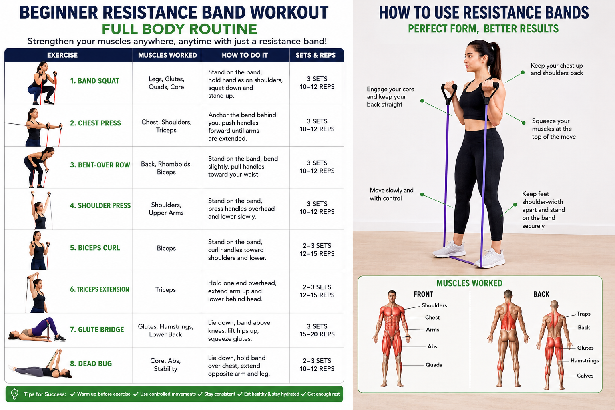
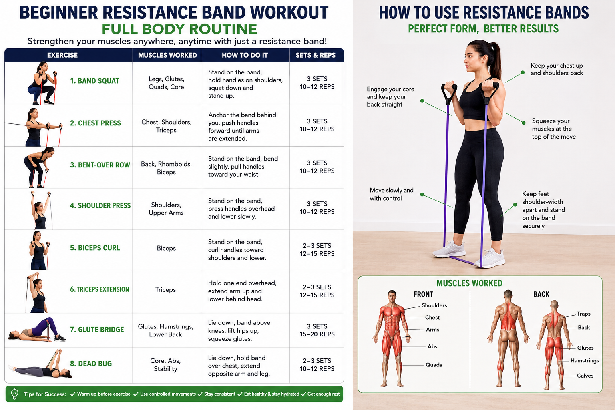
Beginner Resistance Band Workout Full-Body Routine
This beginner resistance band workout targets every major muscle group. Therefore, it is an excellent choice if you want one routine that trains your whole body.
| Exercise | Sets | Reps | Rest |
| Band Squats | 2–3 | 10–12 | 45 sec |
| Chest Press | 2–3 | 10–12 | 45 sec |
| Bent-Over Rows | 2–3 | 10–12 | 45 sec |
| Shoulder Press | 2 | 10 | 45 sec |
| Biceps Curl | 2 | 12 | 30 sec |
| Triceps Extension | 2 | 12 | 30 sec |
| Glute Bridge | 2 | 15 | 30 sec |
| Standing Calf Raise | 2 | 15 | 30 sec |
| Dead Bug with Band | 2 | 12 | 30 sec |
Complete this routine three times each week. Additionally, leave one rest day between strength sessions.
Beginner Resistance Band Workout Exercise 1: Band Squats
Band squats strengthen your legs and hips.
Steps
- Stand on the band.
- Hold the handles near your shoulders.
- Keep your chest up.
- Bend your knees slowly.
- Lower until your thighs are almost parallel.
- Push through your heels.
- Return to standing.
Muscles Worked
- Quadriceps
- Glutes
- Hamstrings
- Core
Beginner Tip
Keep your knees in line with your toes.
Beginner Resistance Band Workout Exercise 2: Chest Press
This exercise strengthens your chest and arms.
Steps
- Anchor the band behind you.
- Hold one handle in each hand.
- Push forward slowly.
- Bring your hands together.
- Return under control.
Muscles Worked
- Chest
- Front shoulders
- Triceps
Beginner Resistance Band Workout Exercise 3: Bent-Over Rows
Rows improve posture and strengthen your back.
Steps
- Stand on the band.
- Bend slightly at your hips.
- Pull the handles toward your waist.
- Squeeze your shoulder blades.
- Lower slowly.
Benefits
- Stronger back
- Better posture
- Improved pulling strength
Beginner Resistance Band Workout Exercise 4: Shoulder Press
Strong shoulders help with everyday activities.
Steps
- Stand on the band.
- Hold handles at shoulder level.
- Press overhead.
- Lower with control.
Keep in Mind
Do not arch your lower back.
Beginner Resistance Band Workout Exercise 5: Lateral Raise
This movement shapes your shoulders.
Steps
- Stand on the middle of the band.
- Hold the handles at your sides.
- Raise your arms to shoulder height.
- Lower slowly.
Avoid lifting too high.
Beginner Resistance Band Workout Exercise 6: Front Raise
Front raises improve shoulder strength.
Move slowly because control matters more than speed.
Beginner Resistance Band Workout Exercise 7: Biceps Curl
This classic exercise builds stronger arms.
Steps
- Stand on the band.
- Hold handles with palms facing forward.
- Curl upward.
- Lower slowly.
Expert Tip
Keep your elbows close to your body.
Beginner Resistance Band Workout Exercise 8: Hammer Curl
Hammer curls strengthen your forearms and biceps.
Hold the handles with your palms facing each other throughout the movement.
Beginner Resistance Band Workout Exercise 9: Triceps Extension
This exercise targets the back of your arms.
Steps
- Hold one end of the band behind your back.
- Extend your arm overhead.
- Straighten your elbow.
- Return slowly.
Beginner Resistance Band Workout Exercise 10: Triceps Kickback
Kickbacks improve arm definition.
Move your forearm only while keeping your upper arm still.
Beginner Resistance Band Workout Exercise 11: Standing Chest Fly
This exercise helps develop chest muscles.
Bring your hands together gently without locking your elbows.
Beginner Resistance Band Workout Exercise 12: Reverse Fly
Reverse fly exercises improve posture.
Additionally, they strengthen the upper back and rear shoulders.
Beginner Resistance Band Workout Exercise 13: Glute Bridge
Strong glutes support healthy hips.
Steps
- Lie on your back.
- Place the band above your knees.
- Lift your hips.
- Pause briefly.
- Lower slowly.
Beginner Resistance Band Workout Exercise 14: Standing Hip Abduction
This movement strengthens your outer hips.
Healthy hip muscles improve balance and walking.
Beginner Resistance Band Workout Exercise 15: Standing Hip Extension
Hip extensions strengthen your glutes.
Avoid leaning forward during the exercise.
Beginner Resistance Band Workout Exercise 16: Side Walk
Loop bands work perfectly for side walks.
Take small controlled steps.
Maintain constant tension on the band.
Beginner Resistance Band Workout Exercise 17: Romanian Deadlift
This exercise targets your hamstrings.
Keep your back straight throughout the movement.
Beginner Resistance Band Workout Exercise 18: Standing Calf Raise
Strong calves improve walking, running, and balance.
Lift your heels slowly.
Pause at the top.
Lower with control.
Beginner Resistance Band Workout Exercise 19: Seated Row
If you have enough floor space, seated rows are excellent.
Sit tall and pull the band toward your waist.
Beginner Resistance Band Workout Exercise 20: Standing Wood Chop
This exercise strengthens your core.
It also improves body rotation.
Beginner Resistance Band Workout Exercise 21: Pallof Press
The Pallof press trains core stability.
Instead of twisting, resist the rotation.
Beginner Resistance Band Workout Exercise 22: Dead Bug with Band
Dead bugs improve coordination.
Furthermore, they strengthen deep core muscles.
Beginner Resistance Band Workout Exercise 23: Bird Dog
Bird dogs improve balance.
Move one arm and the opposite leg together.
Beginner Resistance Band Workout Exercise 24: Band Pull-Apart
Many office workers love this exercise.
It helps reduce rounded shoulders caused by sitting.
Beginner Resistance Band Workout Exercise 25: Standing Crunch
Standing crunches strengthen your abdominal muscles without lying on the floor.
Beginner Resistance Band Workout for Arms
If your goal is stronger arms, combine:
- Biceps curls
- Hammer curls
- Triceps extensions
- Kickbacks
Perform each movement for 2–3 sets.
Beginner Resistance Band Workout for Legs
Your lower body deserves equal attention.
Focus on:
- Squats
- Romanian deadlifts
- Glute bridges
- Side walks
- Hip extensions
- Calf raises
Together, these exercises create stronger legs.
Beginner Resistance Band Workout for Chest
For chest development, include:
- Chest press
- Standing chest fly
These movements improve pushing strength.
Beginner Resistance Band Workout for Back
A healthy back improves posture.
Best exercises include:
- Bent-over row
- Reverse fly
- Pull-aparts
- Seated row
Beginner Resistance Band Workout for Shoulders
Shoulders work in many daily activities.
Train them using:
- Shoulder press
- Front raise
- Lateral raise
- Reverse fly
Beginner Resistance Band Workout for Core
A stronger core protects your lower back.
Include:
- Pallof press
- Dead bug
- Standing crunch
- Wood chop
Sample 30-Minute Beginner Resistance Band Workout
| Exercise | Time |
| Warm-up | 5 min |
| Squats | 3 min |
| Rows | 3 min |
| Chest Press | 3 min |
| Shoulder Press | 3 min |
| Biceps Curl | 2 min |
| Triceps Extension | 2 min |
| Glute Bridge | 3 min |
| Core Exercises | 4 min |
| Cool Down | 2 min |
This workout fits easily into a busy schedule.
Real-Life Example
Sarah, a 42-year-old office worker, wanted to become healthier but felt nervous about joining a gym. She started a beginner resistance band workout at home three days each week. During the first month, she noticed that climbing stairs felt easier and her shoulders became less stiff after long workdays. After three months, she could complete more repetitions with a stronger band, her posture improved, and she felt more energetic throughout the day. Most importantly, she built a consistent exercise habit without spending much money.
Case Study: Home Training Success
A community fitness program introduced resistance band training to a group of beginners aged 30 to 60. Participants completed full-body workouts three times a week for eight weeks while gradually increasing band resistance. By the end of the program:
| Improvement | Result |
| Workout consistency | Increased |
| Lower-body strength | Improved |
| Upper-body strength | Improved |
| Balance | Improved |
| Confidence | Improved |
| Daily movement | Easier |
The program showed that simple resistance band exercises can help beginners become stronger and more active when they follow a regular routine.
Advantages of a Beginner Resistance Band Workout
- Affordable equipment
- Easy to store
- Suitable for all fitness levels
- Great for home workouts
- Gentle on the joints
- Improves strength
- Builds muscle endurance
- Enhances flexibility
- Supports better posture
- Easy to carry while traveling
- Allows full-body training
- Helps create consistent exercise habits
Disadvantages of a Beginner Resistance Band Workout
- Bands can wear out over time.
- Very advanced lifters may eventually need heavier resistance.
- Poor form may reduce exercise effectiveness.
- Some exercises require a secure anchor.
- Resistance varies between different band brands.
Even so, these disadvantages are minor for most beginners.
Expert Advice
Fitness professionals often recommend starting with lighter resistance and focusing on proper form before increasing difficulty. Additionally, performing controlled movements, resting adequately between sessions, and gradually progressing to stronger bands can reduce the risk of injury while helping you build strength steadily.
Beginner Resistance Band Workout Nutrition Tips
A beginner resistance band workout gives the best results when you eat healthy foods. Exercise helps build strength, but good nutrition helps your muscles recover and grow.
Choose simple, healthy meals instead of highly processed foods. Also, try to eat a mix of protein, healthy fats, fruits, vegetables, and whole grains every day.
Best Foods Before Your Workout
Eat a light meal about 1–2 hours before exercising.
Good choices include:
- Oatmeal with banana
- Whole-grain toast with peanut butter
- Greek yogurt with berries
- Apple with peanut butter
- Boiled eggs and whole-grain bread
These foods provide energy without making you feel too full.
Best Foods After Your Beginner Resistance Band Workout
After your workout, your body needs nutrients to recover.
Choose foods such as:
- Grilled chicken with rice
- Fish and vegetables
- Cottage cheese with fruit
- Protein smoothie
- Eggs with toast
- Turkey sandwich
- Brown rice and beans
Additionally, drink plenty of water after every workout.
Stay Hydrated Every Day
Water helps your muscles work properly.
Therefore, aim to drink water throughout the day instead of waiting until you feel thirsty.
Simple tips include:
- Drink a glass of water after waking up.
- Carry a reusable water bottle.
- Drink before, during, and after exercise.
- Increase your water intake on hot days.
Beginner Resistance Band Workout Recovery Tips
Recovery is just as important as exercise.
Without enough recovery, your muscles may stay sore longer, and your progress may slow down.
Sleep Well
Try to sleep 7–9 hours every night.
Good sleep helps your body repair muscles and restore energy.
Stretch After Every Workout
Stretching helps reduce muscle tightness.
Hold each stretch for about 20–30 seconds without bouncing.
Take Rest Days
Rest days help your muscles recover.
You do not need to exercise hard every day.
Beginner Resistance Band Workout Cool-Down Routine
Spend about five minutes cooling down after each workout.
| Stretch | Time |
| Hamstring Stretch | 30 sec |
| Quadriceps Stretch | 30 sec |
| Chest Stretch | 30 sec |
| Shoulder Stretch | 30 sec |
| Back Stretch | 30 sec |
| Hip Flexor Stretch | 30 sec |
| Deep Breathing | 2 min |
Cooling down helps your heart rate return to normal.
Beginner Resistance Band Workout Weekly Progress Plan
Progress happens when you stay consistent.
Use this simple plan.
| Week | Goal |
| Week 1 | Learn proper form |
| Week 2 | Increase repetitions |
| Week 3 | Improve control |
| Week 4 | Add another set |
| Week 5 | Try a stronger band |
| Week 6 | Track strength improvements |
Small improvements each week lead to big results over time.
Beginner Resistance Band Workout Progress Tracker
Keeping a workout journal helps you stay motivated.
Track:
- Workout date
- Exercises completed
- Sets
- Repetitions
- Resistance level
- Energy level
- Notes about progress
Looking back at your progress can inspire you to keep going.
Signs You Are Getting Stronger
You may notice several positive changes.
For example:
- Exercises feel easier.
- You complete more repetitions.
- Your balance improves.
- Daily activities become easier.
- Your posture looks better.
- You recover faster.
- You feel more energetic.
- You can use a stronger band.
Celebrate these milestones—they show your hard work is paying off.
Common Beginner Resistance Band Workout Mistakes
Avoiding common mistakes will help you stay safe and make better progress.
Using a Band That Is Too Heavy
Start with a light or medium band. You can increase resistance later.
Moving Too Fast
Slow, controlled movements work your muscles better.
Skipping Warm-Ups
Always warm up before exercising to prepare your body.
Forgetting to Breathe
Breathe naturally throughout each exercise.
Poor Posture
Stand tall, keep your core engaged, and avoid rounding your back.
Not Resting Enough
Your muscles need time to recover.
Ignoring Pain
Stop if you feel sharp pain. Mild muscle fatigue is normal, but pain is not.
Beginner Resistance Band Workout Motivation Tips
Staying motivated can be challenging, especially when you’re just starting.
Try these ideas:
- Set small, realistic goals.
- Schedule workouts like appointments.
- Listen to your favorite music.
- Exercise with a friend.
- Celebrate small achievements.
- Take progress photos.
- Track your workouts.
- Focus on consistency, not perfection.
Remember, every workout brings you one step closer to your goals.
For Weight Loss
A beginner resistance band workout can support weight loss when combined with healthy eating and regular activity.
Resistance training helps build lean muscle, and muscle burns more calories than fat—even while you’re resting.
For best results:
- Exercise 3–4 times per week.
- Walk daily.
- Eat balanced meals.
- Stay hydrated.
- Sleep well.
Weight loss takes time, so be patient with yourself.
For Better Posture
Many people spend hours sitting at desks.
As a result, shoulders may round forward and the upper back may weaken.
Resistance band exercises such as rows, pull-aparts, and reverse flys strengthen these muscles and encourage better posture.
Better posture can also reduce neck and shoulder discomfort.
While Traveling
One of the best things about resistance bands is their portability.
You can pack a resistance band in almost any suitcase or backpack.
Whether you’re staying in a hotel, visiting family, or camping, you can continue your workouts almost anywhere.
For Older Adults
Resistance bands are also excellent for many older adults because they provide gentle resistance.
Benefits include:
- Improved balance
- Stronger muscles
- Better mobility
- Easier daily activities
- Greater confidence
However, older adults should consult a healthcare provider before starting a new exercise program, especially if they have existing medical conditions.
For Busy People
You don’t need an hour to get stronger.
Even 20–30 minutes of focused exercise can make a difference.
Try exercising:
- Before work
- During lunch breaks
- After dinner
- On weekends
Consistency matters more than long workouts.
Equipment Checklist
Before you begin, make sure you have:
- Resistance band
- Exercise mat
- Comfortable shoes
- Water bottle
- Towel
- Timer
- Workout journal
These simple items are enough to get started.
Expert Advice
Fitness experts often recommend mastering proper technique before increasing resistance. Focus on smooth, controlled movements and maintain good posture throughout every exercise. As your strength improves, gradually increase repetitions, sets, or band resistance instead of making large jumps.
Frequently Asked Questions
- What is a beginner resistance band workout?
It is a strength-training routine that uses elastic resistance bands instead of weights.
- Are resistance bands good for beginners?
Yes. They are easy to use, affordable, and gentle on the joints.
- How often should beginners train?
Most beginners benefit from 3 full-body sessions each week.
- Can resistance bands build muscle?
Yes. They provide resistance that challenges your muscles and supports muscle growth.
- How long should each workout last?
Around 20–45 minutes is enough for most beginners.
- Which resistance band should I buy first?
Start with a light or medium resistance band.
- Can I lose weight with resistance bands?
Yes, especially when combined with healthy eating and regular activity.
- Are resistance bands safe?
Yes, when used correctly and inspected regularly for damage.
- Do I need a gym?
No. Resistance bands are ideal for home workouts.
- Can older adults use resistance bands?
Yes, with proper guidance and medical approval if needed.
- Should I warm up first?
Yes. A 5–10 minute warm-up prepares your body for exercise.
- Is stretching important?
Yes. Stretching helps improve flexibility and supports recovery.
- How do I know when to use a stronger band?
When your current band feels easy for all sets and repetitions while maintaining proper form.
- Can I exercise every day?
Strength training every day is not recommended. Give your muscles time to recover.
- What should I eat after my workout?
Choose a meal with protein and healthy carbohydrates.
- Are resistance bands expensive?
No. Most bands are affordable and last a long time with proper care.
- Can children use resistance bands?
With supervision and age-appropriate exercises, they can be used safely.
- How do I clean my resistance bands?
Wipe them with a damp cloth and allow them to dry completely before storing.
- What should I do if a band breaks?
Replace it immediately and never continue using a damaged band.
- How soon will I see results?
Many beginners notice improvements in strength, energy, and confidence within 4–8 weeks of consistent training.
Conclusion
A beginner resistance band workout is one of the easiest and most effective ways to start your fitness journey. It requires very little equipment, fits almost any budget, and can be done at home, outdoors, or while traveling.
By learning proper form, choosing the right resistance, and following a regular workout schedule, you can build strength, improve flexibility, support better posture, and increase your confidence. Progress may seem small at first, but every workout brings you closer to your goals.
Stay patient, focus on consistency, and remember that healthy habits create lasting results. Your fitness journey begins with a single workout—and a resistance band is an excellent place to start.
External Resources
- American College of Sports Medicine (ACSM)
https://www.acsm.org/
Evidence-based fitness guidelines, exercise recommendations, and strength training resources. - Centers for Disease Control and Prevention (CDC) – Physical Activity
https://www.cdc.gov/physicalactivity/
Official physical activity guidelines and health benefits for adults. - World Health Organization (WHO) – Physical Activity
https://www.who.int/health-topics/physical-activity
Global recommendations on physical activity and healthy lifestyles. - National Institute on Aging – Exercise and Physical Activity
https://www.nia.nih.gov/health/exercise-physical-activity
Safe exercise advice for beginners and older adults. - American Heart Association – Fitness and Physical Activity
https://www.heart.org/
Resources on exercise, heart health, and staying active. - Mayo Clinic – Fitness
https://www.mayoclinic.org/healthy-lifestyle/fitness
Expert guidance on strength training, flexibility, and exercise safety. - Harvard T.H. Chan School of Public Health – Nutrition Source
https://www.hsph.harvard.edu/nutritionsource/
Reliable nutrition advice to support exercise and recovery. - National Strength and Conditioning Association (NSCA)
https://www.nsca.com/
Research-based information on strength training and exercise programming. - MedlinePlus – Exercise and Physical Fitness
https://medlineplus.gov/exerciseandphysicalfitness.html
Consumer-friendly health information from the U.S. National Library of Medicine. - ChooseMyPlate (USDA)
https://www.myplate.gov/
Healthy eating guidance to support fitness goals. - Exercise is Medicine®
https://www.exerciseismedicine.org/
Educational resources explaining how regular exercise supports overall health. - National Health Service (NHS) – Fitness Studio
https://www.nhs.uk/live-well/exercise/
Free beginner-friendly workouts, stretching routines, and fitness advice.