
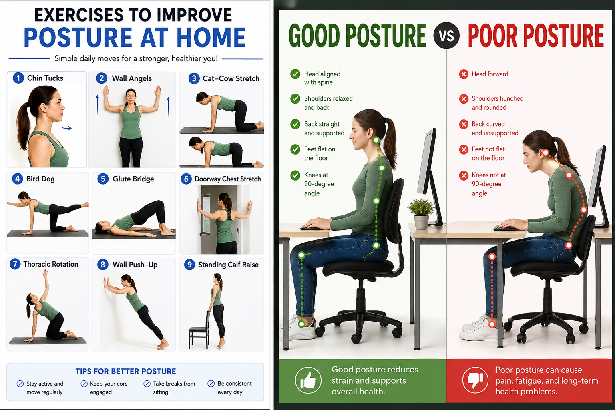
Exercises to improve posture at home can help you build stronger back, shoulder, stomach, and hip muscles while teaching your body better movement habits. You do not need a gym, expensive machine, or large workout room. Instead, a small open space, a wall, and a chair can be enough.
Good posture is not about keeping your body stiff all day. In fact, your body needs to move and change positions. The Occupational Safety and Health Administration (OSHA) advises people who work at computers to change positions often, stretch, stand, and walk around instead of staying in one position for long periods.
This guide explains exercises to improve posture at home in simple steps. It also covers common posture mistakes, benefits, disadvantages, a weekly plan, expert advice, current activity data, a chart, and 20 frequently asked questions.
Health note: This article gives general fitness information. If you have severe pain, numbness, weakness, an injury, balance problems, or a medical condition, speak with a qualified health professional before starting a new exercise routine.
Why Posture Deserves Daily Attention
Posture affects how you sit, stand, walk, work, and use your phone. However, perfect posture does not mean holding one position for hours.
Instead, healthy posture means your body can stay comfortable and balanced while you move. Therefore, regular movement is just as important as strengthening.
The current U.S. physical activity guidelines recommend that adults get 150 to 300 minutes of moderate physical activity each week and perform muscle-strengthening activity on at least two days.
How These Home Exercises Work
Exercises to improve posture at home work best when they combine strength, mobility, balance, and body awareness.
For example, weak upper-back muscles may make it harder to keep your shoulders comfortably positioned. Tight hips may also make sitting and standing feel less comfortable.
Therefore, do not focus only on pulling your shoulders backward. Instead, train your whole body.
The Main Muscles Behind Better Posture
Several muscle groups help support comfortable posture:
- Upper-back muscles
- Shoulder muscles
- Deep abdominal muscles
- Glutes
- Hip muscles
- Neck muscles
- Lower-back muscles
- Leg muscles
A balanced routine trains several of these areas rather than concentrating on one muscle.
Exercises to Improve Posture at Home: Wall Angels
Wall angels are one of the easiest ways to practice upper-body control.
How to do them:
- Stand with your back near a wall.
- Keep your feet a short distance forward.
- Gently bring your upper back toward the wall.
- Place your arms against the wall if comfortable.
- Slowly move your arms upward.
- Return them down with control.
- Repeat 8 to 12 times.
Do not force your arms against the wall. Instead, move only through a comfortable range.
Chin Tucks for a Forward Head
Chin tucks can help you practice a more neutral head position.
Sit or stand tall. Then gently draw your chin backward, as if making a small double chin. Hold for about three seconds and relax.
Repeat 8 to 10 times.
Importantly, do not look down while doing this movement. Your eyes should stay level.
Exercises to Improve Posture at Home With Cat-Cow
The cat-cow movement gently moves the spine through different positions.
Start on your hands and knees. Then slowly round your back. After that, gently move toward the opposite position while keeping the movement comfortable.
Perform 6 to 10 slow repetitions.
This exercise can work well as a warm-up before stronger movements.
Bird Dog for Core and Back Control
The bird dog teaches your trunk to stay controlled while your arms and legs move.
Start on your hands and knees. Tighten your stomach gently. Then extend one arm and the opposite leg.
Pause briefly. Return to the starting position and switch sides.
Begin with 5 repetitions per side. Later, work toward 8 to 10 repetitions.
Glute Bridges for Stronger Hips
Strong glutes support everyday movement.
Lie on your back with your knees bent. Keep your feet flat. Then squeeze your glutes and lift your hips.
Pause for one second. Slowly lower your hips.
Try 8 to 15 repetitions.
Avoid pushing your hips too high. Your goal is controlled movement, not maximum height.
Exercises to Improve Posture at Home Using a Chair
A strong chair can become a useful exercise tool.
Try seated rows without equipment by sitting tall and pulling your elbows gently backward while squeezing your shoulder blades.
Hold the squeeze for one second, then relax.
Perform 10 to 15 repetitions.
Do not use a chair that moves easily or has wheels.
Prone Y Raises for the Upper Back
Lie face down on a comfortable mat. Extend your arms into a Y shape.
Lift your arms slightly from the floor. Keep the movement small and controlled.
Lower your arms slowly.
Start with 6 to 10 repetitions.
Because this movement can feel challenging, do not worry about lifting your arms high.
Prone W Raises for Shoulder Control
W raises train the muscles around your upper back and shoulders.
Lie face down. Bend your elbows so your arms resemble a W.
Gently lift your hands and arms. Then lower them slowly.
Try 8 to 12 repetitions.
Keep your neck relaxed throughout the movement.
Doorway Chest Stretch
Many people spend long periods using phones, laptops, and desks. Therefore, a gentle chest stretch can be a useful part of a movement routine.
Stand in a doorway. Place your forearms against the door frame. Step forward slightly until you feel a gentle stretch across your chest.
Hold for 15 to 30 seconds.
Do not bounce or force the stretch.
Exercises to Improve Posture at Home for Tight Hips
Hip mobility matters because your hips help your body sit, stand, walk, and bend.
Try a half-kneeling hip stretch.
Place one knee on the floor and one foot in front. Keep your upper body tall. Gently move your hips forward.
Hold for 15 to 30 seconds per side.
If you feel sharp pain, stop.
Thoracic Rotation to Wake Up the Upper Back
Thoracic rotations move the middle part of your spine.
Start on your hands and knees. Place one hand behind your head.
Slowly rotate your upper body toward that side. Return to the starting position.
Repeat 6 to 8 times per side.
Move slowly rather than trying to rotate as far as possible.
Exercises to Improve Posture at Home With a Towel
You can use a small towel for gentle shoulder mobility.
Hold the towel with both hands. Keep your grip wider than shoulder width.
Slowly move your arms upward only as far as feels comfortable.
Return slowly.
Perform 5 to 10 repetitions.
This should feel like mobility work, not a painful stretch.
Wall Push-Ups for Easy Strength
Wall push-ups are easier than floor push-ups.
Stand facing a wall. Place your hands on it around chest height.
Bend your elbows and bring your body toward the wall. Then push yourself away.
Keep your body in one straight line.
Start with 8 to 12 repetitions.
As you become stronger, move your feet farther from the wall.
Exercises to Improve Posture at Home With Resistance Bands
If you own a resistance band, band pull-aparts can train the upper back and rear shoulders.
Hold the band with both hands. Keep your arms roughly in front of you.
Pull the band apart slowly. Then return with control.
Try 8 to 15 repetitions.
Use light resistance at first.
Standing Calf Raises for Whole-Body Support
Posture begins at the ground.
Stand behind a sturdy chair for balance. Slowly raise your heels. Pause briefly, then lower them.
Complete 10 to 15 repetitions.
This simple exercise also supports ankle strength and balance.
Exercises to Improve Posture at Home for Beginners
Beginners should not try every exercise at once.
Instead, start with five movements:
- Wall angels
- Chin tucks
- Glute bridges
- Bird dogs
- Wall push-ups
Do one or two sets of each movement.
Most importantly, stop before your form becomes messy.
A Simple 10-Minute Posture Routine
Here is a practical beginner routine:
| Exercise | Reps/Time | Main Goal |
| Chin tucks | 8–10 | Head control |
| Wall angels | 8–12 | Shoulder mobility |
| Glute bridges | 10–15 | Hip strength |
| Bird dogs | 5–8/side | Core control |
| Wall push-ups | 8–12 | Upper-body strength |
| Chest stretch | 20 sec | Chest mobility |
This routine can take about 10 minutes.
However, quality matters more than speed.
Exercises to Improve Posture at Home: Weekly Schedule
Try this beginner schedule:
Monday: Full routine
Tuesday: Walking and gentle stretching
Wednesday: Full routine
Thursday: Easy movement
Friday: Full routine
Saturday: Walking or another enjoyable activity
Sunday: Rest or gentle mobility
The broader goal should also include regular physical activity. Current federal guidance recommends muscle-strengthening work at least two days each week.
How Often Should You Train?
You do not need a long workout every day.
For beginners, three short posture-focused sessions per week can provide a practical starting point.
Meanwhile, add walking and normal daily movement.
The NHS also recommends reducing long periods of sitting and breaking up periods of inactivity with movement.
Why Walking Supports Better Posture
Walking does not directly “fix” posture, but it gives your body more opportunities to move.
Try taking a short walk after a long sitting session.
Even five or ten minutes can help break up a long period of inactivity.
Furthermore, regular walking supports overall physical activity goals.
Exercises to Improve Posture at Home During Work Breaks
You can add tiny movement breaks to your workday.
For example:
- Stand for one minute.
- Roll your shoulders gently.
- Walk around your room.
- Stretch your chest.
- Do five chin tucks.
- Take several slow breaths.
- Change your sitting position.
OSHA recommends changing working positions and taking opportunities to stand, stretch, and move rather than staying still for prolonged periods.
Fix Your Desk Before Blaming Your Posture
Exercise helps, but your environment matters too.
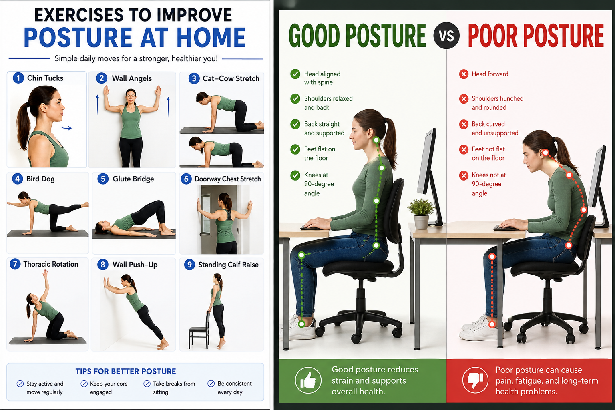
When sitting, aim for:
- Feet supported.
- Knees around hip height.
- Back supported.
- Screen positioned comfortably.
- Shoulders relaxed.
- Elbows supported when possible.
OSHA describes supported sitting with the back supported and the thighs and hips supported, while also stressing the importance of changing position regularly.
Exercises to Improve Posture at Home and Phone Use
Phone habits can encourage long periods of looking downward.
Instead of holding your phone near your waist, raise it closer to eye level when practical.
However, do not hold one position for too long.
The better habit is simple: move often.
The Biggest Posture Mistake
One common mistake is trying to “stand straight” by pulling the shoulders back all day.
That can make your body stiff.
Instead, think:
Tall, relaxed, and moving.
Your shoulders should not need to stay squeezed together.
Real-Life Example: The Desk Worker
Consider a common example.
A person works at a computer for seven or eight hours. They often lean toward the screen and rarely stand.
Instead of doing one intense workout, they start a 10-minute routine three times a week. They also stand and walk briefly during work breaks.
After several weeks, they may find it easier to notice when they slump.
This is an illustrative case study, not a medical trial or guaranteed result.
The lesson is simple: small habits can work better when you repeat them consistently.
Case Study: Building a Simple Home Habit
Imagine a beginner who has never done posture exercises.
During week one, they perform five basic movements.
During week two, they add one repetition to several exercises.
During week three, they add a fourth training day only if recovery feels good.
By week four, they have created a repeatable habit.
The key point is not the exact number of days. Instead, the key is steady practice without forcing painful movement.
Exercises to Improve Posture at Home: Main Advantages
The biggest advantages include:
- No gym membership required.
- Little or no equipment.
- Easy to fit into busy days.
- Can strengthen important muscle groups.
- Can improve body awareness.
- Can support better movement habits.
- Can be adjusted for beginners.
- Can be combined with walking.
Physical activity also provides broader health benefits. Current federal guidance notes that even inactive people can benefit from increasing activity gradually.
Possible Disadvantages and Limits
There are also limits.
Posture exercises cannot solve every source of pain or movement difficulty.
Other disadvantages may include:
- Results take time.
- Poor form can reduce the benefit.
- Some exercises may irritate an existing injury.
- People may expect instant changes.
- Exercise alone cannot fix a poorly designed workstation.
- Some conditions require professional assessment.
Therefore, use exercise as one part of a healthy movement plan.
Exercises to Improve Posture at Home: What Experts Recommend
A sensible approach is to combine strengthening with regular movement.
The current U.S. guidelines recommend muscle-strengthening activity on at least two days each week for adults.
OSHA also recommends changing positions and taking short movement breaks during prolonged computer work.
So, the expert-supported message is simple:
Strengthen your body, move regularly, and avoid staying in one position for too long.
Current Data Worth Knowing
There is an interesting gap between recommendations and real-world activity.
Healthy People 2030 reports that 32.9% of U.S. adults met the muscle-strengthening guideline in 2024, compared with a target of 36.6%.
That means many adults still do not regularly perform enough muscle-strengthening activity.
Therefore, simple home routines can be a practical way to add strength work to a normal week.
A Useful Posture Exercise Comparison Chart
| Movement | Difficulty | Equipment | Main Area | Beginner Friendly |
| Chin tuck | Easy | None | Neck | Yes |
| Wall angel | Easy | Wall | Upper back/shoulders | Yes |
| Cat-cow | Easy | Mat | Spine | Yes |
| Glute bridge | Easy | Mat | Glutes/hips | Yes |
| Bird dog | Medium | Mat | Core/back | Yes |
| Wall push-up | Easy | Wall | Chest/arms | Yes |
| Y raise | Medium | Mat | Upper back | Yes |
| Band pull-apart | Easy | Band | Upper back | Yes |
| Hip stretch | Easy | None | Hips | Yes |
| Thoracic rotation | Easy | Mat | Upper back | Yes |
How to Make Progress Safely
Start with low volume.
For example, perform 8 repetitions instead of 20. Then increase gradually when the movements feel easy and controlled.
You can also make progress by:
- Adding repetitions.
- Adding a second set.
- Using light resistance.
- Slowing the movement.
- Improving control.
- Increasing your walking time.
Do not increase everything at once.
Exercises to Improve Posture at Home Without Equipment
You can create an effective routine without buying anything.
Use:
- A wall
- A stable chair
- A floor mat
- Your body weight
- A towel
That makes posture training accessible for many beginners.
How Breathing Fits Into Posture
Breathing should remain easy during your exercises.
Try not to hold your breath.
Instead, breathe slowly and keep your shoulders relaxed.
During strength movements, exhale through the harder part when comfortable.
Good breathing can also remind you not to create unnecessary tension.
When You Should Stop an Exercise
Stop an exercise if you develop:
- Sharp pain
- New numbness
- Tingling
- Sudden weakness
- Dizziness
- Loss of balance
- Severe or worsening symptoms
Mild muscle effort is different from sharp pain.
If symptoms continue, seek advice from a qualified medical professional.
Exercises to Improve Posture at Home After Sitting
After a long sitting session, do not immediately perform a difficult workout.
Instead, stand up and walk for a few minutes.
Then try:
- Five chin tucks
- Five shoulder rolls
- Five gentle chest stretches
- Five bodyweight squats if comfortable
OSHA specifically encourages people to stand, stretch, and move during periods of prolonged computer work.
How Long Until You Notice a Difference?
There is no single timeline for everyone.
Your experience depends on your current strength, daily habits, exercise quality, sleep, work setup, and consistency.
You may notice better awareness before you notice a visible change.
Therefore, measure progress by how comfortably you move, not only by looking in a mirror.
Exercises to Improve Posture at Home for Older Adults
Older adults should choose exercises based on their fitness level and health needs.
Balance support may be useful. A sturdy chair or countertop can provide support for standing exercises.
The federal physical activity guidance also emphasizes balance activities for older adults.
If you have health concerns or have not exercised for a long time, ask your doctor or qualified exercise professional for advice before starting.
A 30-Day Beginner Challenge
Try this simple plan:
Days 1–7:
Practice five exercises for 5–10 minutes.
Days 8–14:
Add a second set to two exercises.
Days 15–21:
Add short walking breaks during long sitting periods.
Days 22–30:
Continue the routine and improve movement control.
Do not treat the 30 days as a race.
Instead, use the month to build a habit you can keep.
Exercises to Improve Posture at Home: Mistakes to Avoid
Avoid these common errors:
- Exercising through sharp pain.
- Moving too quickly.
- Using too much resistance.
- Holding your breath.
- Squeezing your shoulder blades constantly.
- Ignoring your hips and legs.
- Sitting for hours after exercising.
- Expecting overnight results.
- Copying advanced exercises without preparation.
- Forgetting rest and recovery.
Small, controlled movements usually beat rushed repetitions.
Useful External Resources and Addresses
For reliable health and movement information, use trusted sources rather than random social media posts.
Physical Activity Guidelines:
U.S. Office of Disease Prevention and Health Promotion — Physical Activity Guidelines
NHS exercise guidance:
NHS — Physical activity guidelines for adults
Workstation and posture guidance:
OSHA — Computer Workstations: Positions
OSHA work-process guidance:
OSHA — Computer Workstations: Work Process and Recognition
These resource addresses are useful because they provide public health and workplace guidance rather than product advertisements.
Exercises to Improve Posture at Home: Final Routine
If you want one simple routine to remember, use this:
Warm-up — 2 minutes
- Walk around.
- Roll your shoulders gently.
- Take slow breaths.
Strength and mobility — 8 to 12 minutes
- Chin tucks: 10
- Wall angels: 10
- Glute bridges: 12
- Bird dogs: 6 each side
- Wall push-ups: 10
- Thoracic rotations: 6 each side
Finish — 2 minutes
- Gentle chest stretch
- Gentle hip stretch
- Easy walking
Repeat this routine about three times per week if it feels comfortable.
FAQs About Posture Exercises
- Can exercises to improve posture at home really help?
Yes. Strengthening and mobility exercises can support better movement control and body awareness. However, results vary from person to person.
- How long should I exercise for posture?
A beginner can start with about 10 minutes. Later, you can build a longer routine if you enjoy it.
- Can I improve posture without going to a gym?
Yes. Many useful movements require only your body weight, a wall, or a stable chair.
- How many days per week should I train?
Three short sessions can be a practical starting point. Also, stay active throughout the week.
- Are wall angels good for posture?
Wall angels can help you practice shoulder and upper-back movement. Keep the range comfortable.
- Can posture exercises fix back pain?
Not always. Back pain can have many causes. If pain is severe, persistent, or associated with weakness or numbness, seek professional advice.
- Can children do posture exercises?
Many basic movements can be appropriate for children, but exercises should match their age and ability. Children should not be pushed into painful positions.
- Can I do posture exercises every day?
Gentle mobility can often be included daily. However, stronger exercises need enough recovery.
- Should I stretch before or after exercise?
Either can work depending on the goal. Gentle movement before training can prepare your body, while relaxed stretching can be useful afterward.
- Is sitting bad for posture?
Long periods of sitting without movement can contribute to discomfort and fatigue. OSHA recommends changing positions and taking movement breaks.
- Do posture exercises make you taller?
They do not increase your bone length. However, standing more comfortably and reducing excessive slouching may make you appear more upright.
- Are chin tucks safe?
They are generally a gentle movement when performed comfortably. Do not force the neck backward or continue if the exercise causes pain.
- Can walking help posture?
Walking encourages regular movement and supports overall physical activity. However, it should complement rather than replace strength and mobility work.
- Do I need resistance bands?
No. Resistance bands can add variety, but you can start with bodyweight movements.
- What is the best posture exercise?
There is no single best exercise for everyone. A balanced routine that includes strength, mobility, and movement is usually more useful.
- Can I exercise while working from home?
Yes. Short movement breaks can fit into a workday. Stand, walk, stretch, and change your sitting position regularly.
- Should my shoulders always stay pulled back?
No. Keeping your shoulders squeezed backward all day can create unnecessary tension. Aim for a relaxed, balanced position.
- How quickly can posture improve?
There is no guaranteed timeline. Consistent practice may improve awareness and movement control, but visible changes depend on many factors.
- What if an exercise causes pain?
Stop the exercise. Mild effort is expected, but sharp or unusual pain should not be ignored.
- Can posture exercises replace professional physical therapy?
No. Home exercise can be useful for general fitness, but a physical therapist can assess individual movement problems and create a tailored program when needed.
Conclusion
Exercises to improve posture at home do not need to be complicated. You can start with a wall, chair, floor mat, and 10 minutes of your day.
The most useful plan combines upper-back strength, core control, hip strength, mobility, walking, and regular movement breaks. Furthermore, your daily habits matter just as much as your exercise routine.
Current public health guidance supports regular physical activity and muscle-strengthening work at least two days each week. Meanwhile, workplace guidance stresses that even good sitting posture should not become a long, unchanging position.
So, start small. Practice the movements slowly. Keep your breathing easy. Most importantly, build a routine that you can repeat.
Better posture is not about being perfectly still. It is about becoming stronger, moving more often, and learning to use your body comfortably.