
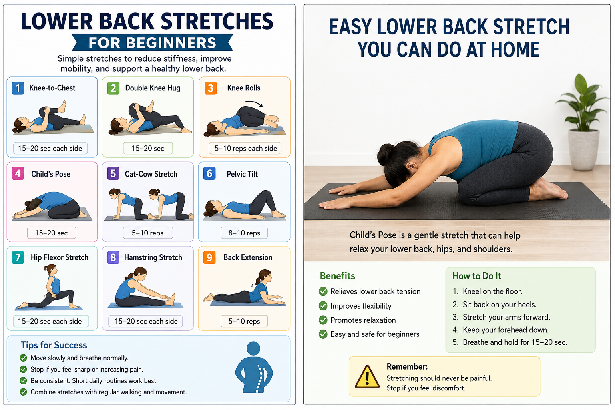
Lower back stretches for beginners can be a simple way to add gentle movement to your day. However, stretching should feel comfortable, not painful.
Lower back pain is very common. In fact, the World Health Organization estimates that about 619 million people experienced low back pain in 2020, making it the leading cause of disability worldwide.
Fortunately, many people can stay active and gradually return to normal activities. The NHS also recommends staying active and trying suitable exercises and stretches instead of spending long periods in bed.
So, this guide explains simple movements you can try at home.
Why Gentle Stretching Can Help
Lower back stretches for beginners may help you move more comfortably when tight muscles limit your motion.
For example, sitting for hours can make your hips and back feel stiff. Therefore, gentle movement can give your body a useful change of position.
However, stretching is not a magic cure. Low back pain can have many causes, and the right exercise depends on the person.
The WHO recommends exercise as part of non-surgical care for chronic primary low back pain.
Know Your Starting Point
Before doing lower back stretches for beginners, notice how your back feels.
Ask yourself:
- Is the discomfort mild?
- Can you walk normally?
- Can you bend and straighten without sharp pain?
- Does the pain stay around your lower back?
- Do you feel numbness or weakness?
If the pain feels sharp or suddenly becomes much worse, stop.
A Simple Beginner Rule
The best lower back stretches for beginners should feel slow and controlled.
You do not need to force your body into a deep stretch.
Instead, move until you feel mild tension. Then breathe normally and return slowly.
A good beginner routine is usually more useful when you repeat it consistently rather than pushing hard once a week.
Before You Stretch, Warm Up
Before lower back stretches for beginners, walk around your room for three to five minutes.
You can also march gently in place.
This simple warm-up helps you transition from sitting or resting into movement.
You do not need special equipment.
A carpet, exercise mat, or firm floor can work well.
Lower Back Stretches for Beginners: Knee-to-Chest
The first movement in this lower back stretches for beginners routine is the single knee-to-chest stretch.
How to do it
- Lie on your back.
- Bend both knees.
- Keep one foot on the floor.
- Slowly bring the other knee toward your chest.
- Hold gently for about 15–20 seconds.
- Lower the leg.
- Repeat on the other side.
Do not pull hard on your knee.
The NHS-linked physiotherapy guidance from Guy’s and St Thomas’ NHS Foundation Trust also includes knee hugs as an early movement option for low back pain.
Why the Knee Hug Feels Good
Many lower back stretches for beginners work by gently moving the hips and lower back through a comfortable range.
The knee-to-chest movement can feel especially useful after sitting.
However, everyone’s response differs.
If bringing your knee toward your chest increases your pain, stop and choose a different movement.
Lower Back Stretches for Beginners: Double Knee Hug
The double knee hug is another gentle option.
Lie on your back and bend both knees.
Then slowly bring both knees toward your chest.
Hold them lightly for around 10–20 seconds.
Afterward, lower your feet slowly.
This movement should never feel like a wrestling match with your own legs.
Keep your breathing relaxed.
Try Gentle Knee Rolls
Knee rolls are simple lower back stretches for beginners because you can control the movement easily.
Lie on your back with your knees bent.
Keep your feet on the floor.
Slowly move both knees toward one side.
Then return to the middle.
Move them toward the other side.
Guy’s and St Thomas’ NHS Foundation Trust includes knee rolls among its early low back exercises.
Keep Your Shoulders Relaxed
During lower back stretches for beginners, avoid lifting your shoulders or holding your breath.
Instead, let your shoulders rest comfortably.
Move your knees only as far as feels easy.
You should feel movement rather than a strong pulling sensation.
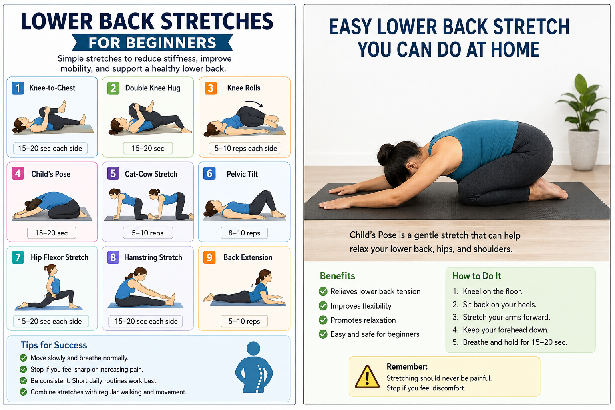
Lower Back Stretches for Beginners: Child’s Pose
A gentle child’s pose can provide a comfortable stretch for some people.
Start on your hands and knees.
Slowly move your hips backward toward your heels.
Reach your arms forward if that feels comfortable.
Keep the movement gentle.
If bending forward makes your pain worse, skip this exercise.
Make Child’s Pose Easier
Some people cannot comfortably sit their hips toward their heels.
That is fine.
Place a pillow between your hips and heels.
You can also keep your knees wider.
The goal of lower back stretches for beginners is comfort and controlled movement, not perfect form.
Lower Back Stretches for Beginners: Cat-Cow
Cat-cow is a gentle mobility exercise.
Start on your hands and knees.
Keep your hands under your shoulders and your knees under your hips.
Slowly round your back.
Then gently move toward a more relaxed, slightly arched position.
Do not push into a deep arch.
Move slowly with your breathing.
Why Cat-Cow Is Beginner-Friendly
One benefit of lower back stretches for beginners is that many can be adjusted.
Cat-cow is easy to make smaller.
For example, you can move only a few centimeters.
That can be useful if your back feels stiff but sensitive.
Lower Back Stretches for Beginners: Pelvic Tilt
Pelvic tilts are another beginner-friendly movement.
Lie on your back with your knees bent.
Keep your feet flat.
Gently tighten your stomach.
Then slightly flatten your lower back toward the floor.
Relax.
Repeat slowly.
The movement should be small.
Focus on Control, Not Speed
When doing lower back stretches for beginners, slow movement matters.
Fast stretching can make it harder to notice discomfort.
Instead, use a steady rhythm.
Try counting:
One—two—three—four.
Then return slowly.
Lower Back Stretches for Beginners: Hip Flexor Stretch
Tight hips can sometimes make movement feel uncomfortable.
A simple hip flexor stretch may help improve hip mobility.
Kneel with one knee on the floor.
Put the other foot forward.
Keep your chest upright.
Gently shift your hips forward.
Stop when you feel a mild stretch at the front of the hip.
Do not force it.
Keep the Hip Stretch Small
With lower back stretches for beginners, bigger does not mean better.
If you push your hips too far forward, you may arch your lower back.
Instead, keep your stomach gently engaged.
Move forward only a little.
Lower Back Stretches for Beginners: Hamstring Stretch
Your hamstrings are the muscles at the back of your thighs.
A gentle hamstring stretch can improve flexibility around your hips and legs.
Sit on the edge of a sturdy chair.
Straighten one leg.
Keep your heel on the floor.
Keep your back reasonably straight.
Lean forward slightly from your hips.
Stop when you feel a mild stretch behind your thigh.
Do Not Chase a Deep Stretch
One common mistake with lower back stretches for beginners is trying to touch your toes.
You do not need to touch your toes.
A small movement can still be useful.
Keep the stretch comfortable.
Lower Back Stretches for Beginners: Back Extension
Some people feel better with gentle backward movement.
The NHS physiotherapy guidance includes back extensions among early low back exercises.
Lie on your stomach.
Support yourself on your forearms.
Gently lift your chest.
Keep your hips relaxed.
Do not force your lower back upward.
If this movement increases your pain, stop.
Which Stretch Should You Pick?
There is no single best lower back stretches for beginners routine for everyone.
Try one or two movements first.
For example:
| Exercise | Beginner Time | Main Goal | Difficulty |
| Knee-to-chest | 15–20 sec | Gentle hip/back movement | Easy |
| Knee rolls | 5–10 reps | Mobility | Easy |
| Child’s pose | 15–20 sec | Relaxed movement | Easy |
| Cat-cow | 5–10 reps | Spine movement | Easy |
| Pelvic tilt | 8–12 reps | Control | Easy |
| Hip flexor stretch | 15–20 sec | Hip flexibility | Easy–Moderate |
| Hamstring stretch | 15–20 sec | Leg flexibility | Easy |
| Back extension | 5–10 reps | Back movement | Moderate |
These are general starting points, not a personal medical prescription.
A Five-Minute Morning Routine
You can use lower back stretches for beginners as part of a short morning routine.
Try this:
- Walk for one minute.
- Do five knee rolls.
- Do five pelvic tilts.
- Hold a knee-to-chest stretch for 15 seconds per side.
- Finish with gentle cat-cow movements.
You can stop earlier if your back feels uncomfortable.
Lower Back Stretches for Beginners at Work
You do not always need a floor mat.
During a long workday, stand up and walk around.
You can gently move your hips and legs.
You can also change your sitting position.
WHO notes that staying physically active and making workplace adjustments can support self-care for low back pain.
Break Up Long Sitting
One practical part of lower back stretches for beginners is taking movement breaks.
For example, stand up every so often.
Walk to get water.
Walk around the room.
Do a few gentle movements.
The goal is not to spend all day stretching.
The goal is to avoid staying in one position for too long.
Lower Back Stretches for Beginners Before Bed
Gentle evening movement may help you relax.
Try knee rolls or a comfortable knee-to-chest movement.
Then take a few slow breaths.
However, stretching does not guarantee better sleep.
Sleep problems and back pain can affect each other, so consider your whole routine.
How Often Should You Stretch?
For lower back stretches for beginners, consistency matters more than intensity.
A simple approach is to practice gentle movements most days if they feel comfortable.
You might begin with five to ten minutes.
Then adjust based on how your body responds.
The NHS advises staying active and trying exercises and stretches for back pain, while also recommending that you stop if exercise makes your pain worse.
A Seven-Day Beginner Plan
Here is a simple example:
| Day | Routine |
| Monday | Knee rolls + knee-to-chest |
| Tuesday | Walking + pelvic tilts |
| Wednesday | Cat-cow + hip stretch |
| Thursday | Easy walking |
| Friday | Knee rolls + hamstring stretch |
| Saturday | Full gentle routine |
| Sunday | Light movement and rest |
This plan is only an example.
Your body may need more or less activity.
Real-Life Example: The Desk Worker
Consider a common real-life situation.
A person works at a computer for seven or eight hours each day.
By evening, the person notices stiffness around the lower back.
Instead of immediately doing a hard workout, they begin with five minutes of walking and gentle movement.
After that, they use knee rolls and pelvic tilts.
Over time, the person also adds regular walking breaks.
This is an illustrative real-life example, not a medical case study or claim about a specific patient.
Case Study: What the Evidence Says
A useful evidence example comes from the WHO review of structured exercise.
WHO reviewed 41 trials when examining structured exercise against no intervention or situations where the exercise effect could be isolated. The review found benefits for pain and function, although certainty varied by outcome and time period.
That finding matters because it shows why lower back stretches for beginners should sit inside a wider movement plan rather than act as the only treatment.
Expert Advice From Health Guidance
Rather than copying social media fitness advice, follow trusted health guidance.
The NHS recommends staying active and trying suitable exercises and stretches.
Meanwhile, WHO recommends exercise programs as one option for chronic primary low back pain.
Therefore, the best beginner plan should be gentle, regular, and matched to your needs.
Advantages of Gentle Stretching
The main advantages of lower back stretches for beginners include:
- Simple movements can be done at home.
- Most require little or no equipment.
- Gentle mobility can help you move more comfortably.
- Short routines can fit into busy days.
- Stretching can become part of a broader exercise plan.
- You can adjust many movements to your comfort level.
However, benefits vary from person to person.
Disadvantages and Limits
There are also limits to lower back stretches for beginners.
Stretching may not solve the cause of your pain.
Some people may feel worse with certain movements.
Also, stretching alone may not build enough strength for long-term function.
WHO describes low back pain care as something that may need several types of support rather than one treatment used alone.
When Stretching May Not Be Right
Do not simply stretch through severe pain.
You should get medical advice if your back pain:
- follows a serious accident,
- does not improve after several weeks,
- stops you from normal daily activities,
- comes with unexplained weight loss,
- causes significant weakness or numbness,
- or concerns you for another reason.
The NHS lists these situations among reasons to seek medical advice.
Warning Signs That Need Urgent Help
Some symptoms need urgent medical attention.
For example, seek urgent help if you develop serious weakness, major changes in bladder or bowel control, or numbness around the groin or inner thigh area.
Severe symptoms after a serious accident also require prompt assessment.
Do not use lower back stretches for beginners as a replacement for urgent medical care.
Avoid the “No Pain, No Gain” Idea
Stretching should not hurt badly.
A mild pulling feeling can be normal.
Sharp, burning, electric, or rapidly increasing pain is different.
Therefore, stop when your body gives you a strong warning.
Use a Comfortable Surface
You can perform many lower back stretches for beginners on a firm but comfortable surface.
A yoga mat can make floor exercises easier.
However, you do not need expensive equipment.
A clean carpet can work for many movements.
Add Walking to Your Routine
Walking pairs well with lower back stretches for beginners.
Start with a comfortable distance.
Then slowly increase your walking time if you feel well.
The NHS lists walking, swimming, yoga, and Pilates among activities that may help ease back pain.
Do Not Stay in Bed All Day
Long bed rest may not help ordinary back pain.
Instead, try to continue normal daily activities when you can.
The NHS specifically advises against staying in bed for long periods.
Of course, serious injury or another medical condition may require different advice.
Address Your Daily Habits
Your stretching routine works better when your daily habits support movement.
Try to:
- walk regularly,
- change positions during long sitting,
- sleep well,
- maintain a healthy body weight,
- avoid smoking,
- and use sensible workplace setup.
WHO includes physical activity, sleep, healthy weight, smoking cessation, and workplace adjustments among self-care factors for low back pain.
A Simple Progress Check
After two weeks, ask:
Can I move more easily?
Can I walk comfortably?
Do I feel less stiff?
Can I complete daily tasks more easily?
If the answer is yes, your routine may be helping.
If symptoms keep getting worse, seek professional advice.
Where to Find Trusted Information
For reliable information, use established health organizations.
The NHS provides practical guidance on back pain, exercises, warning signs, and when to seek care.
WHO also provides its evidence-based guideline for non-surgical management of chronic primary low back pain.
WHO headquarters address: Avenue Appia 20, 1211 Geneva 27, Switzerland.
FAQs About Lower Back Stretches for Beginners
- Are lower back stretches for beginners safe?
They can be safe for many people with mild, uncomplicated back stiffness. However, stop if a movement causes sharp or worsening pain.
- How long should I hold a stretch?
Start with about 15–20 seconds for gentle static stretches. You can adjust the time based on comfort.
- Can I stretch every day?
Yes, many people can use gentle movement daily. However, your routine should match your symptoms and fitness level.
- Should stretching hurt?
No. A mild stretch can feel normal, but sharp or severe pain is a reason to stop.
- Are lower back stretches for beginners good for sitting-related stiffness?
They may help you move after long periods of sitting. Still, regular walking and changing positions are also important.
- Can stretching cure lower back pain?
No single stretch can cure every cause of back pain. Some pain comes from conditions that require professional assessment.
- What is the easiest back stretch?
Knee rolls and gentle knee-to-chest movements are often easy starting options.
- Can I stretch before walking?
Yes. A few gentle movements can help you transition into activity. A short walk itself can also work as a warm-up.
- Should I stretch in the morning?
You can. Morning movement may help if you feel stiff after sleeping.
- Can I stretch before bed?
Yes, if the movements feel comfortable. Gentle movement may fit well into an evening routine.
- How many times should I repeat each exercise?
Start with about 5–10 controlled repetitions for movement exercises. For static stretches, begin with 15–20 seconds.
- Can beginners do cat-cow?
Yes, many beginners can try gentle cat-cow movement. Keep the range small if your back feels sensitive.
- Are lower back stretches for beginners enough for long-term back health?
Not always. A broader plan can include walking, strength work, mobility, sleep, and healthy daily habits.
- Can stretching help after sitting all day?
Gentle movement can help reduce the feeling of stiffness for some people. Regular movement breaks are also useful.
- Should I stretch if I have sciatica?
Ask a healthcare professional for personalized advice, especially if pain travels down your leg or you have numbness or weakness.
- Can older adults do these stretches?
Many older adults can exercise safely, but the routine should match their abilities and health needs. WHO specifically includes older adults in its chronic low back pain guideline.
- What if stretching makes my pain worse?
Stop that movement. If symptoms continue or worsen, contact a healthcare professional.
- Do I need a yoga mat?
No. A mat can improve comfort, but many exercises need no special equipment.
- Can walking replace stretching?
Walking and stretching serve different purposes. A combination may work well for some people.
- When should I see a doctor about back pain?
Seek medical advice when pain does not improve after several weeks, limits daily activities, follows a serious accident, or comes with concerning symptoms.
Build Your Own Beginner Routine
You can now create a simple lower back stretches for beginners routine that fits your day.
Start with:
Morning:
5 minutes of gentle movement.
Workday:
Take regular walking or standing breaks.
Evening:
5–10 minutes of comfortable mobility.
Most importantly, do not rush.
Your goal is not to become flexible overnight.
Your goal is to make movement feel normal and comfortable again.
Final Takeaway
Lower back stretches for beginners can be a useful starting point for people who want gentle movement and better mobility.
However, stretching should not become a test of how much discomfort you can tolerate.
Start small.
Move slowly.
Breathe normally.
Stay active when you can.
Also, remember that back pain has many possible causes. The NHS says most back pain improves within a few weeks, while WHO emphasizes active rehabilitation and exercise as important parts of care.
If your pain becomes severe, keeps getting worse, follows a serious injury, or comes with numbness, weakness, bladder or bowel changes, or other warning signs, get professional medical help rather than relying on lower back stretches for beginners alone.
Recommended external links:
WHO: Low Back Pain Fact Sheet ·
WHO: Chronic Primary Low Back Pain Guideline ·
Guy’s and St Thomas’ NHS: Low Back Pain Exercises