
Hip mobility exercises for beginners can help you move your hips through a comfortable range while building better control.
If your hips feel tight after sitting, walking, running, or working at a desk, you are not alone. Modern life often keeps people in one position for hours. The American College of Sports Medicine notes that too much sitting can contribute to stiffness and encourages people to get up and move more during the day.
However, hip mobility is more than simply stretching.
Your hip joint needs to bend, straighten, rotate, and move sideways. Therefore, a useful beginner routine should include slow movement, gentle stretching, and simple strength work.
This guide explains how to start safely, what exercises to choose, what mistakes to avoid, and how to build a simple routine at home.
What Hip Mobility Really Means
Hip mobility describes how freely your hip joint can move while you maintain control.
For example, getting into a chair requires hip bending. Walking requires your hip to move backward and forward. Turning your body requires rotation.
Therefore, good mobility is not simply about being flexible.
A person may touch their toes easily but still struggle with hip rotation or a deep squat.
Hip Mobility Exercises for Beginners vs. Stretching
Stretching usually focuses on lengthening muscles.
Mobility work often combines movement, joint range, muscle control, and flexibility.
For beginners, both can work together.
ChoosePT, the official patient resource of the American Physical Therapy Association, recommends regular stretching as part of an overall physical activity plan. It also advises warming up before stretching and avoiding bouncing movements.
A Beginner’s Hip Movement Check
Before starting, stand naturally and notice how your hips feel.
Ask yourself:
- Can you squat comfortably?
- Can you lift each knee?
- Can you step sideways easily?
- Can you rotate your leg without pain?
- Does one side feel different?
You do not need perfect symmetry.
Instead, use this simple check to understand where you are starting.
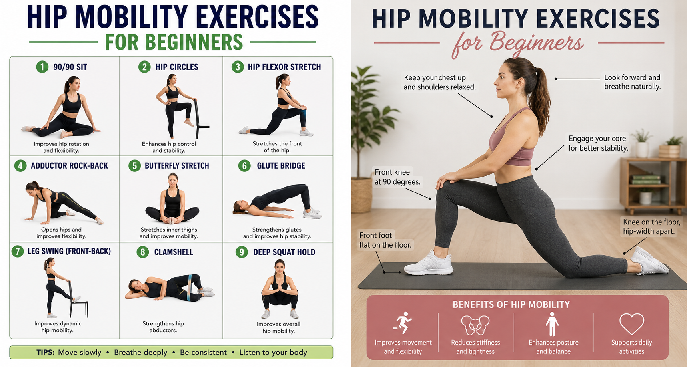
Hip Mobility Exercises for Beginners: The 90/90 Sit
The 90/90 position introduces beginners to hip rotation.
Sit on the floor with one leg in front and the other behind you. Bend both knees comfortably.
Keep your chest tall and slowly move between sides if you can do so without pain.
Beginner target: 5 slow transitions per side.
Do not force your knees toward the floor.
Why the 90/90 Position Is Useful
The 90/90 drill teaches your hips to rotate.
That matters because hip rotation appears in many everyday movements.
For example, getting out of a car, turning around, changing direction during sports, and sitting cross-legged all require some degree of rotation.
Start with a small range.
Over time, you can work toward smoother movement.
Hip Mobility Exercises for Beginners: Hip Circles
Stand beside a wall or sturdy chair.
Lift one knee slightly and draw a slow circle with your thigh.
Complete five circles in each direction.
Then change legs.
This simple drill challenges your ability to control the hip through different directions.
Keep your upper body still.
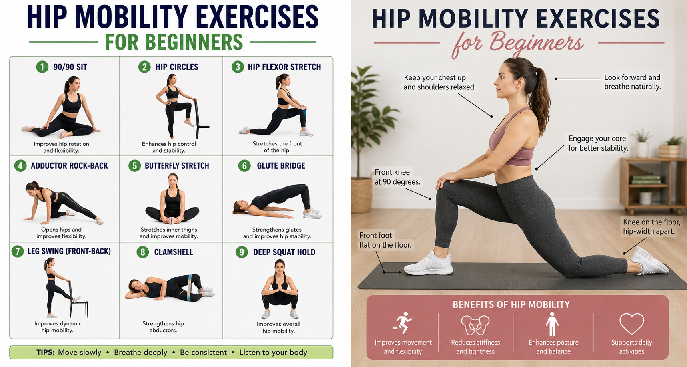
Supported Hip Flexor Stretch
Kneel with one foot in front of you.
Keep your front foot flat and gently move your hips forward.
You should feel a mild stretch near the front of the back hip.
Do not push hard.
Hold for about 15–30 seconds and repeat two or three times if comfortable.
ChoosePT lists hip-flexor stretching among its beginner-friendly stretching exercises and recommends controlled movement rather than bouncing.
Hip Mobility Exercises for Beginners: Adductor Rock-Back
Start on your hands and knees.
Move one leg out to the side while keeping the foot on the floor.
Slowly push your hips backward.
Then return to the starting position.
Repeat 6–10 times.
This movement gently explores the inner-thigh and hip area.
Gentle Butterfly Stretch
Sit down and bring the soles of your feet together.
Let your knees move outward naturally.
Keep your spine comfortable.
You can stay upright or lean forward slightly.
Never press forcefully on your knees.
A gentle stretch is enough.
Hip Mobility Exercises for Beginners: Glute Bridge
Lie on your back.
Bend your knees and place your feet flat on the floor.
Press through your feet and lift your hips.
Pause briefly.
Then lower slowly.
Start with 8–12 repetitions.
ChoosePT includes bridges as an easy hip-extensor strengthening exercise and emphasizes controlled movement.
Why Strength Belongs in Mobility Training
Mobility without strength is only part of the picture.
Your muscles need to control the range you gain.
For example, a stronger glute can help you control hip extension during walking, climbing stairs, and standing.
Therefore, beginners should not spend their entire session stretching.
A balanced routine includes movement plus strength.
Hip Mobility Exercises for Beginners: Standing Leg Swing
Hold a sturdy wall or counter.
Swing one leg gently forward and backward.
Keep the movement controlled.
Start with 10 swings.
Then switch legs.
The goal is not to swing as high as possible.
Instead, aim for smooth movement.
Side-to-Side Leg Swings
Stand beside a support.
Move one leg gently across your body and then outward.
Keep your torso fairly steady.
Start with 8–10 repetitions.
This exercise explores side-to-side hip movement.
However, keep the range small if you feel unstable.
Hip Mobility Exercises for Beginners: Bodyweight Squat
Stand with your feet around shoulder width.
Push your hips backward and bend your knees.
Lower only as far as you can control.
Then stand tall.
Use a chair behind you if you need a target.
Start with 8–10 repetitions.
A squat is useful because it combines hip, knee, and ankle movement.
Assisted Deep Squat Hold
Hold a sturdy support with both hands.
Lower into a comfortable squat.
Stay there for 10–20 seconds.
Keep your heels down if your body allows it.
Then stand slowly.
Do not force yourself into a very deep position.
Hip Mobility Exercises for Beginners: Knee-to-Chest
Lie comfortably on your back.
Bring one knee toward your chest.
Hold it gently.
Then return the leg.
Repeat on the other side.
This movement can help you explore hip flexion.
ChoosePT also includes a knee-to-chest movement in its stretching program.
Half-Kneeling Hip Shift
Place one knee on a comfortable mat.
Put the opposite foot forward.
Keep your chest upright.
Slowly move your hips forward and backward.
Try 8 slow repetitions.
This gives beginners an easy way to practice hip movement without needing equipment.
Hip Mobility Exercises for Beginners: Frog Rock
Start on your hands and knees.
Move your knees slightly wider than your hips.
Keep your feet comfortable.
Slowly move your hips backward.
Then return forward.
Only use a range that feels comfortable.
If your groin feels sharp or painful, stop.
Seated Hip Rotation
Sit on a firm chair.
Keep your feet on the floor.
Lift one foot slightly and gently move your lower leg inward and outward.
Your thigh should remain mostly still.
This drill gives beginners a simple introduction to rotational control.
Hip Mobility Exercises for Beginners: Clamshell
Lie on your side.
Bend your knees comfortably.
Keep your feet together.
Lift your upper knee without rolling your pelvis backward.
Lower slowly.
Try 8–12 repetitions per side.
Physical therapists commonly use clamshell variations to strengthen muscles around the hip. ChoosePT provides a side-lying clamshell as a moderate hip-abductor exercise.
Standing Hip Abduction
Stand next to a wall or sturdy chair.
Move one leg slowly out to the side.
Keep your torso upright.
Return the leg slowly.
Start with 8–12 repetitions.
ChoosePT recommends standing hip-abductor work with support when needed.
Hip Mobility Exercises for Beginners: Low Lunge
Step one foot forward.
Lower your back knee onto a comfortable surface.
Keep your chest upright.
Move your hips forward gently.
You should feel the front of the back hip open.
Hold for 15–30 seconds.
Then change sides.
The Importance of Breathing
Do not hold your breath during mobility work.
Instead, breathe slowly through the exercise.
Try inhaling before the movement and exhaling as you settle into a stretch.
This simple habit can help you stay relaxed.
Hip Mobility Exercises for Beginners: Cossack Preparation
Stand with your feet wider than hip width.
Shift your weight toward one side.
Bend that knee slightly while keeping the other leg straighter.
Return to the middle.
Repeat on the opposite side.
Beginners do not need to reach a deep position.
A 10-Minute Beginner Routine
Here is a simple routine you can try:
| Exercise | Time/Reps |
| Standing hip circles | 5 each direction |
| Leg swings | 10 each leg |
| 90/90 transitions | 5 each side |
| Half-kneeling hip shift | 8 each side |
| Glute bridges | 10 |
| Clamshells | 10 each side |
| Butterfly stretch | 20 seconds |
| Hip-flexor stretch | 20 seconds each side |
This routine takes roughly 10 minutes.
You can perform it three to five days per week if it feels comfortable.
Hip Mobility Exercises for Beginners: Weekly Progression
Week 1: Learn the positions.
Week 2: Make movements smoother.
Week 3: Add a few repetitions.
Week 4: Increase the range slightly.
Do not increase everything at once.
A slow progression gives your body time to adjust.
What Beginners Should Feel
A mobility exercise may create:
- Mild stretching
- Muscle effort
- Gentle tension
- Controlled movement
- A feeling of increased ease afterward
However, sharp pain is different.
Stop if you feel sudden, severe, or worsening pain.
Hip Mobility Exercises for Beginners: What Pain Means
Mobility work should not become a contest.
If a movement causes sharp hip pain, catching, major swelling, numbness, or weakness, stop the exercise.
Persistent pain deserves professional assessment.
ChoosePT advises people with pain or difficulty completing exercises to seek help from a physical therapist or medical professional.
Common Beginner Mistake: Going Too Deep
Many people believe deeper automatically means better.
It does not.
A smaller movement performed with good control can be more useful than a deep movement performed badly.
Therefore, start with a range you can control.
Hip Mobility Exercises for Beginners: Avoid Bouncing
Do not bounce aggressively during stretches.
Instead, move slowly and stay relaxed.
ChoosePT specifically advises against bouncing during stretching.
ACSM guidance also recommends slow, controlled mobility and stretching movements while breathing throughout the exercise.
Common Beginner Mistake: Only Stretching
If your hips feel stiff, you may want to stretch constantly.
However, strength matters too.
Bridges, clamshells, squats, and controlled leg movements can help you build strength around the hips.
Therefore, combine flexibility work with strengthening.
Hip Mobility Exercises for Beginners: Desk-Worker Strategy
If you sit for long periods, do not wait until the evening to move.
Instead, stand up during the day.
Walk around.
Take a few controlled hip movements.
ACSM’s current guidance encourages people to sit less and move more throughout the day.
Even short movement breaks can make your day feel less stiff.
Real-Life Example: The Office Worker
Imagine someone who sits at a computer for eight hours.
After work, their hips feel stiff.
Instead of immediately performing a difficult stretching routine, they could take a five-minute walk, perform gentle leg swings, complete a few bridges, and finish with a comfortable hip-flexor stretch.
The goal is consistency.
Real-Life Example: The New Gym Member
A beginner may struggle with squats because the hips, ankles, and other joints do not yet move comfortably together.
Instead of forcing a deep squat, the person can use a chair squat, hip circles, assisted squat holds, and gradual strength work.
Over several weeks, the movement may feel more natural.
This is a practical progression, not a promise of a specific result.
Case Study: A Simple Four-Week Plan
Consider a fictional beginner named Daniel.
Daniel spends most of his workday sitting.
During week one, he performs five to ten minutes of gentle mobility work three times.
During week two, he adds bridges and clamshells.
During week three, he practices controlled squats.
During week four, he increases the movement range only when each exercise feels comfortable.
His goal is not to become extremely flexible.
Instead, his goal is to move better.
Advantages of Hip Mobility Exercises for Beginners
Regular mobility practice may help you:
- Move more comfortably.
- Practice better joint control.
- Improve flexibility.
- Support everyday movement.
- Prepare for exercise.
- Build hip strength when strength drills are included.
- Reduce the feeling of stiffness associated with inactivity.
However, results differ from person to person.
Mobility exercises are not a guaranteed treatment for pain or injury.
Disadvantages and Limitations
Mobility training also has limits.
Doing too much can irritate muscles or joints.
Poor technique can create unwanted stress.
Some people have injuries or joint problems that require individualized exercises.
Furthermore, mobility work cannot replace medical care when a serious problem exists.
Therefore, use these exercises as general fitness guidance, not as a diagnosis.
Expert Advice: Keep It Controlled
ACSM guidance says mobility and stretching work should be performed slowly and with control rather than forcing a position.
ChoosePT also recommends starting with an easier level and progressing as your ability improves.
That gives beginners a simple rule:
Control first. Range second. Speed last.
Expert Resource: American Academy of Orthopaedic Surgeons
For readers who want orthopedic information, the American Academy of Orthopaedic Surgeons provides patient education and musculoskeletal resources.
Its current headquarters are:
American Academy of Orthopaedic Surgeons
9400 West Higgins Road
Rosemont, Illinois 60018
Phone: 847-823-7186
For journalists, AAOS also maintains a media contact resource and identifies orthopedic experts who can comment on musculoskeletal topics.
Expert Resource: American College of Sports Medicine
The American College of Sports Medicine is another useful source for exercise and fitness information.
Its current listed address is:
American College of Sports Medicine
6510 Telecom Dr., Suite 200
Indianapolis, IN 46278
Phone: 317-637-9200
ACSM publishes exercise, sports medicine, fitness, and physical activity resources.
Hip Mobility Exercises for Beginners: When to See a Professional
You should consider professional help if you have:
- Severe hip pain
- A recent injury
- Major swelling
- A feeling that the hip catches or locks
- Significant weakness
- Numbness or tingling
- Pain that keeps getting worse
- Difficulty walking normally
A physical therapist can examine your movement and build a plan around your needs.
Journalist’s Take: What the Evidence Actually Says
A good health article should avoid dramatic promises.
It is better to say that mobility exercises may support comfortable movement and flexibility than to claim they will fix every hip problem.
ChoosePT’s exercise resources are written with physical-therapy input, while ACSM provides professional exercise guidance.
That distinction matters.
Exercise can be helpful, but pain can have many causes.
Hip Mobility Exercises for Beginners: Quick Comparison Chart
| Exercise | Main goal | Beginner level | Equipment |
| Hip circles | Controlled movement | Easy | None |
| Leg swings | Dynamic movement | Easy | Wall optional |
| 90/90 sit | Hip rotation | Easy–moderate | Mat |
| Glute bridge | Hip strength | Easy | None |
| Clamshell | Side hip strength | Easy | None |
| Hip-flexor stretch | Front-hip flexibility | Easy | Mat |
| Butterfly stretch | Inner-thigh flexibility | Easy | None |
| Supported squat | Combined movement | Easy | Chair |
| Half-kneeling shift | Hip extension | Easy | Mat |
| Standing abduction | Hip control | Easy | Chair optional |
FAQs About Hip Mobility Exercises for Beginners
- How often should beginners do hip mobility work?
Start with three sessions per week. You can add more frequent short sessions if your body responds well.
- How long should a beginner routine take?
Ten to fifteen minutes is enough to start. Consistency matters more than a long session.
- Can I do hip mobility exercises every day?
Gentle mobility can fit into daily movement, but you do not need hard mobility sessions every day.
- Should I stretch before or after exercise?
Dynamic movement can work well during a warm-up. Longer static stretches often fit better after activity. ChoosePT recommends warming up before stretching.
- Can sitting make my hips feel stiff?
Yes. Long periods of sitting can contribute to stiffness and reduced daily movement. ACSM recommends getting up and moving more often.
- Are these exercises good for runners?
They can be part of a runner’s overall movement routine. However, runners should also work on strength, balance, and sport-specific training.
- Can beginners do 90/90 exercises?
Yes. Start with a small range and use your hands for support if necessary.
- Should hip mobility exercises hurt?
No. Mild stretching or muscle effort can be normal, but sharp or severe pain is a reason to stop.
- Can mobility exercises improve squats?
They may help you practice hip movement, but squat ability also depends on ankle mobility, strength, balance, body structure, and technique.
- Do I need gym equipment?
No. Many beginner drills require only a floor and a sturdy chair or wall.
- Can older adults practice hip mobility?
Yes, many mobility exercises can be adapted. ACSM emphasizes adapting physical activity to individual abilities and limitations.
- Are hip circles safe for everyone?
Not necessarily. People with hip injuries or pain should choose exercises based on professional advice.
- How quickly will I become more flexible?
There is no single timeline. Your age, activity level, training history, body structure, and consistency all matter.
- Should I force my hips into a deeper stretch?
No. Forcing range can increase irritation rather than improve movement.
- Can strong muscles improve mobility?
Strength can help you control the movement range you already have. That is why a balanced program includes both mobility and strength.
- Is walking useful for hip mobility?
Walking is a simple way to keep the hips moving. It also supports general physical activity.
- Can I perform these exercises after sitting at work?
Yes. A short movement break can be a practical way to break up long periods of sitting.
- Should both hips feel exactly the same?
Not always. Small differences are common. Large differences combined with pain or weakness deserve professional assessment.
- Can mobility exercises cure hip arthritis?
You should not use general exercises as a guaranteed cure. People with arthritis should receive an individualized exercise plan when needed.
- What is the best beginner exercise?
There is no single best movement. A combination of gentle hip circles, controlled rotation, hip-flexor stretching, bridges, and basic strengthening provides a useful starting point for many healthy beginners.
Final Beginner Checklist
Before each session, remember:
- Warm up gently.
- Move slowly.
- Keep breathing.
- Do not bounce.
- Do not force range.
- Use a wall or chair when needed.
- Train both sides.
- Add strength work.
- Increase difficulty gradually.
- Stop if you develop sharp pain.
- Seek professional advice when symptoms persist.
Conclusion
Hip mobility exercises for beginners do not need to be complicated.
You can start with ten minutes, a comfortable floor space, and a sturdy chair. Begin with hip circles, gentle rotation, leg swings, bridges, controlled squats, and simple stretches.
Most importantly, do not chase extreme flexibility.
Instead, chase smooth, controlled movement.
Physical-therapy guidance supports gradual progression, while ACSM guidance emphasizes slow and controlled mobility work.
So, start small. Practice regularly. Listen to your body. And remember that better movement comes from patience, not from forcing your body into positions it cannot control.
External resources
- ChoosePT — Physical Therapy Exercises and Stretching Resources
- American College of Sports Medicine
- American Academy of Orthopaedic Surgeons