
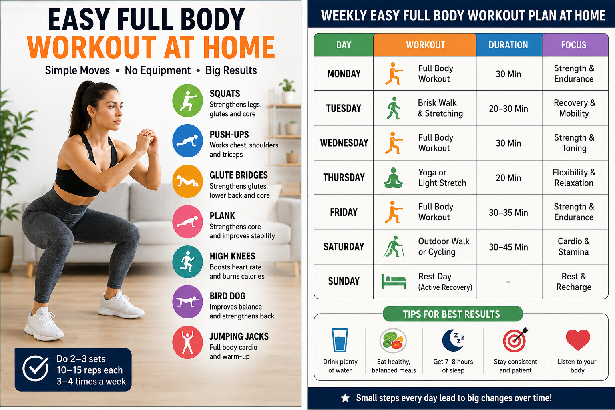
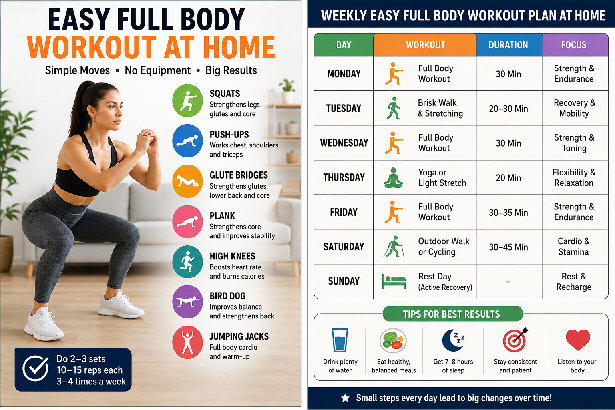
Easy full body workout at home is one of the best ways to improve your health without spending money on a gym. You do not need expensive machines or fancy equipment. Instead, you only need a little space, comfortable clothes, and the desire to move your body. Because home workouts are simple and flexible, many beginners find them easier to follow than gym routines.
Today, people have busy lives. However, staying active is still important. An easy full body workout at home lets you exercise before work, after school, or even during a lunch break. As a result, you can build strength, improve your heart health, and increase your energy without changing your daily schedule too much.
Moreover, exercising at home saves both time and money. You do not need to drive anywhere or wait for gym equipment. Instead, you can begin your workout whenever you want.
This complete guide will teach you everything you need to know. Along the way, you will learn beginner-friendly exercises, workout schedules, common mistakes, expert advice, and practical tips that make exercise enjoyable.
Why Choose an Easy Full Body Workout at Home
An easy full body workout at home helps every major muscle work together. Because your whole body moves during each session, you burn more calories than many single-muscle workouts.
Additionally, full body workouts improve balance, strength, flexibility, and endurance at the same time. Therefore, beginners often see results sooner because every workout trains many muscles instead of just one.
Another great reason is convenience. You can exercise early in the morning, during lunch, or in the evening. Consequently, it becomes easier to stay consistent.
What Is an Easy Full Body Workout at Home?
An easy full body workout at home is a routine that trains your:
- Legs
- Chest
- Back
- Shoulders
- Arms
- Core
Instead of spending one day on legs and another on arms, you train everything together.
Because every muscle works during one session, your body becomes stronger in a balanced way.
Why Beginners Love an Easy Full Body Workout at Home
Many beginners feel nervous about gyms. Fortunately, home workouts remove that fear.
You can:
- Exercise privately.
- Learn at your own speed.
- Wear comfortable clothes.
- Take breaks whenever needed.
- Repeat exercises without pressure.
Most importantly, nobody is watching you. Therefore, confidence grows naturally.
Benefits of an Easy Full Body Workout at Home
There are many reasons people choose this style of exercise.
Saves Money
Gym memberships can cost hundreds of dollars every year. However, home workouts cost almost nothing.
Saves Time
Driving to the gym often takes longer than exercising. Instead, you simply begin moving.
Burns Calories
Large muscles need more energy. Therefore, full body exercises help burn calories during and after workouts.
Builds Strength
Every session helps muscles grow stronger.
Improves Balance
Exercises that use your whole body improve coordination.
Helps Weight Loss
When combined with healthy eating, an easy full body workout at home supports healthy weight management.
Improves Heart Health
Moving continuously raises your heart rate and improves circulation.
Reduces Stress
Exercise releases chemicals that improve mood.
As a result, many people feel happier after finishing a workout.
Who Should Try an Easy Full Body Workout at Home?
Almost everyone can benefit.
This workout is perfect for:
- Beginners
- Busy parents
- Office workers
- Students
- Older adults (with medical approval)
- People returning after a break
- Anyone wanting to improve health
However, if you have a serious medical condition or recent injury, speak with your doctor before starting.
What You Need Before Starting
The best part is how little equipment you need.
Basic items include:
- Comfortable clothing
- Athletic shoes
- Water bottle
- Exercise mat
- Small towel
- Timer
Optional equipment:
- Resistance bands
- Light dumbbells
- Stability ball
Even without these items, an easy full body workout at home remains very effective.
How to Warm Up Before Every Workout
A warm-up prepares your body.
Spend about 5–10 minutes doing:
March in Place
Walk while lifting your knees.
1 minute
Arm Circles
Move both arms in large circles.
30 seconds forward
30 seconds backward
Hip Circles
Rotate your hips gently.
1 minute
Shoulder Rolls
Relax your shoulders.
1 minute
Light Squats
Perform slow bodyweight squats.
10 repetitions
Gentle Stretching
Stretch your legs and arms.
3 minutes
After warming up, your muscles are ready to work safely.
Create the Perfect Home Workout Space
You do not need a large room.
A space about the size of a yoga mat works well.
Choose an area with:
- Good lighting
- Fresh air
- Flat floor
- Enough room to stretch
- No slippery rugs
Additionally, keep water nearby.
Simple Rules for Success
Following a few simple habits helps you stay safe.
Move Slowly
Good form matters more than speed.
Breathe Normally
Never hold your breath.
Drink Water
Stay hydrated before, during, and after exercise.
Listen to Your Body
If something hurts sharply, stop immediately.
Stay Consistent
Three workouts each week are better than one hard workout each month.
Bodyweight Exercises Explained
Bodyweight exercises use your own weight instead of machines.
Examples include:
- Squats
- Push-ups
- Lunges
- Planks
- Bridges
- Mountain climbers
Because they require little space, they are perfect for an easy full body workout at home.
Easy Squats for Beginners
Squats strengthen your:
- Legs
- Glutes
- Core
How to Do a Squat
- Stand with feet shoulder-width apart.
- Keep your chest up.
- Push your hips backward.
- Bend your knees.
- Lower slowly.
- Stand back up.
Begin with:
2 sets of 10 repetitions
Common mistake:
Allowing knees to fall inward.
Wall Push-Ups Made Simple
Wall push-ups build upper-body strength.
Steps
- Stand facing a wall.
- Place hands on the wall.
- Bend elbows slowly.
- Push back.
Repeat:
2 sets of 10 repetitions.
As strength improves, move farther from the wall.
Glute Bridges for Strong Hips
Glute bridges strengthen:
- Glutes
- Hamstrings
- Lower back
- Core
Instructions
- Lie on your back.
- Bend your knees.
- Keep feet flat.
- Lift hips.
- Squeeze your glutes.
- Lower slowly.
Complete:
2 sets of 12 repetitions.
Standing Knee Raises
Standing knee raises improve balance and strengthen your core.
Steps
Stand tall.
Lift one knee.
Lower it.
Lift the other knee.
Continue for one minute.
This exercise also improves coordination.
Beginner Plank Guide
The plank strengthens almost every muscle.
How to Perform
Support yourself on your forearms.
Keep your body straight.
Tighten your stomach muscles.
Hold:
15–30 seconds.
Repeat three times.
As you improve, increase your time.
Safe Stretching Tips
Stretch after every workout.
Good stretches include:
- Hamstring stretch
- Calf stretch
- Shoulder stretch
- Chest stretch
- Hip stretch
Hold each stretch for about 20–30 seconds.
Never bounce while stretching.
Instead, move gently and breathe deeply.
Common Beginner Mistakes During an Easy Full Body Workout at Home
Many beginners make small mistakes. Fortunately, they are easy to fix.
Avoid these common problems:
- Skipping warm-ups
- Exercising every day without rest
- Poor posture
- Moving too quickly
- Forgetting to breathe
- Drinking too little water
- Comparing yourself to others
- Expecting fast results
Instead, focus on steady progress. Small improvements each week lead to big changes over time.
Building Good Exercise Habits
Healthy habits make fitness easier.
Try these simple ideas:
- Exercise at the same time every day.
- Put workouts on your calendar.
- Wear workout clothes before you begin.
- Keep your exercise mat ready.
- Celebrate small wins.
- Start with short sessions.
Because habits grow with repetition, staying consistent matters more than being perfect.
Stay Motivated with an Easy Full Body Workout at Home
Staying motivated is often the hardest part of any fitness journey. However, you can make exercise feel easier by creating simple habits. An easy full body workout at home becomes part of your lifestyle when you enjoy the process instead of chasing quick results.
Here are a few ideas to stay motivated:
- Set small weekly goals.
- Play your favorite music.
- Exercise with a family member.
- Reward yourself after reaching a milestone.
- Take progress photos every month.
- Keep a fitness journal.
- Remember why you started.
Moreover, focus on progress instead of perfection. Even a short workout is better than skipping your exercise completely.
Track Your Easy Full Body Workout at Home Progress
Tracking progress helps you see how much you improve.
Create a simple workout journal.
Record:
| Date | Workout Time | Exercises | Energy Level | Notes |
| Monday | 25 Minutes | Full Body | Great | Felt stronger |
| Wednesday | 30 Minutes | Full Body | Good | More push-ups |
| Friday | 35 Minutes | Full Body | Excellent | Longer plank |
Additionally, measure your progress every four weeks instead of every day.
You can track:
- Weight
- Waist size
- Push-up numbers
- Squat numbers
- Plank time
- Energy levels
- Sleep quality
These small improvements show your hard work is paying off.
Easy Full Body Workout at Home Beginner Workout Chart
Below is a simple beginner routine.
| Exercise | Repetitions | Sets | Rest |
| March in Place | 2 Minutes | 1 | — |
| Squats | 12 | 2 | 30 Seconds |
| Wall Push-Ups | 10 | 2 | 30 Seconds |
| Glute Bridges | 12 | 2 | 30 Seconds |
| Standing Knee Raises | 20 | 2 | 30 Seconds |
| Bird Dogs | 10 Each Side | 2 | 30 Seconds |
| Plank | 20 Seconds | 3 | 30 Seconds |
| Stretching | 5 Minutes | 1 | — |
This workout usually takes around 25–30 minutes.
Weekly Easy Full Body Workout at Home Plan
A weekly schedule helps you stay consistent.
Monday
Full body workout
Tuesday
Walking and stretching
Wednesday
Full body workout
Thursday
Light yoga
Friday
Full body workout
Saturday
Easy bike ride or walking
Sunday
Rest and recovery
Because your muscles grow while resting, recovery days are just as important as workout days.
Add Cardio to Your Easy Full Body Workout at Home
Cardio keeps your heart healthy.
Simple cardio exercises include:
- Walking in place
- Jumping jacks
- High knees
- Dancing
- Stair climbing
- Marching
- Step-ups
Start with ten minutes.
Then slowly increase to twenty or thirty minutes.
Build Strength Without Equipment
Many people think strength training requires heavy weights.
Actually, bodyweight exercises work very well.
Examples include:
- Squats
- Push-ups
- Lunges
- Planks
- Bridges
- Superman holds
As you become stronger, increase repetitions before adding weights.
Improve Balance During an Easy Full Body Workout at Home
Balance reduces the risk of falls and injuries.
Simple balance exercises include:
Single-Leg Stand
Stand on one foot for 20 seconds.
Repeat on the other side.
Heel-to-Toe Walk
Walk in a straight line.
Side Leg Raises
Lift one leg to the side.
Lower slowly.
Repeat.
Practice balance three times each week.
Increase Flexibility Safely
Flexible muscles move better.
Stretch:
- Hamstrings
- Calves
- Hips
- Chest
- Shoulders
- Neck
Hold every stretch for 20–30 seconds.
Never force a stretch.
Instead, move gently.
Easy Full Body Workout at Home for Busy People
Many people believe they do not have enough time.
Fortunately, twenty minutes is enough.
Example:
- Warm-up – 5 minutes
- Workout – 15 minutes
If needed, divide your workout.
Morning:
10 minutes
Evening:
15 minutes
Together, they still improve your fitness.
Easy Full Body Workout at Home for Parents
Parents often stay busy.
However, children can join the workout.
Ideas include:
- Family squats
- Animal walks
- Dance breaks
- Balloon games
- Follow-the-leader exercises
This creates healthy habits for everyone.
Easy Full Body Workout at Home for Older Adults
Many older adults enjoy home workouts.
Good beginner exercises include:
- Chair squats
- Wall push-ups
- Heel raises
- Shoulder rolls
- Light marching
- Gentle stretching
Always move slowly.
Stop if pain appears.
Nutrition Tips to Support an Easy Full Body Workout at Home
Exercise and healthy eating work together.
Choose foods like:
Protein
- Chicken
- Fish
- Eggs
- Beans
- Greek yogurt
Healthy Carbohydrates
- Oats
- Brown rice
- Sweet potatoes
- Whole wheat bread
Healthy Fats
- Nuts
- Seeds
- Avocados
- Olive oil
Fruits
- Apples
- Bananas
- Berries
- Oranges
Vegetables
- Spinach
- Broccoli
- Carrots
- Tomatoes
A colorful plate usually provides many important nutrients.
Hydration Makes Every Workout Better
Water helps every part of your body.
Drink:
- Before exercise
- During exercise
- After exercise
If your workout lasts less than one hour, water is usually enough.
Signs of dehydration include:
- Dry mouth
- Headache
- Dizziness
- Dark urine
Drink water throughout the day instead of waiting until you feel thirsty.
Recovery Helps Muscles Grow
Recovery is when your body repairs itself.
Good recovery habits include:
- Sleeping well
- Drinking water
- Stretching
- Eating protein
- Rest days
- Light walking
Many beginners think working harder every day gives faster results.
Actually, muscles become stronger while recovering.
Why Sleep Matters
Sleep helps your muscles recover.
Most adults need around:
7–9 hours
During sleep:
- Muscles repair.
- Energy returns.
- Hormones stay balanced.
- Your brain recovers.
Poor sleep often reduces workout performance.
Real-Life Example
Sarah is a 38-year-old office worker.
She wanted to become healthier but felt uncomfortable going to a gym.
Instead, she started an easy full body workout at home three times every week.
Her routine included:
- Squats
- Wall push-ups
- Bridges
- Planks
- Walking
After three months:
- She lost 12 pounds.
- Her energy improved.
- She slept better.
- Her back pain became less frequent.
- She felt more confident.
Most importantly, she stayed consistent because home workouts fit her schedule.
Case Study
James worked from home.
He spent nearly ten hours sitting every day.
His doctor encouraged him to exercise regularly.
James began doing an easy full body workout at home four days each week.
He also:
- Walked daily.
- Drank more water.
- Ate more vegetables.
- Reduced sugary drinks.
After six months:
- His endurance improved.
- He completed twice as many push-ups.
- His resting heart rate decreased.
- He reported feeling happier and less stressed.
His success came from consistency rather than perfect workouts.
Expert Advice
Fitness coaches often share similar advice.
Here are their top recommendations:
- Master proper form first.
- Start slowly.
- Focus on consistency.
- Increase difficulty gradually.
- Never skip warm-ups.
- Sleep enough.
- Eat balanced meals.
- Celebrate progress.
- Rest when needed.
- Enjoy the journey.
These simple habits lead to long-term success.
Common Myths About Home Workouts
Many myths stop people from exercising.
Myth 1
Home workouts do not work.
Truth: They can be highly effective.
Myth 2
You need equipment.
Truth: Bodyweight exercises build strength.
Myth 3
Long workouts are always better.
Truth: Quality matters more than time.
Myth 4
You must sweat heavily.
Truth: Every body responds differently.
Myth 5
Only young people benefit.
Truth: Nearly every age group can improve fitness safely.
Signs You Are Making Progress
Progress is more than weight loss.
You may notice:
- Better balance
- More energy
- Improved mood
- Better posture
- Stronger muscles
- Easier daily activities
- Better sleep
- Greater confidence
- Longer plank holds
- More repetitions
These are all signs your body is becoming healthier.
Beginner Safety Checklist
Before every workout:
✅ Warm up
✅ Drink water
✅ Wear comfortable shoes
✅ Exercise on a flat surface
✅ Move with control
✅ Breathe normally
✅ Stretch afterward
Following these simple steps reduces the chance of injury.
Preparing for the Next Stage
Once this beginner routine feels easy, you can slowly increase the challenge.
Ideas include:
- Add one extra set.
- Increase repetitions.
- Hold planks longer.
- Try regular push-ups instead of wall push-ups.
- Add resistance bands.
- Use light dumbbells.
- Reduce rest time slightly.
Remember, slow progress is steady progress.
Advantages of an Easy Full Body Workout at Home
An easy full body workout at home offers many benefits for beginners and experienced exercisers alike. Because you train your whole body in one session, you can improve your fitness without spending hours exercising.
It Saves Money
Gym memberships, travel costs, and expensive equipment can add up quickly. However, home workouts need very little equipment. Many people start with only a yoga mat and a water bottle.
It Saves Time
Traveling to a gym takes time. Instead, you can begin exercising within minutes at home. Therefore, it is easier to fit workouts into a busy schedule.
It Improves Overall Fitness
Full body exercises work your legs, arms, chest, back, shoulders, and core together. As a result, you build balanced strength throughout your body.
It Helps Burn Calories
Exercises that use many muscles at once increase your heart rate. Consequently, your body burns more calories during the workout.
It Builds Healthy Habits
When workouts are easy to start, you are more likely to stay consistent. Over time, consistency creates lasting results.
It Boosts Confidence
Each completed workout is an achievement. Therefore, many beginners feel more confident after just a few weeks.
Disadvantages of an Easy Full Body Workout at Home
Although home workouts have many benefits, they also have a few challenges.
Limited Equipment
Some people eventually need heavier weights to continue building strength. Fortunately, resistance bands or adjustable dumbbells can solve this problem.
Home Distractions
Children, pets, phones, and television can interrupt your workout. Therefore, choose a quiet time and turn off unnecessary notifications.
Less Social Interaction
Some people enjoy exercising with friends at a gym. However, you can invite family members to join your home workouts or connect with friends online.
Motivation Can Drop
Without a trainer, staying motivated may feel harder. Keep a workout schedule and celebrate small wins to stay on track.
How to Progress After the Beginner Stage
Once your easy full body workout at home feels comfortable, it is time to challenge yourself safely.
You can:
- Increase repetitions from 10 to 15.
- Add another workout set.
- Hold planks for 45–60 seconds.
- Try incline or regular push-ups.
- Use resistance bands.
- Add light dumbbells.
- Shorten your rest time slightly.
Remember, increase only one thing at a time. Slow progress helps reduce the risk of injury.
Long-Term Success with an Easy Full Body Workout at Home
Fitness is not a short project. Instead, it is a healthy lifestyle.
Here are simple ways to stay successful for years:
- Set realistic goals.
- Exercise three to five days each week.
- Eat balanced meals.
- Drink enough water.
- Sleep well every night.
- Take recovery days.
- Try new exercises to avoid boredom.
- Keep learning about healthy habits.
Even if you miss a workout, simply start again the next day. One missed session does not erase your progress.
Easy Full Body Workout at Home Challenge
A simple challenge can help you build consistency.
Week 1
- Workout: 3 days
- Walk: 15 minutes daily
Week 2
- Workout: 3 days
- Add 5 extra squats each session
Week 3
- Workout: 4 days
- Increase plank time by 10 seconds
Week 4
- Workout: 4 days
- Add one extra set to each exercise
By the end of four weeks, many beginners notice better strength, improved balance, and more energy.
Daily Healthy Habits That Support Your Workout
Small habits make a big difference over time.
- Eat breakfast if it suits your routine.
- Include vegetables with lunch and dinner.
- Choose whole grains when possible.
- Snack on fruit or nuts instead of sugary treats.
- Stand up and stretch every hour if you sit for long periods.
- Go for a short walk after meals.
- Keep a reusable water bottle nearby.
These habits work together with your easy full body workout at home to improve your overall health.
Home Workout Tips for Every Season
Spring
Take short walks outside before your workout.
Summer
Exercise early in the morning or later in the evening to avoid the hottest part of the day.
Autumn
Keep a regular schedule as the days become shorter.
Winter
Warm up a little longer and wear comfortable layers if your home is cool.
Staying active all year helps you maintain your progress.
Easy Full Body Workout at Home for Families
Exercise can become a fun family activity.
Ideas include:
- Squat challenges.
- Dance sessions.
- Relay races in the backyard.
- Stretching together.
- Walking after dinner.
Children often enjoy joining in, and adults benefit from the extra motivation.
Simple Ways to Measure Success
Do not rely only on the number on the scale.
You can also measure:
- Longer plank times.
- More push-ups.
- Better posture.
- Increased energy.
- Improved mood.
- Better sleep.
- Easier daily activities.
- More flexibility.
- Better balance.
- Consistent workout habits.
These changes often appear before large changes in body weight.
Motivation When Progress Feels Slow
Everyone experiences slow weeks.
When that happens:
- Look back at your workout journal.
- Compare yourself only with your past self.
- Focus on healthy habits instead of perfect results.
- Remember why you started.
Progress is rarely a straight line. Staying consistent matters more than being perfect.
Frequently Asked Questions (FAQs)
- What is an easy full body workout at home?
An easy full body workout at home is a simple exercise routine that works your legs, arms, chest, back, shoulders, and core without needing a gym. It is ideal for beginners because it uses basic movements and little or no equipment.
- Can beginners do an easy full body workout at home?
Yes. Beginners can start with bodyweight exercises like squats, wall push-ups, glute bridges, and planks. Begin slowly and focus on proper form.
- How many days each week should I exercise?
Most beginners do well with 3–4 full body workouts each week. Additionally, include light walking or stretching on the other days.
- Do I need equipment?
No. Most home workouts use only your body weight. However, resistance bands or light dumbbells can add variety as you get stronger.
- How long should each workout last?
A beginner session usually lasts 20–40 minutes, including your warm-up and cool-down.
- Can home workouts help with weight loss?
Yes. An easy full body workout at home, combined with healthy eating and regular activity, can support gradual and sustainable weight loss.
- Is warming up important?
Absolutely. A 5–10 minute warm-up prepares your muscles, improves mobility, and helps reduce the risk of injury.
- Should I stretch after exercising?
Yes. Gentle stretching after your workout helps improve flexibility and may reduce muscle stiffness.
- What should I eat before a workout?
Eat a light meal or snack about 1–2 hours before exercising. Good choices include fruit, oatmeal, yogurt, or whole-grain toast with peanut butter.
- What should I eat after a workout?
Choose a balanced meal with protein and healthy carbohydrates. For example, grilled chicken with brown rice or Greek yogurt with fruit are good options.
- How much water should I drink?
Drink water before, during, and after your workout. Your exact needs depend on your activity level, weather, and overall health.
- Can I build muscle at home?
Yes. Bodyweight exercises build strength, especially for beginners. As you improve, you can increase repetitions or add resistance bands and dumbbells.
- What if I miss a workout?
Missing one workout is not a problem. Simply continue with your next scheduled session and stay consistent over time.
- How soon will I notice results?
Many people notice better energy and mood within 2–4 weeks. Visible physical changes often take 6–12 weeks, depending on consistency, nutrition, sleep, and individual differences.
- Is walking enough on rest days?
Yes. Light walking, gentle stretching, or yoga are excellent ways to stay active while helping your body recover.
- Can older adults follow this routine?
Many older adults can benefit from beginner-friendly home workouts. However, anyone with medical conditions or mobility concerns should speak with a healthcare professional before starting.
- Should I exercise every day?
Not necessarily. Your muscles need time to recover. Most people benefit from 3–5 workout days each week, with rest or light activity on the remaining days.
- Can teenagers do an easy full body workout at home?
Yes. Teenagers can perform beginner-friendly bodyweight exercises with proper technique and age-appropriate supervision when needed.
- How can I stay motivated?
Set realistic goals, track your progress, celebrate small improvements, and choose a regular workout time that fits your schedule.
- What is the biggest secret to success?
Consistency. A simple easy full body workout at home performed regularly will usually produce better long-term results than occasional intense workouts.
Final Expert Advice
Fitness experts often agree on a few key principles:
- Focus on correct form before increasing intensity.
- Build your routine gradually.
- Stay hydrated throughout the day.
- Eat balanced meals with plenty of whole foods.
- Get enough sleep each night.
- Listen to your body and rest when needed.
- Measure progress over months, not days.
Small, consistent actions create lasting results.
Conclusion
An easy full body workout at home is one of the simplest and most effective ways to improve your overall health. It does not require expensive equipment, a gym membership, or hours of free time. Instead, it relies on consistent effort and basic movements that almost anyone can learn.
Whether your goal is to build strength, improve fitness, increase energy, manage your weight, or simply feel healthier, a regular home workout routine can help you move in the right direction. Start with short sessions, focus on good technique, and gradually increase the challenge as you become stronger.
Remember that progress takes time. Some days will feel easier than others, and that is completely normal. The important thing is to keep showing up. Every workout, no matter how short, is another step toward a healthier and more active life.
Trusted External Resources
For additional exercise guidance and evidence-based health information, explore these trusted organizations:
- American College of Sports Medicine (ACSM)
https://www.acsm.org
Evidence-based fitness guidelines, exercise recommendations, and health resources. - Centers for Disease Control and Prevention (CDC) – Physical Activity
https://www.cdc.gov/physicalactivity
Official recommendations for physical activity, exercise benefits, and healthy living. - World Health Organization (WHO) – Physical Activity
https://www.who.int/health-topics/physical-activity
Global guidance on physical activity, health benefits, and exercise recommendations. - American Heart Association (AHA) – Fitness and Physical Activity
https://www.heart.org/en/healthy-living/fitness
Tips for staying active, improving heart health, and building healthy exercise habits. - National Institute on Aging (NIA) – Exercise and Physical Activity
https://www.nia.nih.gov/health/exercise-physical-activity
Safe exercise advice for adults and older adults. - National Institutes of Health (NIH)
https://www.nih.gov
Trusted health research and wellness information. - MedlinePlus – Exercise and Physical Fitness
https://medlineplus.gov/exerciseandphysicalfitness.html
Easy-to-understand information about exercise, fitness, and healthy lifestyles. - Harvard T.H. Chan School of Public Health – Nutrition Source
https://www.hsph.harvard.edu/nutritionsource
Science-based nutrition advice to support fitness and overall health. - Mayo Clinic – Fitness
https://www.mayoclinic.org/healthy-lifestyle/fitness
Expert articles on exercise, strength training, flexibility, and healthy living. - ChooseMyPlate (U.S. Department of Agriculture)
https://www.myplate.gov
Healthy eating guidance to support exercise and long-term wellness.