
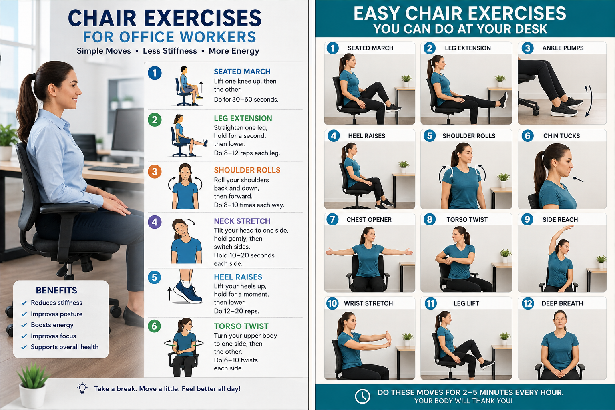
Chair exercises for office workers offer a simple way to move your body when work keeps you at a desk for hours. Instead of waiting until the end of the day to exercise, you can add short movements between emails, meetings, reports, and phone calls.
Moreover, you do not need a gym, special machines, or a large workout space. A strong, stable office chair and a few minutes can be enough to get started.
Long periods of sitting can make your neck, shoulders, back, hips, and legs feel stiff. Therefore, short movement breaks can help you feel more comfortable during the workday. Mayo Clinic also recommends taking time to move and stretch throughout the workday when your job involves a lot of sitting.
At the same time, chair movements should not replace regular exercise. The World Health Organization recommends that adults get at least 150 minutes of moderate physical activity each week, or an equivalent amount of more intense activity.
This guide explains easy exercises you can do at your desk. It also covers benefits, safety tips, real-life examples, a sample office routine, advantages, disadvantages, expert advice, and 20 common questions.
Why Chair Exercises for Office Workers Matter
Modern office work often means sitting for long periods. You may sit while checking email, writing documents, attending online meetings, driving to work, and watching television after work.
As a result, your total sitting time can become very high.
Chair exercises for office workers can break up that long sitting pattern with small movements.
The goal is not to turn your desk into a full gym. Instead, the goal is to make movement a normal part of your workday.
Research on office workers shows that workplace strategies can reduce sitting time. One 2023 systematic review and meta-analysis found that multicomponent workplace programs reduced occupational sitting by about 52 minutes during an eight-hour workday on average.
Therefore, small changes can matter when you repeat them every day.
How Sitting All Day Can Affect Your Body
Sitting itself is not automatically bad. However, staying in one position for many hours without movement can create problems.
You may notice:
- Tight hips
- Stiff legs
- Tired shoulders
- A sore upper back
- Neck stiffness
- Reduced movement
- Tired feet
- Poor posture
- General body discomfort
WHO defines sedentary behavior as waking activity that uses very little energy, including sitting or reclining.
Therefore, the answer is not simply “never sit.” Instead, try to break up long periods of sitting with movement.
Chair exercises for office workers can be one useful part of that plan.
The Simple Science Behind Movement Breaks
Your body likes movement.
When you stay still for a long time, some muscles remain in the same position. Meanwhile, your joints do not move through their normal range very often.
A short movement break gives your body a chance to change position.
For example, you could:
- Roll your shoulders.
- Extend your legs.
- Move your ankles.
- Rotate your upper body gently.
- Stand up and walk.
- Stretch your arms.
- Take a few slow breaths.
Mayo Clinic’s desk-stretch guidance recommends simple workplace stretches because long desk sessions can place stress on the neck, shoulders, and upper back.
So, movement does not need to be difficult to be useful.
Chair Exercises for Office Workers and Daily Energy
Chair exercises for office workers can also make your workday feel less physically dull.
Imagine working for three hours without changing position. Then compare that with moving for two or three minutes every hour.
The second pattern gives you more chances to change position.
However, do not expect chair movements to magically create unlimited energy. Sleep, food, hydration, stress, and regular exercise also matter.
Still, short movement breaks can be an easy first step.
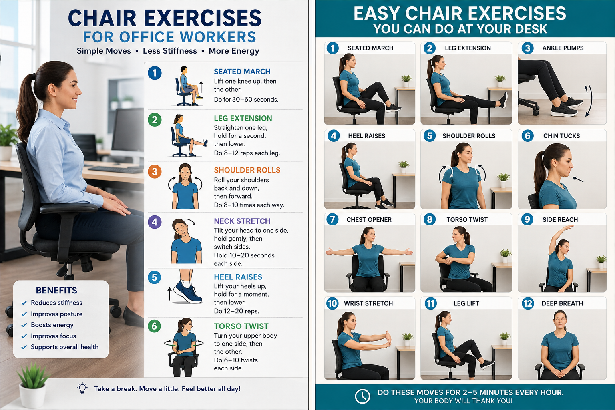
Exercise One: Seated Marching
Seated marching is one of the easiest exercises to learn.
Sit near the front of a stable chair. Keep your back tall and your feet on the floor.
Then:
- Lift your right knee.
- Lower it slowly.
- Lift your left knee.
- Continue switching sides.
- Keep your stomach gently firm.
- Breathe normally.
Start with 20 alternating lifts.
If that feels easy, continue for 30 to 60 seconds.
This movement trains your hip muscles and adds light activity without requiring much space.
Chair exercises for office workers often work best when they are simple enough to repeat.
Exercise Two: Seated Leg Extensions
Leg extensions can wake up the muscles at the front of your thighs.
Sit tall with both feet on the floor.
Next, straighten one leg until it is roughly level with the other thigh. Hold for one or two seconds. Then lower it slowly.
Switch sides.
Try 8 to 12 repetitions per leg.
Do not snap your knee straight. Instead, use a smooth motion.
If you have knee pain, reduce the movement or stop.
Exercise Three: Ankle Pumps for Deskbound Legs
Ankle pumps are small, but they are very easy to fit into a busy day.
Keep both feet on the floor.
Lift your heels while keeping your toes down. Then lower your heels.
After that, lift your toes while keeping your heels down.
Repeat 15 to 20 times.
This exercise is useful when you have been sitting through a long meeting.
You can even perform it while listening to a presentation, provided the movement does not distract you.
Exercise Four: Seated Heel Raises
Heel raises strengthen the lower legs through a simple movement.
Sit with your feet flat.
Push through the balls of your feet and lift both heels. Pause briefly. Then lower them.
Repeat 12 to 20 times.
For more challenge, perform one side at a time.
However, keep your movements controlled.
Exercise Five: Chair Squat Practice
If your office allows you to stand safely, chair squat practice can provide more work for your legs.
Stand in front of a sturdy chair.
Place your feet around hip-width apart.
Then:
- Push your hips backward.
- Bend your knees.
- Lower toward the chair.
- Lightly touch the chair.
- Stand back up.
Try 8 to 12 repetitions.
Do not let your knees collapse inward.
Also, do not use a rolling chair for this exercise.
Chair Exercises for Office Workers With Shoulder Tension
Chair exercises for office workers can help you add gentle movement to areas that often feel tight after computer work.
Shoulders often remain slightly raised while people type or use a mouse.
Try this simple sequence:
- Raise your shoulders toward your ears.
- Hold for one second.
- Lower them completely.
- Repeat 8 to 10 times.
Then gently squeeze your shoulder blades together.
Hold for two seconds.
Release.
Repeat 8 to 12 times.
These movements should feel gentle rather than painful.
Exercise Six: Shoulder Rolls
Shoulder rolls require almost no space.
Sit or stand tall.
Lift your shoulders slightly.
Move them backward, then down, and then forward.
Complete 8 slow circles.
Then reverse the direction.
Avoid fast, large movements.
The goal is controlled motion.
Exercise Seven: Neck Side Stretch
Your neck deserves attention during long computer sessions.
Sit upright.
Keep your shoulders relaxed.
Slowly tilt your right ear toward your right shoulder.
Do not lift the shoulder.
Hold the gentle stretch for about 10 to 20 seconds.
Return to center.
Repeat on the other side.
Do not pull your head down with your hand.
Stop if you feel sharp pain, numbness, dizziness, or unusual symptoms.
Exercise Eight: Chin Tucks
Chin tucks are useful for people who spend much of the day looking at screens.
Sit tall.
Look straight ahead.
Gently move your chin backward, as if you are making a small double chin.
Do not look down.
Hold for three to five seconds.
Relax.
Repeat 8 to 10 times.
The movement should be small.
Exercise Nine: Wrist and Finger Movement
Your hands work hard when you type.
Therefore, give them short breaks.
Open your hands wide.
Hold for two seconds.
Then make a loose fist.
Repeat 10 times.
Next, slowly circle your wrists in both directions.
Avoid forcing the joints.
If you experience ongoing hand pain, tingling, or numbness, speak with an appropriate health professional.
Chair Exercises for Office Workers Who Type All Day
Chair exercises for office workers should not focus only on the legs.
Your hands, wrists, shoulders, and upper back also need regular movement.
Try this one-minute hand break:
20 seconds: Open and close your hands.
20 seconds: Circle your wrists gently.
20 seconds: Shake your hands loosely.
Then return to work.
This tiny break takes almost no time.
However, it gives you a reason to stop typing continuously.
Exercise Ten: Seated Torso Rotation
Sit upright with both feet on the floor.
Place your hands across your chest.
Turn your upper body gently to the right.
Return to the middle.
Then turn left.
Repeat 6 to 10 times per side.
Keep your hips facing forward.
Do not force the twist.
This exercise should feel like a gentle movement, not a competition.
Exercise Eleven: Seated Side Reach
Raise your right arm.
Reach gently toward the left side.
Return to center.
Switch arms.
Keep both feet grounded.
Try 5 to 8 repetitions per side.
This movement adds gentle motion through your side body.
Exercise Twelve: Seated Chest Opener
Long computer sessions can encourage rounded shoulders.
A simple chest opener can help you change position.
Sit tall.
Move your arms behind you if comfortable.
Gently draw your shoulders back.
Think about opening your chest rather than forcing your shoulders down.
Hold for 10 seconds.
Relax.
Repeat three times.
Exercise Thirteen: Seated Calf Stretch
Move one foot slightly forward.
Keep the heel on the floor.
Pull your toes gently upward.
You should feel a mild stretch in your calf.
Hold for 15 to 20 seconds.
Switch legs.
Do not bounce.
Exercise Fourteen: Seated Hamstring Stretch
Move one leg forward.
Keep your heel on the floor.
Straighten the leg comfortably.
Sit tall and gently lean forward from your hips.
Stop when you feel a mild stretch behind your thigh.
Hold for 15 to 20 seconds.
Switch sides.
If you have back problems, keep the movement small or ask a qualified professional whether this stretch suits you.
Chair Exercises for Office Workers During Meetings
Chair exercises for office workers can fit into meetings if they remain quiet and respectful.
During an audio-only meeting, you might perform:
- Ankle pumps
- Seated marching
- Heel raises
- Hand opening
- Shoulder rolls
- Gentle neck movement
However, during video meetings, visible movement may distract others.
Therefore, use common sense.
You can also schedule a two-minute movement break between meetings instead.
Exercise Fifteen: Seated Knee Lift Hold
Lift one knee toward your chest without pulling hard.
Hold for two seconds.
Lower it.
Switch sides.
Repeat 8 times per side.
This exercise adds controlled movement to the hips and legs.
If raising your knee causes pain, use a smaller movement.
Exercise Sixteen: Seated Core Brace
A simple core brace does not require movement.
Sit tall.
Relax your shoulders.
Gently tighten your stomach muscles as if preparing for a light tap.
Keep breathing normally.
Hold for five seconds.
Relax.
Repeat 8 to 10 times.
Do not hold your breath.
This exercise can teach you to notice your trunk position while sitting.
Exercise Seventeen: Seated Toe Taps
Lift your toes while keeping your heels on the floor.
Tap them down.
Then lift your heels while keeping your toes down.
Continue switching between the two.
Perform the movement for 30 seconds.
It is simple enough for almost any desk.
Exercise Eighteen: Desk-Side Calf Raises
Stand behind your desk or beside a stable surface.
Hold the desk lightly.
Rise onto your toes.
Pause.
Lower slowly.
Repeat 10 to 15 times.
Make sure the desk is stable.
Never use a rolling chair as support.
Chair Exercises for Office Workers and Better Posture
Chair exercises for office workers work best when combined with a comfortable workstation.
Mayo Clinic recommends adjusting chair height so your feet can rest flat on the floor or using a footrest when needed. It also recommends keeping elbows close to the body and shoulders relaxed.
Therefore, do not treat exercise as the only answer.
Your workspace matters too.
Check these points:
- Feet supported
- Screen at a comfortable height
- Keyboard close enough to avoid reaching
- Shoulders relaxed
- Elbows near the body
- Lower back supported
- Mouse within easy reach
Good ergonomics can reduce unnecessary strain during the workday.
A Five-Minute Desk Movement Routine
Here is a simple routine for beginners.
Minute 1: Seated marching
Minute 2: Leg extensions
Minute 3: Shoulder rolls and chest opening
Minute 4: Ankle pumps and heel raises
Minute 5: Gentle neck and side stretches
You can perform this once every few hours.
However, your exact schedule depends on your work.
A Ten-Minute Office Routine
If you have ten minutes, use this sequence:
- Seated march — 60 seconds
- Leg extensions — 10 each side
- Shoulder rolls — 10 each direction
- Seated torso rotations — 8 each side
- Heel raises — 15 repetitions
- Toe taps — 30 seconds
- Chest opener — 20 seconds
- Calf stretch — 20 seconds each side
- Chin tucks — 8 repetitions
- Easy walking — 2 minutes
This routine gives you more movement without needing a gym.
Chair Exercises for Office Workers: 20-Minute Plan
Chair exercises for office workers can also form a longer workplace session.
Warm-up: 3 minutes
Start with:
- Shoulder rolls
- Ankle pumps
- Seated marching
- Gentle arm circles
Main section: 12 minutes
Complete two rounds:
- Seated marching — 45 seconds
- Leg extensions — 10 per side
- Seated knee lifts — 10 per side
- Heel raises — 15
- Toe taps — 30 seconds
- Seated torso rotation — 8 per side
Cool-down: 5 minutes
Finish with:
- Neck side stretch
- Calf stretch
- Chest opener
- Slow breathing
Keep the effort light to moderate.
Real-Life Example: The Eight-Hour Desk Worker
Consider a fictional office employee named Sarah.
Sarah works at a computer for about eight hours each weekday.
Before changing her routine, she often stayed seated for long stretches.
She decided to use a simple movement rule.
Every hour, she performed two minutes of movement.
For example, at 10:00 she marched while seated.
At 11:00 she performed leg extensions.
At noon she walked during lunch.
At 1:00 she performed shoulder movements.
At 2:00 she did ankle pumps.
At 3:00 she stood and walked around the office.
At 4:00 she performed another short routine.
After several weeks, Sarah noticed that movement had become part of her normal workday.
This example shows an important point: the goal is consistency, not perfection.
Case Study: What Workplace Research Shows
Research supports the broader idea of breaking up sedentary time.
A 2025 systematic review and meta-analysis examined computer prompts designed to remind office workers to take movement breaks. Across 18 studies involving 1,164 office workers, the intervention reduced sitting time by about 12.5 minutes per workday and increased daily steps by about 1,030 steps on average.
The results do not mean that every person will get the same outcome.
However, they show why reminders can help.
Another systematic review found that office environments designed to encourage movement were linked with greater physical activity.
Therefore, changing your environment can make movement easier.
Chair Exercises for Office Workers and Work Productivity
Chair exercises for office workers may also help you create healthier work habits.
However, be careful with claims about productivity.
A short movement break does not guarantee that you will work faster.
Still, movement can interrupt long periods of sitting and may make it easier to return to your task feeling physically refreshed.
A practical strategy is to place movement between tasks.
For example:
Finish email → move for two minutes → start report.
This makes exercise part of your workflow instead of another large task.
How to Build a Movement Reminder System
You do not need to remember every break yourself.
Use simple reminders.
You could:
- Set a phone timer.
- Use a computer reminder.
- Add movement to your calendar.
- Stand after each meeting.
- Walk while making some phone calls.
- Keep water farther away.
- Use stairs when practical.
- Place your printer away from your desk.
A 2025 review found that computer prompts can help reduce workplace sitting.
Therefore, reminders can be useful for people who become deeply focused on work.
Chair Exercises for Office Workers in Small Spaces
Chair exercises for office workers are especially useful when your office has limited space.
You do not need a large workout room.
A small area beside your desk can be enough for:
- Standing calf raises
- Chair squats
- Marching
- Shoulder movements
- Stretching
- Balance practice
However, always check the floor and nearby furniture first.
Move bags, cables, and other objects away from your feet.
Exercise at Home After Office Hours
Desk movement should support, not replace, a complete activity plan.
After work, you could add:
- Walking
- Cycling
- Swimming
- Dancing
- Strength training
- Gardening
- Sports
- Home workouts
WHO says physical activity includes many types of movement, and some activity is better than none.
Therefore, choose activities you enjoy.
Enjoyment makes it easier to continue.
Advantages of Chair Exercises for Office Workers
Chair exercises for office workers have several practical advantages.
They are convenient
You can do many movements at your desk.
They need little equipment
A sturdy chair may be enough.
They save time
You can exercise for two or five minutes instead of waiting for a full gym session.
They can break up sitting
Movement gives you a reason to change position.
They suit beginners
Many movements use simple actions.
They can fit busy schedules
You can place them between tasks.
They can support mobility
Regular gentle movement can help you keep using your joints through comfortable ranges.
They cost little
You do not need a gym membership.
Disadvantages and Limits to Know
Chair workouts also have limits.
They may not provide enough intensity
A short seated routine may not challenge your heart and muscles enough for all fitness goals.
They cannot replace all exercise
Adults still benefit from regular moderate or vigorous physical activity.
Some movements may not suit everyone
People with injuries, balance problems, severe pain, or certain health conditions may need individual guidance.
Office chairs vary
A rolling chair can create safety problems during standing movements.
Motivation can fade
A routine may seem exciting for one week and boring later.
Therefore, vary your movements and keep your goals realistic.
Chair Exercises for Office Workers With Limited Mobility
Chair exercises for office workers can be adapted for people who cannot stand easily.
For example, seated exercises can include:
- Arm raises
- Hand opening
- Ankle pumps
- Seated marching
- Leg extensions
- Shoulder rolls
- Gentle torso turns
However, individual needs differ.
If you have a disability, injury, or medical condition, ask a qualified health professional or physical therapist for personalized guidance.
You should never force a movement because an online article says you should perform it.
Expert Advice for a Safer Office Routine
A few basic rules make your routine safer.
First, use a stable chair.
Do not perform standing exercises with a chair that rolls.
Second, move slowly.
Fast movements can reduce control.
Third, breathe normally.
Do not hold your breath during easy exercises.
Fourth, avoid sharp pain.
A mild stretch can be normal, but sharp or worsening pain is a reason to stop.
Fifth, increase slowly.
Start with five minutes before trying 20 minutes.
Sixth, change position often.
The best office posture is not one fixed posture held all day. Instead, aim for comfortable support and regular movement.
Mayo Clinic also emphasizes proper chair setup, posture, and movement breaks for people who work at desks.
A Simple Office Exercise Chart
| Exercise | Time/Reps | Main Area | Difficulty | Equipment |
| Seated March | 30–60 sec | Hips, legs | Easy | Chair |
| Leg Extension | 8–12/leg | Thighs | Easy | Chair |
| Ankle Pumps | 15–20 | Ankles | Very easy | Chair |
| Heel Raises | 12–20 | Calves | Easy | Chair |
| Shoulder Rolls | 8–10 | Shoulders | Very easy | None |
| Chin Tucks | 8–10 | Neck area | Easy | None |
| Torso Rotation | 6–10/side | Upper body | Easy | Chair |
| Chest Opener | 10–20 sec | Chest, shoulders | Easy | None |
| Seated Knee Lift | 8–12/side | Hips, core | Easy | Chair |
| Chair Squat | 8–12 | Legs | Moderate | Stable chair |
| Toe Taps | 30 sec | Lower legs | Very easy | Chair |
| Calf Stretch | 15–20 sec/side | Calves | Easy | Chair optional |
Chair Exercises for Office Workers: Beginner Weekly Schedule
Chair exercises for office workers become easier when you follow a weekly plan.
Monday
Five-minute routine during the morning and afternoon.
Tuesday
Three short two-minute breaks plus a short walk.
Wednesday
Ten-minute desk routine.
Thursday
Five-minute routine twice during work.
Friday
Ten-minute routine plus a longer walk.
Saturday
Choose an enjoyable activity such as walking, cycling, or sports.
Sunday
Rest or enjoy gentle movement.
You can adjust the plan to your schedule.
How to Make Your Desk More Movement-Friendly
Your environment can influence your behavior.
A workplace review found that office design can influence physical activity, particularly when environments create opportunities for incidental movement.
Therefore, try simple changes.
Keep your water bottle a short walk away.
Use the stairs when practical.
Walk to a coworker’s desk instead of sending a message when appropriate.
Take calls while standing or walking when your job allows it.
Place frequently used items where you must occasionally stand.
These small choices can increase movement without adding a formal workout.
Chair Exercises for Office Workers and Sit-Stand Desks
Chair exercises for office workers can work alongside a sit-stand desk.
A 2025 systematic review found that sit-stand desk interventions can reduce workplace sitting time, although the long-term effects and impact outside work still need more study.
However, standing all day is not the goal.
Instead, alternate between:
Sitting → standing → walking → sitting → stretching.
Your body benefits from changing positions.
A sit-stand desk can help, but it should not replace regular movement.
The Two-Minute Rule for Busy Workers
Here is one of the easiest plans.
Every hour, move for two minutes.
You could perform:
- 30 seconds of marching
- 30 seconds of shoulder movement
- 30 seconds of leg extensions
- 30 seconds of ankle pumps
That is all.
You can increase the time later.
A two-minute habit may feel easier than promising yourself a full workout every hour.
Chair Exercises for Office Workers: Your Long-Term Plan
Chair exercises for office workers work best when they become part of your normal routine.
Do not chase a perfect schedule.
Instead, aim for regular movement.
A realistic long-term plan looks like this:
Week 1: Two-minute breaks.
Week 2: Add one five-minute session.
Week 3: Add short walks.
Week 4: Add strength or cardio outside work.
Then continue adjusting your routine.
The goal is not to sit perfectly.
The goal is to move more often.
Frequently Asked Questions
- What are the best chair exercises for office workers?
The best options include seated marching, leg extensions, ankle pumps, heel raises, shoulder rolls, chin tucks, torso rotations, and gentle stretches. Choose exercises that feel comfortable and are easy to repeat.
- Can chair exercises replace going to the gym?
No. Chair exercises for office workers can help you move during your workday, but they do not replace a complete fitness program. Regular aerobic activity and muscle-strengthening exercise remain important.
- How often should I exercise at my desk?
Try short movement breaks throughout the day. For example, two to five minutes every hour can be a practical starting point.
- Can I do chair exercises while working?
Some gentle movements, such as ankle pumps or hand opening, can fit into certain tasks. However, exercise should not interfere with safe work or concentration.
- Are chair exercises good for beginners?
Yes. Many movements are beginner-friendly because they use simple actions and little resistance.
- Can chair exercises help with stiffness?
They may help you change position and move stiff areas gently. Mayo Clinic recommends regular movement and workplace stretches for people who sit for long periods.
- How long should a desk exercise session last?
Start with five minutes. If you feel comfortable, you can gradually increase the session.
- Can I lose weight with chair exercises?
Chair exercises alone may not create enough activity for major weight loss. However, they can add movement to your day and support a broader healthy lifestyle.
- What if I have back pain?
Use caution. Choose gentle movements and avoid anything that increases pain. If you have ongoing or severe pain, ask a qualified health professional for advice.
- Can older adults do office chair exercises?
Many older adults can perform adapted seated movements. However, exercise choices should match individual ability, balance, strength, and health needs.
- Are chair exercises good for circulation?
Gentle movements such as ankle pumps and marching can help you avoid staying completely still. However, people with medical circulation problems should seek personal medical advice.
- Can I exercise during a video meeting?
You can perform very small movements if they do not distract others. During important meetings, however, it may be better to take a short movement break before or afterward.
- What chair is safest for office exercises?
Use a strong, stable chair that does not roll when you perform seated exercises. Avoid using unstable furniture for standing movements.
- How can I remember to take exercise breaks?
Use a computer timer, calendar reminder, phone alarm, or workplace wellness app. Research suggests that computer prompts can help reduce sitting time among office workers.
- Can desk exercises improve posture?
They can help you change position and practice better body awareness. However, posture also depends on your workstation setup, chair, screen, keyboard, and daily habits.
- How many calories do chair exercises burn?
The number varies widely depending on the exercise, speed, body size, and duration. Seated exercises generally use less energy than brisk walking or running.
- Can I do chair exercises without equipment?
Yes. Many movements require only your body and a stable chair.
- Should chair exercises hurt?
No. Mild muscle effort or a gentle stretch can be expected, but sharp, severe, or unusual pain means you should stop.
- Do chair exercises count as physical activity?
Yes, movement is physical activity. However, the amount and intensity matter. Short, easy movements should complement rather than replace regular moderate or vigorous activity.
- What is the easiest office exercise to start with?
Start with seated marching, ankle pumps, shoulder rolls, or leg extensions. Pick one that feels comfortable and repeat it consistently.
Safety Checklist Before You Start
Before doing chair exercises for office workers, check your space.
Ask yourself:
- Is my chair stable?
- Is the floor clear?
- Can I move my arms safely?
- Can I keep my feet supported?
- Do I have enough room to stand?
- Does the exercise cause pain?
- Am I breathing normally?
- Am I moving slowly?
If you have a known medical condition, recent injury, significant pain, or concerns about exercise safety, ask a qualified health professional for individual guidance.
Also, stop exercising and seek appropriate medical care if you develop serious or unusual symptoms.
External Resources for Office Workers
For trustworthy guidance, these resources are useful:
- Mayo Clinic: Office Ergonomics — practical advice on chair setup, posture, equipment placement, and comfortable desk work.
- Mayo Clinic: Desk Stretches — simple workplace stretches and movement ideas.
- World Health Organization: Physical Activity — information about physical activity and health.
- WHO Guidelines on Physical Activity and Sedentary Behaviour — evidence-based activity and sedentary-behavior guidance.
- PubMed: Workplace Sedentary Behavior Research — research on workplace programs that reduce sitting time.
Final Thoughts
Chair exercises for office workers provide a practical way to add movement to a busy workday. They are easy to learn, require little space, and can fit between normal office tasks.
Most importantly, you do not need to create a perfect routine.
Start small.
Try two minutes of movement each hour. Add short walks when possible. Adjust your chair and computer setup. Stand when it makes sense. Stretch gently. Then build your activity level over time.
The bigger goal is simple: do not let work force your body to stay in one position all day.
Research supports breaking up long periods of workplace sitting, while WHO guidance reminds adults to get regular physical activity throughout the week.
So, choose three movements you enjoy and start today.
A few minutes may seem small. However, small movements repeated across many workdays can become a meaningful part of a healthier daily routine.