
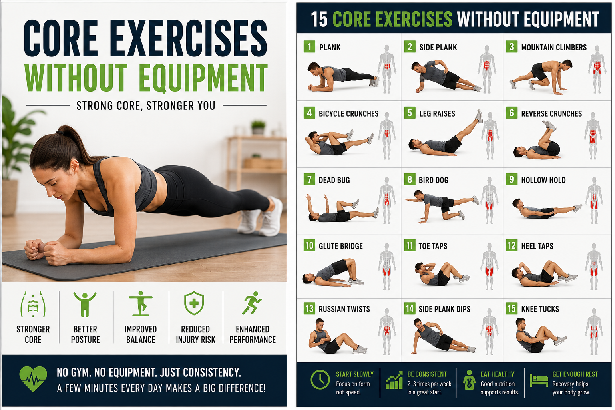
Core exercises without equipment give you a simple way to train your stomach, back, hips, and deep core muscles almost anywhere. You do not need a gym, weights, or expensive machines. Instead, your own body can provide the resistance.
Moreover, a strong core does more than create visible abs. Your core helps you stay balanced, control your body, support movement, and keep your trunk steady during everyday tasks. Mayo Clinic explains that the core includes muscles around the abdomen, pelvis, hips, and lower back, and that stronger core muscles can improve balance and stability.
The best part is simple: you can start with a few minutes today.
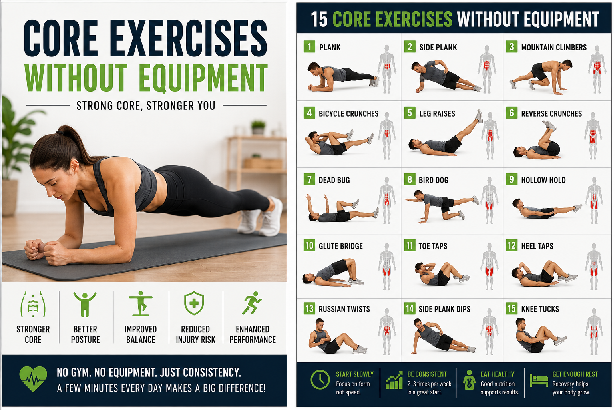
This guide gives you 45 practical and unique sections, beginner-friendly instructions, a workout chart, advantages, disadvantages, expert advice, real-life examples, safety tips, and 20 FAQs.
Why Core Exercises Without Equipment Matter
Core exercises without equipment can fit into almost any lifestyle.
For example, you can exercise in your bedroom, living room, office, hotel room, or outdoor space. You only need enough room to move safely.
Also, bodyweight training can count as muscle-strengthening activity. The CDC lists bodyweight movements such as planks among examples of muscle-strengthening exercises.
Therefore, you can build a useful fitness habit without paying for a gym.
What Your Core Really Includes
Many people think the core means only the six-pack muscles. However, your core is much larger.
It includes your:
- Abdominal muscles
- Obliques
- Deep abdominal muscles
- Lower-back muscles
- Pelvic muscles
- Hip muscles
These muscles work together when you walk, run, bend, turn, lift, sit, and play sports.
Mayo Clinic also describes the core as the central part of the body that includes the pelvis, lower back, hips, and stomach.
The First Core Move: Front Plank
The front plank is one of the easiest exercises to understand but one of the hardest to master well.
Start on your hands and knees. Then extend your legs behind you and support yourself on your forearms or hands.
Keep your body in a straight line.
Next, tighten your stomach gently and breathe normally.
Start with 15 to 20 seconds. As you improve, work toward 30, 45, or 60 seconds.
Do not let your hips drop toward the floor.
ACE lists the front plank as a no-equipment exercise that works the abs and back.
Try a Side Plank for Better Balance
The side plank trains the muscles along the sides of your body.
Lie on one side and place your forearm under your shoulder. Then lift your hips from the floor.
Keep your body long.
Beginners can keep the lower knee on the floor. Later, straighten both legs.
Hold for 15 to 30 seconds per side.
This movement is useful because your core must resist sideways movement instead of simply bending your body.
Core Exercises Without Equipment for Beginners
Core exercises without equipment work especially well for beginners because you can control the speed and difficulty.
Start with simple movements instead of jumping straight into advanced exercises.
A beginner routine might include:
- Dead bug
- Bird dog
- Glute bridge
- Knee plank
- Side plank from the knees
- Heel taps
Perform each exercise slowly.
Most importantly, focus on good form rather than chasing a high number of repetitions.
ACE recommends beginning with manageable repetitions and increasing the amount as your strength improves.
Dead Bug Builds Deep Control
The dead bug looks easy.
Yet it can challenge your core control when you perform it slowly.
Lie on your back. Raise your knees over your hips and your arms toward the ceiling.
Slowly lower your right arm and left leg.
Then return them to the starting position.
Switch sides.
Keep your lower back controlled throughout the movement.
Try 6 to 10 repetitions per side.
Bird Dog Trains Stability
The bird dog is another excellent beginner movement.
Start on your hands and knees.
Place your hands under your shoulders and your knees under your hips.
Then extend your right arm and left leg.
Pause briefly.
Return to the starting position and switch sides.
Mayo Clinic describes this movement as a quadruped or bird dog and recommends maintaining trunk control while moving the opposite arm and leg.
Core Exercises Without Equipment With Bird Dog
Core exercises without equipment do not have to focus only on your stomach.
The bird dog also challenges your back, hips, and balance.
To make it harder, pause for three seconds when your arm and leg are fully extended.
To make it easier, move only one limb at a time.
That simple change allows people with different fitness levels to use the same movement.
Glute Bridge Supports the Core
Lie on your back with your knees bent.
Place your feet flat on the floor.
Then tighten your stomach gently and lift your hips.
Your shoulders, hips, and knees should form a comfortable line.
Pause for one or two seconds.
Then lower your hips slowly.
Try 10 to 15 repetitions.
Mayo Clinic recommends the bridge as a core-strength exercise and explains that proper form includes keeping the back neutral and lifting the hips toward alignment with the shoulders and knees.
Heel Taps Strengthen Abdominal Control
Lie on your back with your knees bent.
Lift your feet so your knees stay above your hips.
Slowly lower one heel toward the floor.
Tap lightly.
Then return it.
Switch legs.
Keep your stomach gently braced.
Start with 8 to 12 taps per side.
Reverse Crunch Without Momentum
A reverse crunch can train the abdominal muscles without equipment.
Lie on your back.
Bend your knees.
Bring your knees toward your chest.
Then gently curl your hips away from the floor.
Avoid swinging your legs.
Instead, use slow and controlled movement.
Start with 8 to 10 repetitions.
If you feel discomfort in your lower back, stop and choose an easier exercise.
Core Exercises Without Equipment for Stronger Abs
Core exercises without equipment can help strengthen your abdominal muscles, but they do not automatically remove belly fat.
That distinction matters.
You can strengthen your abdominal muscles through training. However, visible abdominal definition also depends on overall body composition, food intake, genetics, sleep, and total activity.
Therefore, do not judge your progress only by how your stomach looks.
A stronger plank, better balance, or easier daily movement can also show progress.
Slow Bicycle Crunches
Bicycle crunches add rotation to your routine.
Lie on your back.
Bring your hands behind your head without pulling on your neck.
Lift your shoulders slightly.
Bring one knee toward your chest while rotating your upper body toward it.
Then switch sides.
Move slowly.
Do not race through the exercise.
Try 6 to 10 controlled repetitions per side.
Mountain Climbers Add Movement
Mountain climbers turn core training into a more active exercise.
Start in a high-plank position.
Bring one knee toward your chest.
Return it.
Then bring the other knee forward.
Beginners should move slowly.
More advanced exercisers can increase the pace.
However, never increase speed if your hips begin bouncing or your lower back starts arching.
Core Exercises Without Equipment and Mountain Climbers
Core exercises without equipment can also raise your heart rate when you use movements such as mountain climbers.
However, remember that a fast exercise is not automatically a better exercise.
A slow mountain climber with strong control can teach your body more than a rushed set.
Therefore, build control first.
Then build speed.
Bear Crawl Challenges the Whole Body
The bear crawl requires your hands and feet to support your body.
Start on your hands and knees.
Lift your knees slightly from the floor.
Then move one hand and the opposite foot forward.
Continue slowly.
Keep your back as steady as possible.
ACE includes bear crawls among its no-equipment exercises.
Hollow Hold Builds Full-Body Tension
The hollow hold is more advanced.
Lie on your back.
Lift your shoulders and legs slightly from the floor.
Extend your arms overhead.
Keep your lower back controlled.
Hold for 10 to 20 seconds.
If that feels too difficult, bend your knees.
The goal is control, not suffering.
Toe Taps Keep the Movement Simple
Toe taps are excellent when you want a gentle abdominal challenge.
Lie on your back.
Raise both legs with knees bent.
Slowly lower one foot toward the floor.
Tap.
Return.
Repeat on the other side.
ACE also includes supine toe taps among core stability movements.
Core Exercises Without Equipment for Small Spaces
Core exercises without equipment are especially useful when you have limited space.
You can complete many movements in an area roughly the size of a small exercise mat.
For example, you can combine:
- Planks
- Dead bugs
- Bird dogs
- Glute bridges
- Heel taps
- Side planks
You do not need a large home gym.
Standing Knee Drive for No-Floor Training
Not every core workout needs floor exercises.
Stand tall.
Lift one knee toward your chest.
At the same time, gently tighten your stomach.
Lower your foot.
Then switch legs.
Keep your upper body steady.
Perform 10 to 15 repetitions per side.
This option works well for people who do not enjoy floor exercises.
Standing Cross-Body Knee Touch
Stand with your feet about hip-width apart.
Raise your right knee.
Bring your left hand toward the knee.
Return to the start.
Then switch sides.
Move at a steady pace.
This exercise can work your trunk while also challenging coordination.
Core Exercises Without Equipment for Busy Days
Core exercises without equipment can fit into a busy schedule.
You do not always need a 60-minute workout.
Instead, try this short session:
- 30-second plank
- 10 dead bugs per side
- 10 bird dogs per side
- 15 glute bridges
- 20 heel taps
- 20-second side plank per side
Rest between movements when needed.
The entire session can take about 10 to 15 minutes.
A 15-Minute Home Core Routine
Here is a simple routine you can repeat two or three times each week.
| Exercise | Beginner | Intermediate | Advanced |
| Front plank | 15 sec | 30 sec | 45–60 sec |
| Dead bug | 6/side | 10/side | 12/side |
| Bird dog | 6/side | 10/side | 12/side |
| Glute bridge | 10 | 15 | 20 |
| Side plank | 10 sec/side | 20 sec/side | 30–45 sec/side |
| Heel taps | 8/side | 12/side | 15/side |
| Mountain climber | 10/side | 15/side | 20/side |
Rest for about 30 to 60 seconds between rounds.
Core Exercises Without Equipment Weekly Plan
Core exercises without equipment work best when you give your body time to recover.
Try this simple weekly plan:
Monday: 15-minute core workout
Tuesday: Walking or another activity
Wednesday: 10-minute core workout
Thursday: Rest or easy movement
Friday: 15-minute core workout
Saturday: Full-body activity
Sunday: Rest
The CDC recommends muscle-strengthening activity for all major muscle groups on at least two days each week.
How to Progress Without Weights
You might wonder how to make bodyweight training harder.
You have several options.
First, add repetitions.
Next, increase hold time.
Then, slow down each repetition.
After that, reduce rest time slightly.
Finally, choose a harder variation.
For example:
Knee plank → full plank → long plank → shoulder-tap plank
This gives you progression without buying equipment.
Core Exercises Without Equipment for Weight Management
Core exercises without equipment can support an active lifestyle, but they should not be treated as a magic weight-loss method.
A complete plan should include regular movement, strength training, sleep, and a balanced eating pattern.
Bodyweight strength training can help maintain muscle while you work toward weight-management goals. The CDC notes that muscle-strengthening activity can help maintain muscle mass during weight loss.
What Makes a Core Workout Effective?
An effective workout has three main parts:
Control: You move with purpose.
Challenge: The exercise feels difficult enough to stimulate your muscles.
Progression: You slowly make the workout harder over time.
You do not need to feel exhausted after every session.
Instead, aim for steady improvement.
Advantages of Core Exercises Without Equipment
Core exercises without equipment offer several useful advantages.
Main advantages
- They cost little or nothing.
- You can exercise almost anywhere.
- They save travel time.
- They work well for home workouts.
- Beginners can modify many exercises.
- You can increase difficulty gradually.
- They can improve body control.
- They can support balance and stability.
- They require very little space.
Mayo Clinic specifically notes that core training does not require a gym membership or special equipment.
Disadvantages You Should Know
There are also limits.
Core exercises without equipment may become less challenging once you become very strong.
Some advanced athletes may need additional resistance to keep progressing.
Also, bodyweight exercises can be difficult for people who have poor movement control.
Furthermore, doing only abdominal exercises will not create a complete fitness program.
You should train your legs, upper body, heart, and mobility too.
Core Exercises Without Equipment and Back Comfort
Core exercises without equipment can support stronger trunk muscles, but you should not use exercise to push through sharp or unusual pain.
If an exercise causes pain, stop.
Then try an easier variation.
Mayo Clinic advises people with back problems, osteoporosis, or other health concerns to speak with a health professional before starting certain core-strength exercises.
Real-Life Example: The Busy Office Worker
Imagine a person who works at a desk for eight hours each day.
They have little time for a gym.
Instead, they start with a 10-minute routine three times per week.
They perform:
- Dead bugs
- Bird dogs
- Glute bridges
- Planks
- Side planks
After several weeks, they may notice that the exercises feel easier.
That is a useful sign of progress.
The goal is not to copy someone else’s routine. The goal is to create a routine you can repeat.
Real-Life Example: The Traveler
Now imagine someone traveling for work.
They have no gym access.
Instead of skipping training completely, they use a hotel-room routine.
They complete two rounds of:
- 20-second plank
- 8 dead bugs per side
- 10 glute bridges
- 8 bird dogs per side
- 15 heel taps
This approach keeps exercise simple.
ACE also highlights bodyweight and no-equipment movements as useful options for people who travel.
Expert Advice for Better Results
Fitness experts often focus on quality before quantity.
ACE recommends exercises that improve trunk stability and movement control, including planks, bird dogs, and glute bridges.
Mayo Clinic also recommends breathing freely during core exercises and focusing on controlled abdominal engagement.
Therefore, remember three simple rules:
- Do not hold your breath.
- Do not rush.
- Stop when your form breaks down.
Core Exercises Without Equipment and Breathing
Core exercises without equipment become easier to control when you breathe properly.
Try breathing in before the movement.
Then breathe out during the harder part.
For example, during a bridge, breathe out as you lift your hips.
Do not hold your breath for long periods.
Good breathing helps you stay relaxed while your muscles work.
Common Mistakes Beginners Make
Many people make the same mistakes.
Mistake 1: Doing too many repetitions
More repetitions do not always mean better results.
Mistake 2: Moving too quickly
Fast movements can reduce control.
Mistake 3: Holding your breath
Keep breathing naturally.
Mistake 4: Training only the abs
Your core includes more than your stomach muscles.
Mistake 5: Ignoring recovery
Your muscles need time to recover.
Mistake 6: Chasing soreness
Soreness is not the only sign of progress.
How Long Should a Core Workout Take?
A beginner may need only 10 minutes.
An intermediate exerciser may enjoy 15 to 20 minutes.
An advanced athlete may use longer sessions as part of a complete training program.
However, longer is not automatically better.
A short routine that you perform consistently can be more useful than a long workout you abandon after one week.
Core Exercises Without Equipment for Older Beginners
Core exercises without equipment can be adjusted for different ages and fitness levels.
Older beginners can start with standing movements, supported bird dogs, gentle bridges, or short planks.
The key is to choose a level that feels safe and manageable.
If you have a health condition or significant pain, ask a qualified health professional for individual guidance before starting a new routine.
How to Make Planks Easier
A full plank can feel difficult at first.
So start with your knees on the floor.
Keep your shoulders above your hands or elbows.
Brace your stomach gently.
Hold for 10 to 20 seconds.
As your strength improves, move to a full plank.
This gradual approach can help you build confidence.
How to Make Core Exercises Harder
Once the basic exercises feel easy, increase the challenge.
For example:
Dead bug: Move more slowly.
Bird dog: Add a longer pause.
Plank: Extend the hold.
Side plank: Straighten the legs.
Glute bridge: Pause at the top.
Mountain climber: Increase speed while keeping control.
These changes can make the same exercise more demanding.
Core Exercises Without Equipment vs Gym Machines
Core exercises without equipment offer freedom and convenience.
Gym machines can provide adjustable resistance and useful support.
Neither choice is automatically better.
Your best option depends on your goals, experience, budget, and available time.
If your main goal is general core strength, bodyweight exercises can provide a strong starting point.
ACE’s exercise library currently includes more than 100 movements categorized as requiring no equipment, showing how many options exist beyond machines.
A Simple Progress Tracker
Track your workouts for four weeks.
| Week | Plank | Dead Bug | Bridge | Bird Dog | Main Goal |
| 1 | 15 sec | 6/side | 10 | 6/side | Learn form |
| 2 | 20 sec | 8/side | 12 | 8/side | Build control |
| 3 | 30 sec | 10/side | 15 | 10/side | Add volume |
| 4 | 35–45 sec | 12/side | 18 | 12/side | Improve strength |
Do not worry if you need more time.
Your body does not have to follow a perfect calendar.
When Will You Notice Results?
You may notice better control before you notice visual changes.
For example, you might hold a plank longer.
You may also feel steadier when doing other exercises.
Your posture and movement confidence may improve.
However, visible muscle changes usually require consistent training over time.
Your nutrition, sleep, genetics, activity level, and starting fitness level also affect the result.
Safety Checklist Before You Start
Before your workout:
- Choose a clear floor area.
- Wear comfortable clothing.
- Warm up for a few minutes.
- Start with easy movements.
- Keep breathing.
- Use slow movements.
- Stop if you feel sharp pain.
- Progress gradually.
Also, do not copy advanced social-media workouts simply because they look impressive.
Good exercise should match your current ability.
Frequently Asked Questions
Can I do core exercises without equipment every day?
You can perform gentle core movements frequently, but hard strength sessions need recovery. For most beginners, two or three focused sessions each week provide a practical starting point.
What are the best core exercises without equipment?
Good choices include planks, side planks, dead bugs, bird dogs, glute bridges, heel taps, and controlled mountain climbers. The best exercise is one you can perform safely and consistently.
Can I build abs without going to the gym?
Yes. Bodyweight training can strengthen your abdominal muscles. However, visible abs depend on more than abdominal exercise alone.
Are planks better than crunches?
Neither exercise is automatically better. Planks train your ability to stabilize your trunk, while crunches involve repeated trunk movement. A balanced routine can use different movements.
How long should I hold a plank?
Beginners can start with 10 to 20 seconds. Increase the time when you can keep good form.
Can beginners do core workouts?
Yes. Beginners should start with simple exercises and easier versions. Dead bugs, bird dogs, bridges, and knee planks can provide a good starting point.
Can core workouts reduce belly fat?
Core workouts strengthen the muscles, but they cannot specifically remove fat from one body area. Overall activity, nutrition, and other lifestyle factors matter too.
Do I need a yoga mat?
No. A mat can make floor exercises more comfortable, but it is not required. Choose a safe surface that does not cause your hands, knees, or back unnecessary discomfort.
Can I train my core in a small bedroom?
Yes. Many exercises need very little space. Planks, dead bugs, bridges, bird dogs, and heel taps can all work in a small area.
Are core exercises good for posture?
A stronger and better-controlled core can support good movement and posture. However, posture also depends on your hips, back, shoulders, habits, and overall movement.
How many core exercises should I do?
You do not need dozens. Five or six well-chosen movements can create a useful session.
Should I train my core before or after cardio?
Either can work. If core strength is your main goal, train it when you have enough energy to maintain good form.
Can I do core exercises before running?
Yes, but keep the session moderate if running performance is your priority. A very tiring core workout may make running feel harder.
Why does my lower back hurt during core exercises?
Your form, exercise choice, fatigue, or individual body factors may contribute. Stop any movement that causes pain and consider professional advice if the problem continues.
Are sit-ups necessary for a strong core?
No. You can train your core with many different movements, including planks, bridges, bird dogs, dead bugs, and other bodyweight exercises.
Can teenagers do bodyweight core exercises?
Healthy teenagers can generally participate in age-appropriate physical activity, but exercise should match their ability and supervision needs.
How can I make a no-equipment workout harder?
Increase repetitions, slow the movement, add pauses, increase hold time, reduce rest slightly, or choose a harder variation.
Can I do core exercises while traveling?
Yes. Travel is one of the best situations for bodyweight training because you can exercise without carrying weights or finding a gym.
How quickly can core strength improve?
Progress varies. Beginners often notice that exercises become easier as they practice consistently. However, strength gains depend on training, recovery, nutrition, age, and starting fitness.
What is the biggest mistake in core training?
Poor form is one of the biggest problems. Do fewer repetitions with better control rather than rushing through a large number.
Conclusion
Core exercises without equipment prove that effective training does not have to be expensive or complicated.
You can start with a few minutes and a small amount of floor space.
Begin with simple movements such as planks, dead bugs, bird dogs, bridges, heel taps, and side planks. Then, as your strength improves, increase your hold time, repetitions, or exercise difficulty.
Most importantly, stay consistent.
A strong core is not built in one workout. It develops through repeated practice, good form, enough recovery, and gradual progress.
You do not need the fanciest gym.
You do not need expensive equipment.
You simply need a safe place to move and a routine you can follow.
For additional exercise guidance, the [Mayo Clinic core exercise guide]Mayo Clinic core exercise guide and [ACE exercise library]ACE no-equipment exercise library provide useful professional exercise resources. The [CDC Physical Activity Guidelines]CDC Physical Activity Guidelines can also help you build a broader weekly activity plan.