
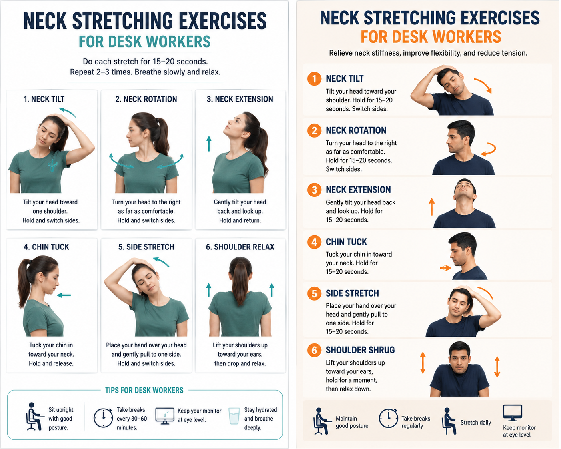
Neck stretching exercises for desk workers can help reduce everyday stiffness caused by long hours at a computer. If your neck feels tight after emails, meetings, studying, gaming, or working from home, a few gentle movements can make your workday more comfortable.
However, stretching is only one part of the answer. Your screen height, chair position, sitting habits, and regular movement breaks also matter. Therefore, the best approach combines simple stretches with a better desk setup.
Mayo Clinic recommends gentle workplace neck stretches such as chin-to-chest movements, head turns, and side bends. It also advises keeping stretches gentle and stopping if a movement causes pain.
Important: This article provides general wellness information, not a personal medical diagnosis. If neck pain follows an injury, causes weakness, numbness, tingling, severe pain, or gets worse, seek medical care.
Why Desk Work Makes Your Neck Tight
When you sit at a computer, your head can stay in almost the same position for a long time. As a result, your neck and shoulder muscles may become tired and stiff.
Poor posture can make the problem worse. Mayo Clinic notes that leaning over a computer can strain neck muscles and contribute to neck pain.
Therefore, neck stretching exercises for desk workers work best when you also change the habit that caused the stiffness.
The Main Signs Your Neck Needs a Break
You may need a movement break if you notice:
- Neck tightness
- Shoulder tension
- Reduced neck movement
- A stiff feeling after sitting
- Mild upper-back discomfort
- Tension-type headaches
- A strong urge to roll your shoulders
However, these symptoms can have many causes. Persistent or severe symptoms deserve professional advice.
Neck Stretching Exercises for Desk Workers: Start Gently
Before stretching, sit or stand tall. Keep your shoulders relaxed and breathe normally.
Then move slowly.
Do not bounce your head. Also, do not force your neck into a deep position.
Mayo Clinic advises holding common workplace neck stretches for about 15 to 30 seconds and keeping the movement gentle.
The Chin-to-Chest Reset
This is one of the easiest neck stretching exercises for desk workers.
Sit tall and look straight ahead. Slowly lower your chin toward your chest. You should feel a gentle stretch along the back of your neck.
Hold for 15 to 30 seconds. Then slowly return to the starting position.
Do not push your head down with your hands.
The Slow Look-Left Stretch
Next, turn your head slowly toward your left side.
Keep your shoulders facing forward. Stop when you feel a gentle stretch.
Hold for 15 to 30 seconds. Then return to center.
Afterward, repeat on the right side.
This simple movement can fit into a short computer break.
The Ear-to-Shoulder Stretch
Another useful option is the side neck stretch.
Keep your shoulders relaxed. Slowly move your right ear toward your right shoulder.
Do not lift your shoulder toward your ear.
Hold for 15 to 30 seconds. Then return to center and repeat on the other side. Mayo Clinic gives similar instructions for this workplace stretch.
The Shoulder Roll Companion
Although shoulder rolls do not directly stretch every neck muscle, they can help loosen the upper shoulder area.
Lift your shoulders gently. Move them back, then down.
Repeat slowly several times.
In addition, shoulder rolls are easy to perform during a phone call or short meeting.
The Desk-Friendly Neck Routine
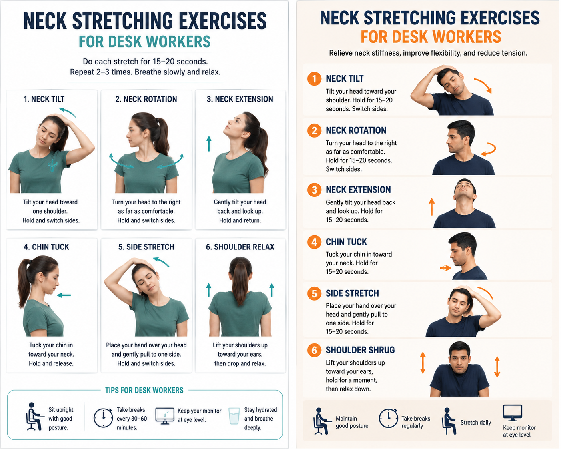
A short routine can include:
- Chin to chest
- Look left
- Look right
- Right ear toward shoulder
- Left ear toward shoulder
- Shoulder rolls
- One short walk
Therefore, you do not need a gym or special equipment.
Neck Stretching Exercises for Desk Workers During Work
The best routine is one you actually remember.
For example, stretch after finishing a meeting. Then move again after sending a large email.
Mayo Clinic also recommends breaking up long sitting periods with stretches and physical activity.
Try the 30-Minute Movement Reminder
You do not need to wait until your neck hurts.
Instead, set a reminder every 30 to 45 minutes.
When the reminder appears, stand up. Walk around. Roll your shoulders. Then perform one or two gentle neck movements.
Mayo Clinic has suggested taking breaks every 30 to 45 minutes during the workday for simple stretches or movement.
A Two-Minute Office Reset
Here is a quick routine:
| Movement | Time |
| Chin to chest | 20 seconds |
| Look left | 20 seconds |
| Look right | 20 seconds |
| Side stretch left | 20 seconds |
| Side stretch right | 20 seconds |
| Shoulder rolls | 20 seconds |
That gives you a simple two-minute reset.
The Screen Height Check
Even the best neck stretching exercises for desk workers cannot fully solve a poor workstation.
Your monitor should allow you to work without constantly bending or twisting your neck.
OSHA recommends keeping your head level and aligned with your torso during computer work.
Therefore, check your screen before blaming your chair or neck.
Keep Your Head Over Your Body
Your head should not constantly move forward toward the screen.
Instead, keep your head balanced over your torso.
This position reduces unnecessary strain and makes your work posture easier to maintain.
Give Your Feet a Stable Base
Your feet should have good support.
If your feet do not reach the floor comfortably, consider a footrest.
Mayo Clinic recommends supporting the feet on the floor or using a footrest when needed.
Relax Your Shoulders While Typing
Many desk workers slowly raise their shoulders while concentrating.
However, this can add tension.
Check your shoulders several times each hour. Let them drop naturally.
Then take one slow breath.
Keep the Keyboard Close
A keyboard that sits too far away can make you reach forward.
As a result, your shoulders may move forward and your neck may follow.
OSHA recommends keeping the upper arms close to the body and maintaining a neutral working position.
Do Not Stretch Through Pain
A stretch should feel gentle.
You may notice mild pulling or tension. However, sharp pain is different.
If a movement hurts, stop it.
Mayo Clinic specifically advises that pain means you have gone too far during workplace stretching.
Neck Stretching Exercises for Desk Workers and Breathing
Your breathing can help you stay relaxed while stretching.
Breathe slowly instead of holding your breath.
For example, breathe in before the movement. Then breathe out while you settle into the gentle stretch.
This simple habit can make the routine feel calmer.
Add Upper-Back Movement
Your neck does not work alone.
Your shoulders and upper back also affect how you sit.
Therefore, add simple shoulder blade movements, chest opening, and short walks to your daily routine.
Why Short Breaks Matter
A long workout at night cannot fully replace movement during a long workday.
Instead, regular small breaks can reduce the time you spend in one fixed posture.
A randomized study of office workers found that active-break and posture-shift programs reduced recurrence of neck and lower-back pain compared with a control group.
What Research Says About Office Workers
Research gives useful support for combining movement with workplace changes.
One 12-month randomized trial included 567 office workers. The exercise group used daily stretching and twice-weekly muscle endurance training. During the study, 12.1% of people in the exercise group developed neck pain compared with 26.7% in the control group.
That does not mean stretching guarantees pain prevention. However, it shows why regular exercise can be useful for office workers.
A More Recent Eight-Week Example
Another randomized controlled trial studied 60 office workers with chronic non-specific neck pain.
Participants received physical exercises and ergonomic changes or ergonomic changes alone. The exercise group showed improvements in pain, disability, stress, and quality of life during the study.
Therefore, neck stretching exercises for desk workers should be viewed as part of a wider movement plan.
Real-Life Example: The Remote Employee
Imagine Sarah, a fictional 34-year-old remote employee.
She works from a laptop for seven hours each day. By late afternoon, her neck feels stiff.
Instead of doing one long stretching session at night, she starts using three short movement breaks.
At 10:30 a.m., she does two gentle stretches. At noon, she walks for five minutes. At 3 p.m., she repeats the neck routine.
After several weeks, she notices that her neck feels less stiff during the afternoon.
This example shows an important lesson: consistency matters more than doing a complicated routine once.
Case Study: What the Research Shows
The 567-person office-worker trial provides a stronger real-world example than a single personal story.
Researchers followed workers for 12 months and compared an exercise program with no exercise intervention. The exercise program included stretching and muscle endurance work.
The researchers found a lower rate of new neck pain in the exercise group.
However, the study does not prove that every person will get the same result.
Expert Advice for Safer Stretching
Mayo Clinic’s workplace guidance is simple: move slowly, breathe normally, avoid bouncing, and stop if the stretch causes pain.
Also, Mayo Clinic recommends changing your workspace so your monitor, chair, keyboard, and desk support a more comfortable posture.
Therefore, experts generally support a combination of movement and good workstation habits rather than relying on stretching alone.
The Biggest Advantage of These Exercises
One major advantage is convenience.
You can perform most neck stretching exercises for desk workers without equipment.
You can also do them at home, at work, or during a study session.
Another Benefit: Better Movement Awareness
Stretching can remind you that you have been sitting still.
That reminder can be valuable.
Once you notice your posture, you may naturally start changing position more often.
A Benefit for Busy Workers
You do not need 30 minutes.
A two-minute routine can fit between tasks.
Furthermore, short movement breaks may feel easier to maintain than a long exercise session.
A Benefit for Students and Gamers
The same habits can help people who spend long hours studying or gaming.
However, young people with ongoing pain should also tell a parent, guardian, doctor, or another qualified health professional.
Possible Disadvantages and Limits
Stretching is not perfect for every problem.
For example, stretching may not solve pain caused by an injury, nerve problem, joint condition, or another medical issue.
Also, doing a stretch too strongly can make symptoms worse.
Therefore, gentle movement is the safer starting point for general desk stiffness.
When You Should Stop Stretching
Stop and seek medical advice if you develop:
- Severe or increasing pain
- Numbness
- Tingling
- Weakness
- Pain traveling into an arm
- Trouble walking
- Serious symptoms after an injury
Mayo Clinic advises medical evaluation for neck pain associated with weakness, numbness, tingling, traumatic injury, or other concerning symptoms.
Neck Stretching Exercises for Desk Workers Before a Meeting
Try a quick routine before a long meeting.
First, sit tall.
Next, perform one chin-to-chest stretch.
Then slowly turn left and right.
Finally, roll your shoulders.
This can help you start the meeting with a more relaxed body.
What to Do After Long Screen Time
After two or three hours of screen work, do more than stretch.
Stand up.
Walk around.
Drink water.
Look away from the screen.
Then return to work.
This approach breaks up long periods of sitting.
Your Phone Can Add More Neck Time
Desk work is not the only problem.
Many people spend their breaks looking down at phones.
Therefore, your neck may get little rest even after leaving the computer.
Hold your phone higher when possible and avoid spending every break in a bent-neck position.
Mayo Clinic recommends bringing small screens closer to eye level rather than repeatedly bending the neck downward.
The Laptop Problem
Laptops are convenient, but their screen and keyboard stay connected.
That can make ideal positioning harder.
If you work for long periods, consider raising the screen and using a separate keyboard and mouse.
This setup can make it easier to keep your head and neck in a neutral position.
Use a Simple Desk Check
Ask yourself five questions:
- Is my screen easy to see?
- Are my shoulders relaxed?
- Are my feet supported?
- Is my keyboard close?
- Have I moved recently?
If the answer to the last question is no, stand up.
OSHA’s Neutral Position Advice
OSHA recommends a neutral computer-working position with the head level and forward, shoulders relaxed, elbows near the body, and feet supported.
These small changes matter because awkward positions can increase muscle fatigue and discomfort.
The Document Holder Trick
If you often read printed documents while typing, place them near your screen.
Otherwise, repeatedly looking down or sideways can create extra neck movement.
OSHA recommends positioning documents close to the monitor height and distance to reduce awkward head and neck positions.
A Five-Minute Daily Plan
Try this simple schedule:
Minute 1: Chin-to-chest stretch
Minute 2: Gentle left and right turns
Minute 3: Side neck stretches
Minute 4: Shoulder rolls and chest opening
Minute 5: Walk around the room
Repeat once or twice during a long workday.
Neck Stretching Exercises for Desk Workers: Weekly Plan
| Day | Main Goal | Suggested Routine |
| Monday | Start gently | 5-minute routine |
| Tuesday | Add movement | Stretch + short walk |
| Wednesday | Check posture | Stretch + desk adjustment |
| Thursday | Stay consistent | 2-minute breaks |
| Friday | Reduce sitting | Stretch + walking |
| Saturday | General movement | Walk and stretch |
| Sunday | Easy recovery | Gentle mobility |
The goal is not perfection. Instead, aim for regular movement.
A Simple Progress Chart
| Habit | Week 1 | Week 2 | Week 3 | Week 4 |
| Stretch breaks | 1/day | 2/day | 2–3/day | 3/day |
| Walking breaks | 1/day | 2/day | 2/day | 3/day |
| Posture checks | 2/day | 3/day | 4/day | 5/day |
| Screen checks | Yes | Yes | Yes | Yes |
Use the chart as a reminder, not a medical treatment plan.
What Not to Do
Avoid aggressive neck circles, forceful pulling, fast movements, or bouncing.
Also, do not copy an advanced exercise simply because it looks impressive online.
Simple movements are often easier to control.
Where to Find Trusted Guidance
For more workplace stretching information, see Mayo Clinic’s desk stretch guide.
For computer workstation guidance, see OSHA’s computer workstation guidance.
For research on exercise and office-worker neck pain, see the PubMed research record.
Reference address: Mayo Clinic, 200 First St SW, Rochester, MN 55905, USA.
Neck Stretching Exercises for Desk Workers: Best Daily Habit
The best routine is the one you can repeat.
Therefore, do not wait until your neck becomes very stiff.
Instead, use small movement breaks throughout the day.
For example, stretch after a meeting, walk after lunch, and check your posture before starting another long task.
Build Your Own Easy Routine
You can now create a routine that fits your schedule.
Start with three gentle neck movements. Add shoulder rolls. Then stand and walk.
After that, check your screen and chair.
This approach is simple, cheap, and realistic for most desk workers.
Frequently Asked Questions
- What are the best neck stretching exercises for desk workers?
The best beginner options include chin-to-chest stretches, gentle head turns, and ear-to-shoulder stretches. Keep each movement slow and gentle.
- How often should I stretch my neck at work?
Try taking short movement breaks throughout the day. Mayo Clinic has suggested breaks every 30 to 45 minutes for simple stretches or movement.
- How long should I hold a neck stretch?
For common workplace stretches, Mayo Clinic suggests about 15 to 30 seconds.
- Should neck stretching hurt?
No. You may feel gentle tension, but sharp or increasing pain is a reason to stop.
- Can stretching fix poor posture?
Stretching can support movement, but it cannot replace good workstation habits. Adjust your chair, screen, keyboard, and desk as needed.
- Can I stretch while sitting?
Yes. Many simple neck stretches can be performed while seated.
- Can I do neck stretches every day?
Gentle mobility can fit into a daily routine for many people. However, stop if a movement causes pain or new symptoms.
- Should I stretch before or after computer work?
Either can work. However, taking movement breaks during computer work is especially useful because it reduces long periods in one position.
- Can neck stretches help headaches?
Some headaches may occur with neck tension, but headaches have many causes. Persistent or severe headaches need professional evaluation.
- What if my neck pain travels into my arm?
Do not simply keep stretching. Pain that travels into an arm, especially with numbness, tingling, or weakness, should be assessed by a healthcare professional.
- Should I use my hands to pull my head during a stretch?
Beginners generally do not need to force the movement with their hands. Use your own gentle range of motion.
- Are neck circles safe?
Forceful or fast neck circles are not necessary for a basic desk routine. Slow, controlled movements are easier to manage.
- Can a bad computer setup cause neck pain?
Yes. Poor workstation alignment can encourage awkward head, neck, and shoulder positions. OSHA recommends a neutral working posture.
- Where should my computer screen be?
Your setup should let you see the screen without repeatedly bending or twisting your neck. Adjust the screen and chair to support a comfortable neutral position.
- Are stretching exercises enough?
Not always. Research suggests that exercise combined with ergonomic changes can help office workers with neck problems.
- Can standing desks solve neck pain?
A standing desk can help you change positions, but it does not automatically create good posture. You still need correct screen height and regular movement.
- How long should I sit before moving?
Rather than waiting for pain, use frequent short movement breaks. A 30- to 45-minute reminder can be a practical starting point.
- Can students use these stretches?
Yes, gentle workplace-style movements can also fit study sessions. However, students with persistent or severe pain should talk with a qualified adult or healthcare professional.
- What is the biggest mistake people make?
Many people stretch once and then return to the same poor workstation position for hours. Therefore, combine stretching with better posture and regular movement.
- When should I see a doctor for neck pain?
Seek medical advice if pain continues, becomes worse, follows an injury, or occurs with weakness, numbness, tingling, trouble walking, or other concerning symptoms.
Final Thoughts
Neck stretching exercises for desk workers can become a simple part of a healthier workday. You do not need expensive equipment or a long workout. Instead, start with gentle movements, take regular breaks, and improve your desk setup.
The research is also encouraging. A 12-month trial involving 567 office workers found fewer new cases of neck pain in the group that performed stretching and muscle endurance exercises. Another study found benefits when office-worker exercise was combined with ergonomic changes.
However, stretching should not be used to ignore serious symptoms. If pain is severe, follows an injury, travels into an arm, or comes with numbness or weakness, get professional medical advice.
Most importantly, move often, stretch gently, sit comfortably, and avoid staying in one position for too long. Small changes repeated every workday can be much easier to maintain than one big workout once in a while.