
Shoulder mobility routine can help you move your arms more freely and make everyday tasks feel easier. For example, reaching for a shelf, putting on a shirt, washing your hair, or lifting a light bag all need good shoulder movement.
The shoulder is built for a large amount of movement. However, that freedom also means the joint can become uncomfortable when you spend long hours sitting, repeat the same motion, or suddenly increase your exercise.
Therefore, the goal is not to force your shoulder into a huge stretch. Instead, you want calm, controlled movement.
The American Academy of Orthopaedic Surgeons includes gentle movements such as pendulums and crossover stretches in its shoulder conditioning guidance.
What Shoulder Mobility Really Means
Mobility means how well a joint can move through its available range.
A shoulder mobility routine is different from a heavy shoulder workout. Mobility work focuses on controlled movement, while strength training focuses more on making muscles stronger.
You need both over time.
For example, you may have enough strength to press a dumbbell overhead but still struggle to put your hand comfortably behind your head. That can happen when movement is limited.
Why Daily Shoulder Movement Matters
A shoulder mobility routine may be useful for people who spend much of the day at a desk or use their arms often.
Regular movement also gives you a simple way to notice changes in your range of motion.
The NHS advises people with many types of shoulder pain to stay active and gently move the shoulder rather than completely stopping its use.
However, more movement is not always better. Smooth and comfortable movement matters more than forcing a joint farther.
Shoulder Bones You Should Know
Three main bones are important around the shoulder: the upper arm bone, shoulder blade, and collarbone.
The upper arm bone is called the humerus. The shoulder blade is the scapula, while the collarbone is the clavicle.
Together, these structures help your arm move in many directions.
Therefore, a good shoulder mobility routine should not focus only on the arm. Your shoulder blade and upper back also matter.
The Shoulder Blade Has a Big Job
Your shoulder blade moves as your arm moves.
For example, when you reach overhead, the shoulder blade does not simply stay still. It moves with the upper arm to help create the full movement.
Research indexed by the CDC describes three-dimensional scapular movement during everyday activities and arm movements.
So, gentle shoulder-blade control deserves a place in your routine.
When to Use This Routine
A shoulder mobility routine can work well as a short warm-up before exercise or as a movement break during a long workday.
You can also use gentle mobility exercises after sitting for a long time.
However, do not treat this routine as a replacement for medical care when you have an injury or serious symptoms.
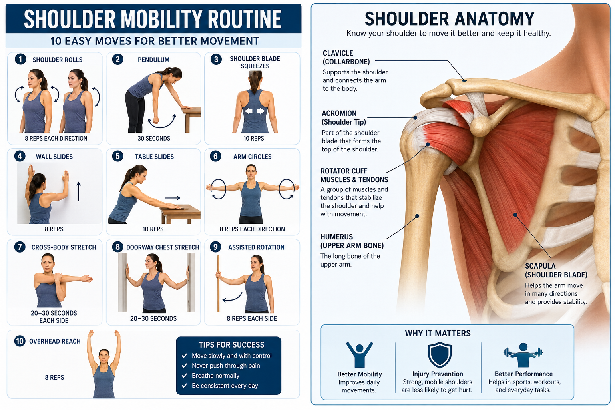
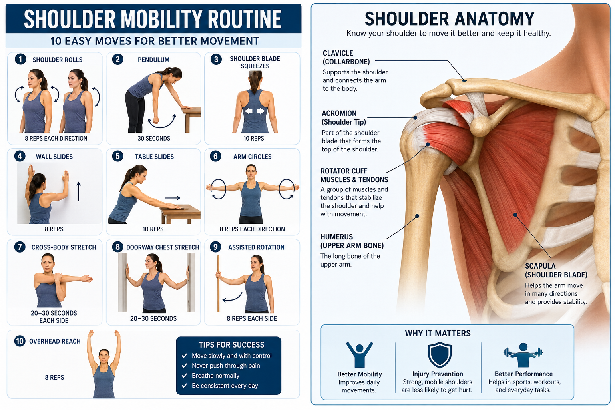
A Simple 10-Minute Plan
Here is a beginner-friendly structure:
| Exercise | Suggested amount | Main goal |
| Shoulder rolls | 8 each direction | Warm-up |
| Pendulum | 30 seconds | Gentle movement |
| Shoulder blade squeezes | 10 reps | Scapular control |
| Wall slides | 8 reps | Overhead movement |
| Table slides | 10 reps | Assisted range |
| Arm circles | 8 each direction | Controlled motion |
| Cross-body stretch | 20–30 seconds | Back shoulder |
| Doorway chest stretch | 20–30 seconds | Chest mobility |
| Assisted rotation | 8 reps | Rotation |
| Easy overhead reach | 8 reps | Functional movement |
The exact number should change based on your comfort and ability.
Shoulder Mobility Routine Warm-Up
Before starting a shoulder mobility routine, spend one or two minutes walking around or gently moving your arms.
Do not jump straight into a hard stretch.
Instead, let your body warm up naturally. You can also move your elbows, wrists, and upper back gently.
Shoulder Rolls Without Forcing
Stand tall and relax your arms.
Slowly lift your shoulders toward your ears. Then move them backward, down, and forward in a smooth circle.
Complete about eight slow circles.
Then reverse the direction.
The movement should feel easy. If your shoulder clicks without pain, that alone does not always mean there is a serious problem. Still, painful clicking deserves attention.
Pendulum Movement for a Relaxed Shoulder
The pendulum is one of the gentlest exercises in a shoulder mobility routine.
Place one hand on a table or counter. Let the other arm hang freely.
Then gently move the relaxed arm forward and backward. After that, move it side to side and make small circles.
AAOS recommends pendulum exercises as part of its shoulder conditioning program.
Keep the movement small at first.
Shoulder Blade Squeezes
Sit or stand comfortably.
Gently draw your shoulder blades toward each other. Hold for about two seconds, then relax.
Do not shrug your shoulders upward.
This simple exercise helps you become more aware of your shoulder-blade position.
Wall Slides for Overhead Control
Stand facing a wall.
Place your hands or forearms against the wall and slowly slide them upward as far as comfortable. Then return slowly.
A shoulder mobility routine can include this movement because it combines arm movement with shoulder-blade control.
Do not push through sharp pain.
Table Slides for Beginners
Table slides are useful when overhead movement feels difficult.
Sit near a table and place your hands on its surface. Slowly slide your hands forward.
As your hands travel away from you, allow your upper body to lean forward slightly.
Then return to the starting position.
Cambridge University Hospitals lists shoulder range-of-motion exercises among its physiotherapy resources.
Gentle Arm Circles
Stand with your feet comfortable and your arms relaxed.
Make small circles with one arm.
Gradually make the circles slightly larger if the movement feels comfortable.
Then change direction.
A shoulder mobility routine should use control rather than speed. Fast circles can make it harder to notice poor movement or discomfort.
Cross-Body Shoulder Stretch
Bring one arm across your chest.
Use your other hand to support the upper arm rather than pulling hard on the elbow.
Hold for around 20 to 30 seconds, then change sides.
AAOS recommends the crossover arm stretch with a 30-second hold.
You should feel a mild stretch around the back of the shoulder, not sharp pain.
Doorway Chest Stretch
Stand in a doorway with your forearms resting gently against the door frame.
Take a small step forward.
You should feel a stretch across the chest and the front of the shoulders.
Do not lean aggressively.
This can be a useful addition to a shoulder mobility routine for people who spend many hours sitting.
Gentle Shoulder Rotation
Keep your elbow close to your side and bent about 90 degrees.
Move your forearm outward slowly. Then return to the starting position.
Next, try the opposite direction if it feels comfortable.
NHS physiotherapy guidance includes assisted shoulder rotation exercises for improving movement.
Assisted Overhead Reach
Lie on your back if standing overhead movement feels difficult.
Use one arm to help the other arm move upward.
This gives you more control over the movement.
Cambridge University Hospitals describes assisted arm raising as an early shoulder movement exercise.
Behind-the-Head Reach Check
Reach one hand gently toward the back of your head.
Do not force the position.
Compare the left and right sides.
If one side moves much less than the other, note it. That does not automatically mean something is wrong, but a large or worsening difference deserves professional advice.
Behind-the-Back Reach Check
Try placing one hand behind your back.
Again, keep the movement gentle.
This position needs shoulder rotation and movement from other parts of the upper body.
A shoulder mobility routine should gradually improve comfortable movement rather than chase a perfect position.
Upper-Back Movement Matters
Your upper back can affect how your shoulder moves.
Sit tall and gently rotate your upper body from one side to the other.
Avoid twisting quickly.
The CDC’s physical activity guidance notes that stretching can help flexibility and make movements in daily life easier.
How Often Should You Do It?
You do not need a long workout.
A shoulder mobility routine lasting about 5 to 10 minutes can fit into a normal day.
You might do it after waking up, before a workout, during a work break, or in the evening.
Consistency matters more than doing one very long session.
How to Progress Slowly
Start with a small range.
Once a movement becomes easy, slowly increase the range or repetitions.
NHS physiotherapy guidance recommends gradually progressing exercises as they become easier.
Do not suddenly add heavy weights because the movement feels better.
Mobility and strength should progress together.
A Desk-Worker Example
Imagine someone who sits at a computer for eight hours.
By late afternoon, the person notices tight shoulders and difficulty reaching overhead.
Instead of doing a 30-minute workout, the person takes two short movement breaks.
Each break includes shoulder rolls, wall slides, gentle rotations, and a chest stretch.
This approach makes the shoulder mobility routine easier to maintain because it fits into the workday.
A Gym-Goer’s Example
Consider someone who lifts weights three times each week.
The person notices that one shoulder feels stiff during overhead pressing.
Instead of immediately adding more weight, the person reduces the load and adds gentle mobility work.
That is a smarter approach because pain or restricted movement should not simply be ignored.
A Real-Life Daily Task Test
Try three simple tasks:
- Reach toward a high shelf.
- Put on a shirt.
- Reach behind your head.
Notice whether one side feels very different from the other.
These everyday movements can show why a shoulder mobility routine is useful beyond the gym.
Benefits You May Notice
A regular shoulder mobility routine may help you:
- Move your arms more comfortably.
- Prepare for upper-body exercise.
- Maintain useful range of motion.
- Reduce stiffness caused by inactivity.
- Become more aware of your posture.
- Make reaching tasks feel easier.
- Build better movement habits.
However, mobility exercises do not guarantee that every shoulder problem will disappear.
What Mobility Work Cannot Do
A shoulder mobility routine cannot diagnose a torn tendon, broken bone, dislocation, nerve problem, or other medical condition.
It also cannot replace an individualized rehabilitation plan after surgery.
For that reason, use mobility exercises as general movement tools rather than a cure for every shoulder problem.
Advantages for Beginners
The biggest advantage is simplicity.
You do not need a gym.
You can use a wall, table, doorway, or chair.
Also, most movements can be performed slowly.
That makes a shoulder mobility routine easy to add to a normal day.
Possible Disadvantages
Mobility work can become a problem when people push too hard.
For example, forcing a stiff shoulder into a painful stretch may make symptoms worse.
Another issue is doing the same exercise every day without considering the cause of the stiffness.
Therefore, listen to your body and change the exercise when needed.
Expert Advice on Pain
Cambridge University Hospitals advises reducing the range or stopping an exercise when it causes pain, particularly during early shoulder exercises.
Another NHS physiotherapy resource gives a practical guide: mild discomfort during some exercises may be acceptable if it settles quickly and does not affect sleep or the following day.
Still, pain rules can differ between conditions.
When You Should Stop
Stop the shoulder mobility routine if you experience sudden severe pain, a new feeling of instability, major weakness, numbness, or another unusual symptom.
Also stop if an exercise repeatedly makes your symptoms worse.
Do not try to “push through” severe pain.
When to See a Doctor
The NHS advises seeking medical help when shoulder pain becomes worse, does not improve, or makes movement very difficult.
Urgent medical attention may be needed after an accident, when you cannot move the arm, when the shoulder changes shape, or when you have persistent numbness or pins and needles.
Shoulder Mobility Routine After Injury
After an injury, your exercise plan should depend on what happened.
A mild strain and a dislocation are not the same.
Therefore, do not copy a random online routine after trauma.
A physical therapist can assess your movement and select exercises that match your condition.
Shoulder Mobility Routine After Surgery
Post-surgery exercise requires even more care.
Your surgeon or physical therapist may limit certain movements during the early healing period.
Therefore, never assume that a normal shoulder mobility routine is safe immediately after an operation.
Follow the plan provided by your medical team.
Shoulder Mobility Routine for Older Adults
Older adults can benefit from maintaining movement for daily tasks.
However, the routine should match current ability.
Start with easy movements and use support when needed.
The CDC notes that flexibility activities can help maintain the flexibility needed for physical activity and daily life.
Shoulder Mobility Routine Before Strength Training
Before lifting, use gentle movements instead of long, aggressive stretches.
For example, you can use arm circles, wall slides, and light shoulder rotations.
Then gradually move into your workout.
The goal is to prepare your body, not tire your shoulder before strength work.
Shoulder Mobility Routine After Sitting
If you sit for hours, try a short movement break.
Stand up.
Roll your shoulders.
Move your arms overhead if comfortable.
Then perform a few controlled rotations.
This small habit can be easier to maintain than waiting until the end of the day.
Simple Equipment Choices
You can perform most beginner mobility exercises without equipment.
A wall and table are enough for many movements.
A light stick can also help with assisted movement, although you should use it carefully.
NHS physiotherapy resources describe stick-assisted shoulder movements for range of motion.
What the Research-Based Approach Looks Like
The best approach is simple: move regularly, progress gradually, and match exercise to your symptoms.
A shoulder mobility routine should therefore be comfortable enough to repeat.
The NHS also advises people with shoulder pain not to completely stop using the shoulder because inactivity can make recovery harder.
7-Day Beginner Plan
| Day | Routine | Time |
| Monday | Rolls, pendulums, wall slides | 8 min |
| Tuesday | Rolls, rotations, chest stretch | 7 min |
| Wednesday | Full routine | 10 min |
| Thursday | Gentle movement only | 5 min |
| Friday | Full routine | 10 min |
| Saturday | Mobility before activity | 8 min |
| Sunday | Easy stretches and walking | 5–10 min |
If your shoulder hurts, reduce the range or stop the exercise.
Common Mistakes to Avoid
Avoid these mistakes:
- Moving too fast.
- Forcing a stretch.
- Holding your breath.
- Shrugging during every movement.
- Ignoring sharp pain.
- Adding heavy weights too soon.
- Comparing your range with another person’s.
- Doing exercises after a serious injury without advice.
A good shoulder mobility routine should feel controlled and manageable.
Frequently Asked Questions
What is the best shoulder mobility routine for beginners?
A beginner can start with shoulder rolls, pendulums, shoulder-blade squeezes, wall slides, gentle rotations, and a cross-body stretch. Keep each movement slow and comfortable.
How long should a shoulder mobility routine take?
Five to ten minutes is enough for a simple daily session. You can use a longer session if you have a specific training or rehabilitation plan.
Can I do a shoulder mobility routine every day?
Many gentle movements can fit into daily activity, but the correct frequency depends on your condition. If an exercise causes increasing pain, reduce it or seek professional advice.
Can a shoulder mobility routine fix stiff shoulders?
It may help improve movement when stiffness comes from inactivity or manageable movement limits. However, persistent stiffness can have many causes and may need assessment.
Is a shoulder mobility routine good before lifting?
Yes, gentle mobility can help prepare your shoulders for movement. However, it should not replace a full warm-up or appropriate strength progression.
Should I stretch a painful shoulder?
It depends on the cause of the pain. Gentle movement may help some conditions, but forcing a painful shoulder can make symptoms worse.
Can office workers use a shoulder mobility routine?
Yes. Desk workers can use short movement breaks during the day. Shoulder rolls, wall slides, and gentle chest stretches are simple options.
Does a shoulder mobility routine improve posture?
It can help you become more aware of shoulder and upper-back movement. However, posture depends on your whole body and daily habits, not one exercise.
Can I do these exercises without equipment?
Yes. Most of the movements in this guide need no equipment. A wall, table, or doorway can provide useful support.
How many repetitions should beginners do?
Start with around 5 to 10 slow repetitions for movement exercises. For stretches, 20 to 30 seconds can be a reasonable starting point if comfortable.
Should mobility exercises hurt?
They should not cause sharp or severe pain. If pain increases during or after an exercise, reduce the range, stop, or seek professional guidance.
Can mobility exercises help athletes?
They can be useful as part of a wider training plan. Athletes should also work on strength, technique, recovery, and sport-specific movement.
Is shoulder clicking always bad?
No. Clicking can occur without serious injury, especially when there is no pain or loss of function. However, painful clicking, weakness, locking, or instability deserves assessment.
Can I do mobility work after a shoulder injury?
Do not assume that every exercise is safe after an injury. A doctor or physical therapist should guide you, especially after a fall, dislocation, fracture, or surgery.
Can older adults do shoulder mobility exercises?
Yes, many older adults can use gentle mobility exercises. However, the routine should match their ability and medical needs.
What if one shoulder is less mobile?
A small difference can be normal. A large, new, painful, or worsening difference should be checked by a qualified health professional.
Can I use a resistance band?
A resistance band can be useful for shoulder strengthening, but it adds resistance rather than simply mobility. Start light and learn the movement before adding load.
What is the biggest mobility mistake?
The biggest mistake is forcing movement because you think more range is always better. Controlled progress usually makes more sense than aggressive stretching.
How quickly can I improve shoulder mobility?
Results vary. Some people notice easier movement quickly, while others need several weeks of consistent work. The cause of stiffness matters greatly.
Where can I find reliable shoulder exercise information?
Useful starting points include the American Academy of Orthopaedic Surgeons, the NHS, and major hospital physiotherapy departments. AAOS provides a shoulder conditioning program, while NHS services provide exercise and safety guidance.
External Resources and Useful Addresses
For readers who want reliable medical information, these resources are stronger choices than random social-media exercise videos:
- American Academy of Orthopaedic Surgeons — OrthoInfo: AAOS OrthoInfo shoulder conditioning program
- NHS shoulder pain guidance: NHS Shoulder Pain
- Cambridge University Hospitals physiotherapy resources: Cambridge University Hospitals Shoulder Physiotherapy
- CDC physical activity guidance: CDC Physical Activity Guidelines
AAOS address: American Academy of Orthopaedic Surgeons, 9400 West Higgins Road, Rosemont, Illinois 60018, USA.
NHS: National Health Service, England, United Kingdom.
These sources can provide more detailed guidance, particularly if you have an existing shoulder problem.
The Main Takeaway
A shoulder mobility routine does not need to be complicated.
Start with gentle movements.
Then build control.
After that, slowly increase your range and add strength when appropriate.
Most importantly, do not treat pain as something you must simply defeat. Your shoulder has a large range of motion, and it needs a balance of mobility, strength, control, and recovery.
For everyday fitness, a short routine of shoulder rolls, pendulums, wall slides, rotations, shoulder-blade movements, and gentle stretches can be a practical starting point.
If pain continues, becomes severe, follows an injury, or limits normal movement, get professional advice rather than relying on an online routine alone.
In short, consistency beats complexity. A few calm minutes of useful movement can become a simple habit that supports comfortable shoulder movement throughout your day.
Health note: This guide is for general education. If you have a recent shoulder injury, surgery, severe pain, numbness, weakness, or a shoulder that looks out of place, talk with a doctor or physical therapist before exercising.