
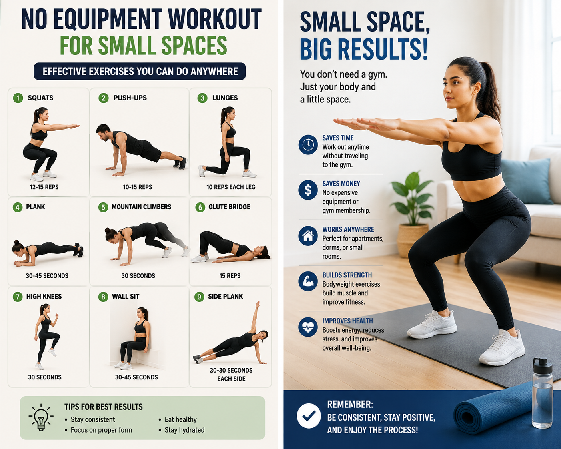
No equipment workout for small spaces; Finding time and space to exercise can feel hard. However, you do not need a large gym or expensive equipment to become fit. A no equipment workout for small spaces helps you stay active wherever you are. Whether you live in a small apartment, a college dorm, a tiny house, or simply have one free corner in your home, you can still enjoy an effective workout.
Many people believe they need treadmills, dumbbells, or weight machines to get results. In reality, your own body is one of the best fitness tools you will ever have. Bodyweight exercises improve strength, balance, flexibility, endurance, and heart health. Even better, they cost nothing.
Today, millions of people choose a no equipment workout for small spaces because it saves money, saves time, and removes excuses. You can finish a full-body workout before work, during lunch, or after dinner without leaving your home.
In this complete guide, you will learn beginner-friendly workouts, simple routines, expert tips, common mistakes, and real-life success stories. By the end, you will know exactly how to exercise safely and effectively in a very small area.
Why Choose a No Equipment Workout for Small Spaces?
A no equipment workout for small spaces removes almost every barrier to exercise.
Many people skip workouts because they think they need:
- A gym membership
- Exercise machines
- Heavy weights
- Large workout rooms
- Expensive fitness gear
However, none of these things are necessary.
Instead, you only need:
- Your body
- Comfortable clothes
- Water
- Ten to thirty minutes
- A small open floor
Even a space measuring about 6 feet by 6 feet is enough.
Because of this, more people than ever now exercise from home.
What Is a No Equipment Workout for Small Spaces?
A no equipment workout for small spaces uses bodyweight exercises instead of machines or weights.
Your muscles create resistance using your own body.
Examples include:
- Squats
- Push-ups
- Lunges
- Planks
- Mountain climbers
- Glute bridges
- High knees
- Jumping jacks
- Wall sits
- Bird dogs
These exercises work together to strengthen your entire body.
Benefits of a No Equipment Workout for Small Spaces
There are many reasons people enjoy this workout style.
Saves Money
First, you never need to buy equipment.
You save hundreds or even thousands of dollars over time.
Saves Time
Next, you eliminate travel time.
Instead of driving to the gym, you simply begin exercising.
Fits Every Home
Whether your home is large or tiny, this workout fits almost anywhere.
Even hotel rooms work well.
Builds Functional Strength
Your muscles learn movements you use every day.
For example:
- Standing
- Sitting
- Walking
- Carrying groceries
- Climbing stairs
Improves Heart Health
Many bodyweight exercises increase your heart rate.
As a result, your heart becomes stronger over time.
Burns Calories
Although equipment helps, bodyweight training also burns plenty of calories.
The exact amount depends on:
- Age
- Weight
- Workout intensity
- Workout length
Reduces Stress
Exercise releases natural chemicals that improve your mood.
Consequently, many people feel happier after only twenty minutes.
Who Can Do a No Equipment Workout for Small Spaces?
Almost everyone can enjoy these workouts.
Examples include:
- Beginners
- Busy parents
- Students
- Office workers
- Travelers
- Older adults
- Teenagers
- Remote workers
However, if you have a medical condition or injury, talk with your healthcare provider before starting a new exercise program.
Preparing Your Small Workout Area
Fortunately, you do not need much room.
Step 1
Move chairs out of the way.
Step 2
Clear loose objects from the floor.
Step 3
Wear supportive athletic shoes if needed.
Step 4
Keep water nearby.
Step 5
Turn off distractions.
Step 6
Open a window if possible.
Fresh air helps you stay comfortable.
Safety Tips Before Starting
Safety should always come first.
Remember these simple tips:
- Warm up first.
- Drink water.
- Wear comfortable clothing.
- Stop if you feel sharp pain.
- Exercise on a non-slip surface.
- Keep children away during intense movements.
- Focus on good form.
Good technique matters more than speed.
Warm-Up Before Every No Equipment Workout for Small Spaces
Never skip your warm-up.
Instead, spend five to eight minutes preparing your body.
March in Place
Time: 1 minute
Lift your knees gently.
Swing your arms naturally.
Arm Circles
Time: 30 seconds forward
30 seconds backward
This movement warms your shoulders.
Hip Circles
Rotate your hips slowly.
Complete 10 circles each direction.
Leg Swings
Hold a wall if necessary.
Swing each leg gently.
Bodyweight Squats
Perform 10 slow repetitions.
Focus on smooth movement.
Shoulder Rolls
Roll both shoulders forward and backward.
This reduces stiffness.
Basic Workout Rules
Following simple rules helps you progress safely.
Exercise Slowly
Quality always beats speed.
Breathe Naturally
Never hold your breath.
Keep Good Posture
Stand tall.
Keep your back straight.
Rest When Needed
Short breaks help maintain proper form.
Stay Consistent
Three workouts every week are better than one long workout every month.
Best Beginner Exercises for a No Equipment Workout for Small Spaces
These exercises require almost no room.
Bodyweight Squats
How to Do It
Stand with feet shoulder-width apart.
Push your hips backward.
Lower slowly.
Stand back up.
Repetitions
10–15
Muscles Worked
- Legs
- Glutes
- Core
Wall Push-Ups
Beginners often find wall push-ups easier than floor push-ups.
Steps
Place your hands on a wall.
Lean forward.
Push yourself back.
Repetitions
10–15
Glute Bridges
Lie on your back.
Bend your knees.
Lift your hips.
Pause.
Lower slowly.
Benefits
- Strong glutes
- Better posture
- Lower back support
Bird Dog
Start on your hands and knees.
Extend one arm forward.
Extend the opposite leg backward.
Hold briefly.
Switch sides.
This improves balance and core strength.
Standing Knee Raises
Lift one knee.
Lower slowly.
Alternate legs.
This exercise gently strengthens your core.
Wall Sit
Lean against a wall.
Lower until your knees form roughly a right angle.
Hold for 20–40 seconds.
Great for leg endurance.
Standing Calf Raises
Rise onto your toes.
Pause.
Lower slowly.
Repeat 15 times.
Plank
Support yourself on your forearms and toes.
Keep your body straight.
Hold for 20 seconds.
Gradually increase your time.
High Knees
March first.
Later, increase speed.
This movement improves cardiovascular fitness.
Modified Mountain Climbers
Move one knee toward your chest.
Switch slowly.
Focus on control.
Sample Beginner No Equipment Workout for Small Spaces
| Exercise | Reps |
| March in Place | 1 minute |
| Squats | 12 |
| Wall Push-Ups | 10 |
| Glute Bridges | 12 |
| Bird Dog | 10 each side |
| Standing Knee Raises | 20 |
| Wall Sit | 30 seconds |
| Plank | 20 seconds |
| High Knees | 30 seconds |
| Stretch | 5 minutes |
Repeat the circuit two or three times depending on your fitness level.
Real-Life Example
Sarah worked from home in a small apartment. She believed she needed a gym to become healthier. However, she decided to try a no equipment workout for small spaces for just twenty minutes each morning.
During the first week, she focused on squats, wall push-ups, planks, and marching in place. After one month, she noticed she had more energy throughout the day. She also found climbing stairs easier and felt less stiff after long hours at her desk.
Her story shows that even a small space and a consistent routine can lead to meaningful improvements in everyday fitness.
Common Beginner Mistakes
Many beginners make simple mistakes. Fortunately, they are easy to avoid.
Skipping the Warm-Up
Your muscles need time to prepare.
Exercising Too Fast
Instead, move slowly and focus on proper form.
Forgetting to Breathe
Steady breathing helps your body perform better.
Doing Too Much Too Soon
Start with shorter workouts and gradually increase intensity.
Ignoring Rest Days
Recovery is an important part of getting stronger.
Build a Weekly No Equipment Workout for Small Spaces Routine
A no equipment workout for small spaces works best when you follow a simple weekly plan. Instead of exercising only once in a while, aim to move your body several days each week. As a result, you will build strength, improve your fitness, and create a healthy habit.
Here is an easy weekly schedule for beginners.
| Day | Workout |
| Monday | Full Body Strength |
| Tuesday | Cardio and Core |
| Wednesday | Active Recovery and Stretching |
| Thursday | Lower Body Workout |
| Friday | Upper Body Workout |
| Saturday | Full Body Circuit |
| Sunday | Rest or Light Walking |
This schedule gives your muscles time to recover while keeping you active.
Full-Body No Equipment Workout for Small Spaces
A full-body workout trains many muscles at the same time. Therefore, it helps you burn calories and improve overall fitness.
Complete each exercise before moving to the next.
| Exercise | Reps |
| Bodyweight Squats | 15 |
| Push-Ups or Wall Push-Ups | 12 |
| Reverse Lunges | 10 each leg |
| Plank | 30 seconds |
| Glute Bridges | 15 |
| Standing Knee Raises | 20 |
| High Knees | 30 seconds |
Repeat the circuit three times.
Rest for one minute between rounds.
Upper Body No Equipment Workout for Small Spaces
Many people think they need dumbbells to build upper-body strength. However, your body weight can provide enough resistance for beginners.
Incline Push-Ups
Use a sturdy table or countertop.
Complete 10–15 repetitions.
Wall Push-Ups
Perfect for beginners.
Perform 15 repetitions.
Shoulder Taps
Start in a plank position.
Touch one shoulder with the opposite hand.
Alternate sides.
Complete 20 taps.
Arm Circles
Although this exercise looks simple, it improves shoulder endurance.
Rotate forward for 30 seconds.
Rotate backward for 30 seconds.
Plank Hold
Keep your body straight.
Hold for 30–45 seconds.
Lower Body No Equipment Workout for Small Spaces
Strong legs make daily life easier.
Additionally, leg exercises burn many calories because they work large muscles.
Squats
Complete 15 repetitions.
Reverse Lunges
Step backward instead of forward.
Complete 10 repetitions on each leg.
Glute Bridges
Perform 15 repetitions.
Pause at the top for one second.
Wall Sit
Hold for 45 seconds.
Calf Raises
Perform 20 repetitions.
Core No Equipment Workout for Small Spaces
A strong core supports your back and improves balance.
Try this simple routine.
| Exercise | Time |
| Plank | 30 seconds |
| Side Plank | 20 seconds each side |
| Bird Dog | 12 each side |
| Dead Bug | 12 each side |
| Standing Knee Raises | 20 |
Repeat twice.
Cardio No Equipment Workout for Small Spaces
Cardio keeps your heart healthy.
Fortunately, you do not need a treadmill.
March in Place
Great for beginners.
High Knees
Increase your pace gradually.
Jumping Jacks
If jumping bothers your knees, step one foot out at a time instead.
Mountain Climbers
Move slowly at first.
Increase speed as your fitness improves.
Fast Feet
Move your feet quickly while staying in one spot.
Continue for 30 seconds.
HIIT No Equipment Workout for Small Spaces
HIIT means High-Intensity Interval Training.
It alternates short bursts of hard work with brief recovery periods.
For example:
- 30 seconds work
- 20 seconds rest
Repeat five rounds.
Exercises include:
- Squats
- High Knees
- Push-Ups
- Mountain Climbers
- Plank
A HIIT workout usually lasts only 15–20 minutes.
Low-Impact No Equipment Workout for Small Spaces
Not everyone enjoys jumping.
Fortunately, low-impact workouts are gentle on the joints.
Good options include:
- Marching in place
- Standing knee lifts
- Side steps
- Wall push-ups
- Squats
- Bird Dog
- Glute Bridges
These exercises still provide excellent results.
Morning No Equipment Workout for Small Spaces
Morning exercise helps many people feel energized.
Try this routine.
- Stretch
- March in Place
- Squats
- Push-Ups
- Plank
- High Knees
Finish in about twenty minutes.
Evening No Equipment Workout for Small Spaces
An evening workout helps reduce stress after a busy day.
A gentle routine might include:
- Walking in place
- Glute Bridges
- Bird Dog
- Wall Sit
- Stretching
You will likely sleep better afterward.
Improve Balance with a No Equipment Workout for Small Spaces
Balance becomes more important as we age.
Practice these exercises.
Single-Leg Stand
Stand on one foot.
Hold for 20 seconds.
Switch legs.
Heel-to-Toe Walk
Walk in a straight line.
Place one foot directly in front of the other.
Bird Dog
Move slowly.
Keep your hips steady.
Improve Flexibility During a No Equipment Workout for Small Spaces
Flexible muscles move more comfortably.
Stretch after every workout.
Include:
- Hamstring stretch
- Calf stretch
- Shoulder stretch
- Hip stretch
- Chest stretch
- Cat-Cow stretch
Hold each stretch for about 20–30 seconds.
Improve Posture Naturally
Many people sit all day.
Consequently, poor posture becomes common.
These exercises help.
- Glute Bridges
- Bird Dog
- Plank
- Wall Angels
- Superman Hold
Practice them several times each week.
Breathing Tips During Exercise
Good breathing improves every workout.
Remember these tips.
- Breathe in while lowering.
- Breathe out while pushing.
- Never hold your breath.
- Stay relaxed.
Proper breathing reduces fatigue.
Stay Motivated Every Week
Motivation changes from day to day.
However, habits last much longer.
Try these ideas.
- Set small goals.
- Celebrate progress.
- Take photos each month.
- Keep a workout calendar.
- Exercise with family.
- Listen to music.
- Follow a routine.
Consistency beats perfection.
Real-Life Example
James lived in a studio apartment with very little room. At first, he believed he could not exercise at home. Then he started a no equipment workout for small spaces using only bodyweight exercises.
He exercised for twenty-five minutes, four days each week.
After three months:
- He lost 18 pounds.
- He could complete 30 push-ups.
- His energy improved.
- His blood pressure became healthier after following his doctor’s advice alongside regular exercise and better eating habits.
- He felt more confident.
His success came from consistency rather than expensive equipment.
Case Study – Working From Home
A small group of office employees added a 20-minute no equipment workout for small spaces to their workdays.
After eight weeks, many participants reported:
| Improvement | Observation |
| Energy | Higher during the afternoon |
| Mood | Better overall |
| Back stiffness | Reduced |
| Focus | Improved during work |
| Daily movement | Increased |
While individual results varied, the group found that regular movement helped them stay more active and productive.
Advantages of a No Equipment Workout for Small Spaces
There are many reasons to choose this workout style.
- Free to start
- Fits small homes
- Saves travel time
- Builds strength
- Improves heart health
- Burns calories
- Increases flexibility
- Helps reduce stress
- Easy for beginners
- Works for busy schedules
- Can be adjusted for different fitness levels
- Encourages long-term healthy habits
Possible Disadvantages
Although bodyweight training offers many benefits, it also has a few limits.
- It may become less challenging as you grow stronger unless you increase difficulty.
- Building maximum muscle size often requires additional resistance.
- Some exercises need modifications for people with injuries.
- Staying motivated without a gym environment can be difficult for some people.
Fortunately, you can overcome most of these challenges by changing exercise variations, increasing repetitions, slowing movement, or adding extra workout rounds.
Advanced No Equipment Workout for Small Spaces
Once you become comfortable with beginner exercises, you can safely increase the challenge. However, you do not need weights to make your workouts harder. Instead, you can change the speed, increase repetitions, or choose more difficult exercise variations.
Try this advanced full-body circuit.
| Exercise | Reps |
| Jump Squats | 15 |
| Standard Push-Ups | 15 |
| Walking Lunges | 20 |
| Mountain Climbers | 40 |
| Plank with Shoulder Taps | 30 |
| Burpees | 12 |
| High Knees | 45 seconds |
Repeat the circuit 3–4 times, depending on your fitness level.
Progressive Overload in a No Equipment Workout for Small Spaces
Progressive overload means making your workouts a little harder over time. As a result, your muscles continue to grow stronger.
You can increase difficulty by:
- Adding more repetitions
- Holding exercises longer
- Completing more workout rounds
- Reducing rest time
- Moving more slowly during each repetition
- Trying harder exercise variations
Small improvements each week often lead to big results over several months.
A 30-Day No Equipment Workout for Small Spaces Challenge
A simple challenge helps many people stay motivated.
| Week | Goal |
| Week 1 | Learn proper form and build consistency |
| Week 2 | Add one extra workout round |
| Week 3 | Increase repetitions by 5 for each exercise |
| Week 4 | Reduce rest time and improve endurance |
Remember to listen to your body. If you feel unusually tired or sore, take an extra recovery day.
Healthy Eating Supports Every Workout
Exercise works best when combined with balanced eating.
Choose foods that provide energy and nutrients, such as:
- Fresh fruit
- Vegetables
- Whole grains
- Lean protein
- Beans
- Eggs
- Yogurt
- Nuts and seeds
Also, drink water throughout the day, especially before and after exercise.
Recovery Helps You Get Stronger
Many beginners think they should exercise every day without rest. However, recovery is an important part of fitness.
Good recovery habits include:
- Sleeping 7–9 hours each night
- Drinking enough water
- Stretching after workouts
- Taking at least one rest day each week
- Eating nutritious meals
Your body becomes stronger while it recovers.
Expert Advice for Better Results
Fitness professionals often recommend focusing on consistency rather than perfection.
Here are a few practical tips:
- Start with workouts you can finish.
- Focus on correct form before increasing speed.
- Set realistic weekly goals.
- Keep a workout journal.
- Celebrate small improvements.
- Don’t compare your progress to others.
Steady progress is more sustainable than trying to do too much too soon.
Track Your Progress
Keeping track of your workouts helps you stay motivated.
Use a simple chart like this.
| Date | Workout Completed | Energy Level | Notes |
| Monday | ✔ | High | Felt strong |
| Tuesday | ✔ | Medium | Added extra squats |
| Wednesday | Stretching | High | Recovery day |
| Thursday | ✔ | High | Longer plank |
| Friday | ✔ | Medium | Improved push-ups |
| Saturday | ✔ | High | Great workout |
| Sunday | Rest | High | Ready for next week |
Common Questions About a No Equipment Workout for Small Spaces
Can I build muscle without equipment?
Yes. Beginners can gain strength and muscle using bodyweight exercises. As you progress, you may need harder exercise variations to continue improving.
How many days should I work out?
Three to five days each week is a good starting point for most people.
How long should each workout last?
Most sessions can last between 20 and 40 minutes, depending on your goals and fitness level.
Can I lose weight with bodyweight workouts?
Regular exercise, combined with healthy eating and an appropriate calorie intake, can help support weight loss.
Do I need special shoes?
Comfortable athletic shoes are helpful for many workouts, especially if you include jumping or fast movements.
Is a warm-up necessary?
Yes. A warm-up prepares your muscles and joints for exercise and may reduce the risk of injury.
Should I stretch after exercising?
Yes. Stretching after your workout can improve flexibility and reduce muscle tightness.
Can older adults do these workouts?
Many bodyweight exercises can be adapted for older adults. It’s best to choose movements that match your fitness level and speak with a healthcare provider if you have medical concerns.
What if I miss a workout?
Simply continue with your next scheduled session. Missing one workout will not erase your progress.
Is daily exercise safe?
Light movement every day is fine for many people, but harder workouts should usually be balanced with recovery days.
Can I exercise in a bedroom?
Yes. A small, clear area is often enough for many bodyweight exercises.
How much space do I really need?
About 6 feet by 6 feet is enough for most routines.
Can children join?
Many simple bodyweight exercises can be fun for families. Choose age-appropriate activities and supervise younger children.
What if I cannot do push-ups?
Start with wall push-ups or incline push-ups. As you get stronger, progress to floor push-ups.
Are these workouts good for beginners?
Yes. Most exercises can be modified to match different fitness levels.
How can I stay motivated?
Create a schedule, track your progress, and celebrate small milestones.
Do I need expensive workout clothes?
No. Comfortable clothing that allows you to move freely is enough.
Can I combine walking with these workouts?
Absolutely. Walking is an excellent way to add extra daily movement.
How soon will I notice results?
Many people notice improved energy and endurance within a few weeks. Visible changes depend on factors such as consistency, nutrition, sleep, and individual differences.
What is the biggest key to success?
The biggest key is staying consistent over time.
Conclusion
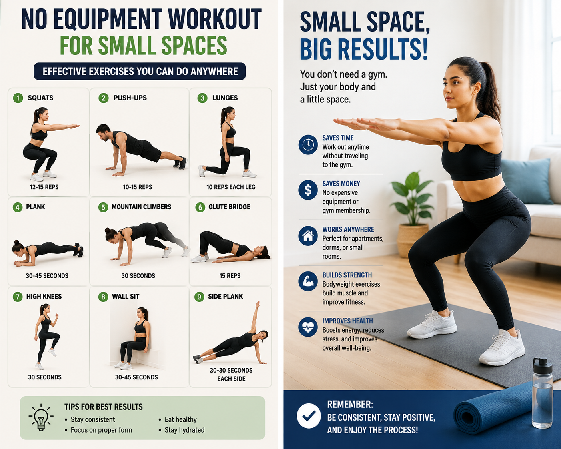
A no equipment workout for small spaces proves that you do not need a gym, expensive equipment, or a large home to improve your fitness. By using your own body weight, following a simple plan, and staying consistent, you can become stronger, healthier, and more confident.
Remember to warm up before every workout, focus on good technique, and give your body time to recover. Most importantly, keep showing up. Small daily actions often lead to meaningful long-term results.
Whether you live in a tiny apartment, a dorm room, or simply have one open corner in your home, you already have enough space to begin. Start today, stay patient, and enjoy the journey toward better health.
External Resources
For additional evidence-based fitness and physical activity guidance, explore these trusted organizations:
- World Health Organization (WHO) – Physical Activity
- https://www.who.int/news-room/fact-sheets/detail/physical-activity
- Learn about global physical activity recommendations and health benefits.
- Centers for Disease Control and Prevention (CDC) – Physical Activity Basics
- https://www.cdc.gov/physicalactivity/basics/index.htm
- Covers the basics of staying active and recommended activity levels.
- American College of Sports Medicine (ACSM)
- https://www.acsm.org
- Provides evidence-based fitness guidelines, research, and exercise recommendations.
- American Heart Association – Fitness & Exercise
- https://www.heart.org/en/healthy-living/fitness
- Offers practical advice on exercise for heart health and overall wellness.
- National Institute on Aging – Exercise and Physical Activity
- https://www.nia.nih.gov/health/exercise-and-physical-activity
- Includes simple exercise guides and safety tips for adults and older adults.
- NHS (National Health Service) – Exercise
- https://www.nhs.uk/live-well/exercise/
- Features beginner-friendly fitness advice, home workouts, and activity ideas.
- Harvard T.H. Chan School of Public Health – Nutrition Source
- https://www.hsph.harvard.edu/nutritionsource/
- Provides science-based nutrition information to support healthy fitness goals.
- Mayo Clinic – Fitness
- https://www.mayoclinic.org/healthy-lifestyle/fitness
- Covers exercise planning, strength training, flexibility, and healthy habits.
- President’s Council on Sports, Fitness & Nutrition
- https://www.hhs.gov/fitness
- Offers resources to help people become more physically active and maintain a healthy lifestyle.
- MedlinePlus – Exercise and Physical Fitness
- https://medlineplus.gov/exerciseandphysicalfitness.html
- A trusted U.S. National Library of Medicine resource with fitness and exercise information.