
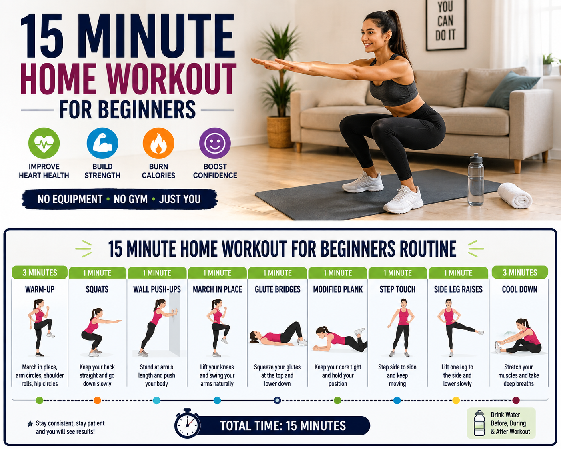
15 minute home workout for beginners; starting a healthier lifestyle does not have to be hard. 15 minute home workout for beginners is one of the easiest ways to become stronger, healthier, and more active without joining a gym. You only need a small space, comfortable clothes, and a little motivation. Most importantly, you can finish the workout before your busy day gets in the way.
Many people think they need expensive equipment or hours of exercise to see results. However, that is not true. A simple routine done every day can improve your health, increase your energy, and help you feel happier. In fact, even fifteen minutes of movement can make a big difference when you stay consistent.
This complete guide will show you how to begin safely, stay motivated, and enjoy every workout. Moreover, you will learn beginner-friendly exercises, warm-up tips, workout schedules, and healthy habits that support your fitness journey.
What Is a 15 Minute Home Workout for Beginners?
A 15 minute home workout for beginners is a short exercise routine designed for people with little or no fitness experience. It focuses on easy bodyweight exercises that improve strength, flexibility, balance, and heart health.
Because the workout lasts only fifteen minutes, almost anyone can fit it into a busy schedule. Furthermore, beginners usually feel less overwhelmed by a short routine than by a one-hour workout.
The best part is that you do not need expensive machines. Instead, your own body provides enough resistance to build strength.
Why Short Workouts Really Work
Many people believe longer workouts always give better results. However, research shows that consistent short workouts can improve fitness when performed regularly.
For example:
- They increase daily movement.
- They improve heart health.
- They burn calories.
- They reduce stress.
- They improve mood.
- They help build healthy habits.
Moreover, shorter workouts are easier to maintain over many months.
Who Should Try This Workout?
A 15 minute home workout for beginners works well for many people.
It is perfect for:
- Beginners
- Busy parents
- Office workers
- Students
- Older adults
- People returning after a long break
- Anyone wanting better health
Even if you have never exercised before, you can start slowly and improve each week.
Benefits of a 15 Minute Home Workout for Beginners
There are many reasons why beginners enjoy this simple routine.
Improves Heart Health
Your heart becomes stronger when you move every day. As a result, your blood flows better throughout your body.
Builds Stronger Muscles
Bodyweight exercises help strengthen your legs, arms, chest, shoulders, and core.
Although you start with simple movements, your muscles gradually become stronger.
Burns Calories
Fifteen minutes may seem short. However, it still helps burn calories, especially when you exercise regularly.
Improves Balance
Simple exercises teach your body better control.
Consequently, everyday activities become easier.
Increases Flexibility
Stretching during your workout helps reduce muscle tightness.
Therefore, you feel more comfortable throughout the day.
Boosts Energy
Exercise increases blood circulation.
Because of this, many people feel more energetic after finishing their workout.
Reduces Stress
Physical activity releases natural chemicals that improve your mood.
As a result, you feel calmer and happier.
Helps You Sleep Better
Regular exercise supports healthy sleep patterns.
However, avoid intense workouts right before bedtime if they keep you awake.
Improves Confidence
Every completed workout gives you a sense of achievement.
Eventually, you begin believing in yourself even more.
Why Home Workouts Are Growing in Popularity
Millions of people now choose home workouts.
Here are some reasons why:
| Benefit | Explanation |
| Saves Time | No driving to the gym |
| Saves Money | No membership fees |
| Private | Exercise without feeling judged |
| Flexible | Workout anytime |
| Family Friendly | Exercise together |
| Easy to Start | Little or no equipment |
Because home workouts remove many barriers, more people stick with them.
How Your Body Changes with Daily Exercise
Your body changes slowly, but those changes add up.
Week One
- Better mood
- Slightly more energy
- Improved circulation
Week Two
- Exercises become easier.
- Your breathing improves.
- Muscles begin adapting.
Week Four
- Better endurance
- Improved balance
- Increased confidence
Two Months
- Stronger muscles
- Better posture
- Healthier heart
- More daily energy
Consistency matters much more than perfection.
What You Need Before You Start
One great thing about a 15 minute home workout for beginners is its simplicity.
You only need:
- Comfortable clothing
- Athletic shoes
- Water bottle
- Small towel
- Exercise mat (optional)
That is enough to begin.
Choosing the Right Workout Space
Pick a place where you can move safely.
Look for:
- Good lighting
- Fresh air
- Flat floor
- Enough room to stretch
- Quiet surroundings
Even a small bedroom or living room can work well.
Wearing Comfortable Workout Clothes
Your clothes should help you move freely.
Choose:
- Breathable fabric
- Comfortable shorts or leggings
- T-shirt
- Supportive athletic shoes
Avoid clothing that feels tight or uncomfortable.
Simple Equipment That Helps
Although equipment is optional, a few inexpensive items can make workouts more enjoyable.
Examples include:
- Resistance bands
- Yoga mat
- Light dumbbells
- Jump rope
- Water bottle
Remember, bodyweight exercises alone are enough for beginners.
Safety Tips Before Exercising
Safety should always come first.
Follow these tips:
- Warm up first.
- Drink water.
- Listen to your body.
- Stop if you feel sharp pain.
- Use good form.
- Exercise on a stable surface.
- Start slowly.
If you have a medical condition, speak with your healthcare provider before starting a new exercise program.
Easy Warm-Up Routine
A warm-up prepares your body for movement.
Spend about three minutes doing these exercises.
March in Place
Time: 30 seconds
Lift your knees gently while swinging your arms.
Arm Circles
Time: 30 seconds
Move your arms in slow circles.
Then reverse direction.
Shoulder Rolls
Time: 30 seconds
Roll your shoulders forward.
Next, roll them backward.
Hip Circles
Time: 30 seconds
Place your hands on your hips.
Make slow circles.
Leg Swings
Time: 30 seconds
Swing each leg gently.
This helps loosen your hips.
Light Squats
Time: 30 seconds
Perform slow, shallow squats.
Now your body is ready.
Common Beginner Mistakes
Everyone makes mistakes at first.
Fortunately, they are easy to avoid.
Doing Too Much Too Soon
Many beginners try difficult workouts immediately.
Instead, increase intensity gradually.
Skipping Warm-Ups
Cold muscles are more likely to become sore.
Always warm up first.
Comparing Yourself to Others
Your journey is unique.
Focus on your own progress.
Ignoring Proper Form
Good form prevents injuries.
Quality always beats speed.
Missing Workout Days Often
Missing one day is normal.
However, do your best to return the next day.
Setting Realistic Fitness Goals
Good goals keep you motivated.
Examples include:
- Exercise three times this week.
- Finish every workout.
- Walk more every day.
- Drink more water.
- Sleep eight hours.
Small goals create big success over time.
Preparing Your Mind for Success
Your mindset matters as much as your muscles.
Remember these simple ideas:
- Every workout counts.
- Progress takes time.
- Small steps lead to big results.
- Stay patient.
- Celebrate every improvement.
Most importantly, enjoy the journey.
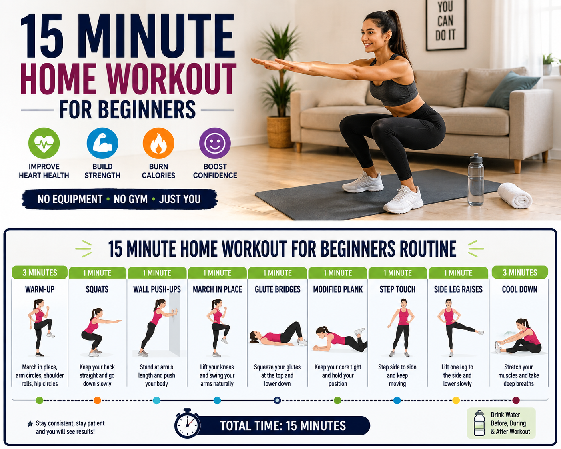
The Complete 15 Minute Home Workout for Beginners Routine
This workout uses only your body weight. Therefore, you can do it almost anywhere.
| Exercise | Time |
| Warm-Up | 3 Minutes |
| Squats | 1 Minute |
| Wall Push-Ups | 1 Minute |
| March in Place | 1 Minute |
| Glute Bridges | 1 Minute |
| Standing Knee Raises | 1 Minute |
| Bird Dog | 1 Minute |
| Modified Plank | 1 Minute |
| Step Touch | 1 Minute |
| Standing Side Leg Raises | 1 Minute |
| Cool Down | 3 Minutes |
The full routine takes about 15 minutes. Moreover, every exercise is beginner-friendly.
Squats Build Strong Legs
Squats are one of the best exercises in a 15 minute home workout for beginners.
How to Do Squats
- Stand with your feet shoulder-width apart.
- Keep your chest up.
- Bend your knees.
- Push your hips back.
- Lower slowly.
- Stand back up.
Benefits
- Stronger legs
- Better balance
- Improved posture
- Easier daily movement
Beginner Tip
Only squat as low as feels comfortable.
Wall Push-Ups Strengthen Your Upper Body
Wall push-ups are much easier than floor push-ups.
Steps
- Stand facing a wall.
- Place your hands on the wall.
- Bend your elbows slowly.
- Push yourself back.
Muscles Worked
- Chest
- Shoulders
- Arms
- Core
Furthermore, wall push-ups reduce pressure on your joints.
March in Place Improves Heart Health
Marching in place is simple, but it works well.
How to Do It
- Lift one knee.
- Swing your arms.
- Keep moving steadily.
- Breathe normally.
This exercise increases your heart rate without putting too much stress on your body.
Glute Bridges Support Your Lower Body
Glute bridges help strengthen your hips and lower back.
Instructions
- Lie on your back.
- Bend your knees.
- Keep your feet flat.
- Lift your hips.
- Hold for two seconds.
- Lower slowly.
Benefits
- Strong hips
- Better posture
- Reduced lower back discomfort
- Improved balance
Standing Knee Raises Improve Balance
Standing knee raises are easy for beginners.
Steps
- Stand tall.
- Lift one knee.
- Lower it slowly.
- Repeat with the other leg.
Because this exercise works your core, it also improves stability.
Bird Dog Builds Core Strength
Bird Dog is gentle but very effective.
Instructions
- Get on your hands and knees.
- Extend one arm.
- Extend the opposite leg.
- Hold for two seconds.
- Return.
- Switch sides.
Benefits
- Better balance
- Stronger core
- Better coordination
Modified Plank Builds Stability
A modified plank is perfect for a 15 minute home workout for beginners.
Steps
- Rest on your knees and forearms.
- Keep your back straight.
- Tighten your stomach muscles.
- Hold for 20–30 seconds.
Tips
Do not hold your breath.
Instead, breathe slowly.
Step Touch Keeps You Moving
Step touch is fun and easy.
Instructions
- Step right.
- Bring your left foot in.
- Step left.
- Bring your right foot in.
Swing your arms naturally.
This movement helps improve coordination.
Standing Side Leg Raises Strengthen Your Hips
Strong hips improve balance.
How to Perform
- Stand tall.
- Lift one leg to the side.
- Lower slowly.
- Repeat.
Avoid leaning your body.
Cool Down After Every Workout
Cooling down helps your body recover.
Spend three minutes stretching.
Include:
- Hamstring stretch
- Quad stretch
- Shoulder stretch
- Chest stretch
- Deep breathing
As a result, your muscles feel less tight.
Weekly 15 Minute Home Workout for Beginners Schedule
| Day | Activity |
| Monday | Full Workout |
| Tuesday | Walk 20 Minutes |
| Wednesday | Full Workout |
| Thursday | Gentle Stretching |
| Friday | Full Workout |
| Saturday | Easy Walk |
| Sunday | Rest |
This schedule helps beginners stay active without overtraining.
How Many Calories Can You Burn?
Calories burned depend on your:
- Weight
- Age
- Fitness level
- Workout intensity
Estimated Calories
| Body Weight | Calories in 15 Minutes |
| 120 lbs | 55–75 |
| 150 lbs | 70–90 |
| 180 lbs | 80–105 |
| 220 lbs | 95–120 |
Remember, healthy eating also plays a major role in reaching your fitness goals.
Best Time of Day to Exercise
There is no perfect time for everyone.
Morning
Advantages
- More energy
- Builds routine
- Starts the day well
Afternoon
Advantages
- Muscles feel warmer
- Often better performance
Evening
Advantages
- Great stress relief
- Fits many work schedules
The best time is the one you can follow consistently.
How to Stay Motivated
Staying motivated can be challenging. However, a few simple habits can help.
- Set small goals.
- Mark workouts on a calendar.
- Celebrate progress.
- Listen to upbeat music.
- Exercise with a friend.
- Track improvements.
Consistency beats perfection every time.
Real-Life Example
Sarah, a 39-year-old office worker, wanted to become more active. She did not have time for long gym sessions, so she chose a 15 minute home workout for beginners every weekday.
During her first week, she focused on learning proper form. Although the exercises felt challenging at first, she stayed consistent.
After one month:
- She had more daily energy.
- She climbed stairs without feeling tired.
- Her posture improved.
- She slept better.
- She felt more confident.
Her success came from doing short workouts regularly instead of chasing quick results.
Case Study: Small Steps Led to Big Results
Background
James, age 52, worked from home and rarely exercised. He decided to follow a 15 minute home workout for beginners program five days a week.
Month 1
- Learned correct exercise form
- Improved flexibility
- Reduced stiffness
Month 2
- Lost 6 pounds through exercise and healthier eating
- Walked longer without fatigue
- Improved balance
Month 3
- Increased strength
- Lower resting heart rate
- Better confidence
- Continued exercising because the routine fit his schedule
Lesson: Short, consistent workouts can produce meaningful improvements when paired with healthy habits.
Advantages of a 15 Minute Home Workout for Beginners
| Advantage | Why It Matters |
| Saves Time | Fits busy schedules |
| Costs Less | No gym membership required |
| Beginner-Friendly | Easy to learn |
| Improves Strength | Uses bodyweight effectively |
| Supports Heart Health | Encourages regular movement |
| Increases Energy | Helps you feel more active |
| Builds Confidence | Small wins keep you motivated |
| Flexible | Exercise almost anywhere |
Disadvantages of a 15 Minute Home Workout for Beginners
Although this routine has many benefits, it also has a few limitations.
- Progress may slow if you never increase the challenge.
- Some people prefer the social atmosphere of a gym.
- Home distractions can interrupt your workout.
- Limited equipment may reduce exercise variety over time.
- Beginners may need guidance to maintain proper form.
You can overcome these challenges by gradually increasing difficulty, following a structured plan, and focusing on good technique.
Expert Advice for Long-Term Success
Fitness professionals often recommend these simple strategies:
- Start slowly and focus on correct form.
- Warm up before every session.
- Cool down after exercising.
- Drink enough water throughout the day.
- Eat balanced meals with protein, fruits, vegetables, whole grains, and healthy fats.
- Sleep 7–9 hours each night to support recovery.
- Increase intensity only when the current routine feels comfortable.
- Stay patient, because lasting fitness is built over time.
Health authorities also recommend adults include regular physical activity each week for overall health and well-being.
Eat Healthy to Support Your 15 Minute Home Workout for Beginners
Exercise is only one part of a healthy lifestyle. Food gives your body the energy it needs to move, recover, and grow stronger.
Choose simple, healthy foods such as:
- Fresh fruits
- Colorful vegetables
- Whole grains
- Lean chicken or fish
- Eggs
- Beans
- Nuts and seeds
- Low-fat dairy or dairy alternatives
Also, try to limit sugary drinks, candy, and highly processed snacks. Small changes each day can make a big difference over time.
Drink Enough Water Every Day
Water helps your body work well before, during, and after exercise.
Here are a few easy tips:
- Drink a glass of water when you wake up.
- Sip water before your workout.
- Take small drinks if you feel thirsty during exercise.
- Drink water after finishing your routine.
If you exercise in hot weather, you may need more water than usual.
Why Rest Days Matter
Many beginners think they should work out every day without a break. However, your body needs time to recover.
Rest days help:
- Repair muscles
- Reduce soreness
- Prevent injuries
- Improve energy
- Keep you motivated
A gentle walk or light stretching is a great way to stay active on rest days.
How to Measure Your Progress
Progress is not only about the number on a scale.
You can also track:
| Progress Indicator | What to Notice |
| Energy | Do you feel less tired? |
| Strength | Can you do more repetitions? |
| Balance | Do exercises feel easier? |
| Flexibility | Can you stretch farther? |
| Mood | Do you feel happier after workouts? |
| Endurance | Can you exercise longer without stopping? |
Keeping a simple notebook or fitness app can help you see your improvements.
Increase the Challenge Gradually
After a few weeks, your body becomes stronger. Therefore, you can slowly make your workouts a little harder.
Try these ideas:
- Add five more repetitions.
- Hold a plank for a few extra seconds.
- Walk faster during marching exercises.
- Use light dumbbells or resistance bands.
- Reduce rest time between exercises.
Increase the challenge only when you feel ready.
Common Myths About Home Workouts
Many people believe things that are simply not true.
Myth 1: You Need a Gym
Truth: A 15 minute home workout for beginners can improve your fitness without a gym.
Myth 2: You Must Exercise for Hours
Truth: Short, consistent workouts can still improve health.
Myth 3: Sweating Means Success
Truth: Everyone sweats differently. Good form and consistency matter more.
Myth 4: Beginners Should Lift Heavy Weights
Truth: Bodyweight exercises are enough for many beginners.
Myth 5: Results Happen Overnight
Truth: Healthy progress takes time and patience.
Build a Daily Fitness Habit
Good habits are easier to keep than strict rules.
Try these simple ideas:
- Exercise at the same time each day.
- Prepare your workout clothes the night before.
- Set a reminder on your phone.
- Invite a family member to join you.
- Reward yourself after reaching small goals.
The more consistent you are, the more natural your routine will become.
Beginner Workout Variations
As you gain confidence, you can change your routine to keep it interesting.
Low-Impact Version
- Wall push-ups
- Chair squats
- March in place
- Standing knee raises
- Bird dog
Cardio Version
- Step touches
- High knee marches
- Side steps
- Gentle jumping jacks (if comfortable)
Strength Version
- Squats
- Glute bridges
- Modified planks
- Wall push-ups
- Lunges (when ready)
Changing your routine can help prevent boredom while working different muscle groups.
Mistakes to Avoid as You Improve
Even after a few weeks, it is important to stay careful.
Avoid these common mistakes:
- Skipping warm-ups
- Ignoring proper form
- Exercising through sharp pain
- Forgetting to drink water
- Comparing yourself to others
- Increasing difficulty too quickly
Slow and steady progress is safer and more effective.
Your Long-Term Success Plan
A 15 minute home workout for beginners is a great starting point, but your journey does not end after a few weeks.
Here is a simple long-term plan:
Month 1
- Learn correct form.
- Build the habit.
- Complete three to five workouts each week.
Month 2
- Increase repetitions.
- Improve balance.
- Add light resistance if needed.
Month 3
- Try new exercises.
- Walk more often.
- Set a new fitness goal.
Month 6 and Beyond
- Stay consistent.
- Challenge yourself safely.
- Celebrate every milestone.
Remember, lasting fitness comes from regular effort, not perfection.
Frequently Asked Questions (FAQs)
- Is a 15 minute home workout enough for beginners?
Yes. It is enough to improve fitness, especially when you stay consistent.
- Can I lose weight with a 15 minute home workout?
Yes. Combined with healthy eating, regular exercise can support weight loss.
- Do I need equipment?
No. Most beginners can start with bodyweight exercises only.
- How many days each week should I exercise?
Aim for three to five days each week.
- Should I warm up first?
Yes. A warm-up prepares your muscles and helps reduce the risk of injury.
- Can older adults follow this workout?
Many older adults can, but they should adjust exercises as needed and consult a healthcare provider if they have medical concerns.
- What if I miss a workout?
Simply continue with your next scheduled session.
- How long before I see results?
Many people notice improved energy within a few weeks. Visible changes often take longer.
- Can I exercise every day?
You can stay active daily, but include lighter days or rest days to help your body recover.
- Should I stretch after exercising?
Yes. Stretching helps improve flexibility and reduce muscle tightness.
- Can beginners do squats safely?
Yes, when they use proper form and start slowly.
- What should I eat after a workout?
A balanced meal with protein, healthy carbohydrates, and vegetables is a good choice.
- Is walking also good exercise?
Yes. Walking is an excellent way to improve overall health.
- How do I stay motivated?
Set small goals, track your progress, and celebrate your achievements.
- Can children join this workout?
Children should follow age-appropriate physical activity under adult supervision.
- What if an exercise feels too difficult?
Choose an easier variation and improve gradually.
- Do I need expensive workout clothes?
No. Comfortable clothing and supportive shoes are enough.
- Can I listen to music while exercising?
Yes. Many people enjoy music because it makes workouts more enjoyable.
- How important is sleep?
Sleep is very important because it supports recovery and overall health.
- What is the biggest key to success?
Consistency is the biggest key. Small daily efforts lead to lasting results.
Conclusion
A 15 minute home workout for beginners proves that you do not need a gym, expensive equipment, or hours of free time to become healthier. By setting aside just fifteen minutes a day, you can build strength, improve your heart health, increase your energy, and boost your confidence.
The most important step is simply getting started. Focus on proper form, stay consistent, and make healthy choices with your food, water intake, and sleep. Over time, these small actions will become lifelong habits that support a healthier and happier life.
Remember, every workout counts. Even on busy days, fifteen minutes of movement is far better than doing nothing. Keep showing up, believe in your progress, and enjoy the journey toward better fitness.
External Resources
For more guidance on physical activity and healthy living, explore these trusted resources:
- World Health Organization (WHO) – Physical Activity
- https://www.who.int/news-room/fact-sheets/detail/physical-activity
- Learn about global physical activity recommendations and health benefits.
- Centers for Disease Control and Prevention (CDC) – Physical Activity Basics
- https://www.cdc.gov/physicalactivity/basics/index.htm
- Find beginner-friendly exercise guidance and health information.
- American Heart Association – Fitness and Exercise
- https://www.heart.org/en/healthy-living/fitness
- Explore tips for improving heart health through regular physical activity.
- American College of Sports Medicine (ACSM)
- https://www.acsm.org
- Access evidence-based fitness advice and exercise recommendations.
- National Institute on Aging – Exercise and Physical Activity
- https://www.nia.nih.gov/health/exercise-and-physical-activity
- Discover safe exercise tips for beginners and older adults.
- MedlinePlus – Exercise and Physical Fitness
- https://medlineplus.gov/exerciseandphysicalfitness.html
- Read reliable information about exercise, fitness, and healthy living.
- National Health Service (NHS) – Fitness
- https://www.nhs.uk/live-well/exercise/
- Get practical workout ideas and beginner exercise advice.
- Harvard T.H. Chan School of Public Health – The Nutrition Source
- https://www.hsph.harvard.edu/nutritionsource/
- Learn about healthy eating to support your fitness goals.
- President’s Council on Sports, Fitness & Nutrition
- https://health.gov/our-work/nutrition-physical-activity/presidents-council
- Find resources that encourage lifelong physical activity and wellness.
- ChooseMyPlate – U.S. Department of Agriculture (USDA)
- https://www.myplate.gov
- Learn how to build balanced meals that support an active lifestyle.