
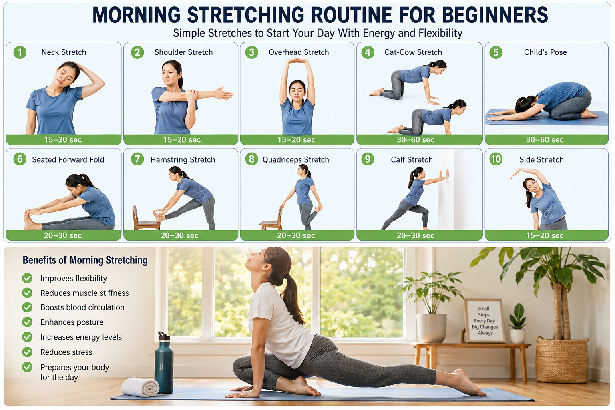
Morning stretching routine for beginners; Have you ever woken up feeling stiff, tired, or slow? If yes, you are not alone. Many people feel this way because their muscles stay still for many hours during sleep. The good news is that a morning stretching routine for beginners can help your body wake up naturally. It takes only a few minutes, yet it can make a big difference in how you feel all day.
Moreover, stretching in the morning helps your muscles loosen up, improves blood flow, and prepares your body for daily activities. You do not need expensive equipment or a gym membership. Instead, all you need is a small space, comfortable clothing, and a few minutes of your time.
This guide explains everything you need to know about creating the perfect morning stretching routine for beginners. You will discover easy stretches, common mistakes to avoid, expert advice, real-life examples, and much more. By the end of this guide, you will feel confident enough to start your own healthy morning habit.
What Is a Morning Stretching Routine for Beginners?
A morning stretching routine for beginners is a simple group of gentle movements that help your body wake up after sleeping. These stretches improve flexibility, increase blood flow, and reduce stiffness.
Unlike difficult workouts, beginner stretches are slow and comfortable. Therefore, almost anyone can do them, regardless of age or fitness level.
In addition, stretching every morning helps your muscles become more flexible over time. Even five to ten minutes each day can improve how you move and feel.
Why Morning Stretching Matters
Many people jump out of bed and immediately begin working. However, your body needs a little time to wake up properly.
Stretching each morning helps your body in several ways.
For example:
- It increases circulation.
- It loosens tight muscles.
- It improves posture.
- It reduces stiffness.
- It prepares your joints for movement.
- It helps improve focus.
- It supports healthy mobility.
Furthermore, stretching creates a peaceful start to the day. Instead of rushing, you spend a few quiet minutes caring for your body.
How Stretching Helps Your Body Wake Up
During sleep, your muscles stay relaxed for several hours. As a result, they often feel tight when you wake up.
A morning stretching routine for beginners gently tells your muscles that it is time to move again.
Stretching also increases blood flow. Consequently, more oxygen reaches your muscles and brain. This can help you feel more awake without depending only on coffee.
Additionally, stretching wakes up your nervous system. Better communication between your brain and muscles improves balance and coordination throughout the day.
Benefits of Morning Stretching Routine for Beginners
There are many reasons people choose to stretch every morning.
Here are some of the biggest benefits.
Better Flexibility
First, stretching regularly helps your muscles become longer and more flexible.
Less Morning Stiffness
Many beginners notice they move more comfortably after just one week.
Improved Posture
Good posture reduces unnecessary pressure on your neck, shoulders, and back.
Better Blood Circulation
Healthy circulation helps deliver oxygen throughout your body.
More Energy
Instead of feeling sleepy, your body becomes alert naturally.
Reduced Stress
Stretching encourages slow breathing. As a result, your mind feels calmer.
Better Balance
Flexible muscles improve coordination and stability.
Easier Daily Activities
Simple tasks like walking, climbing stairs, or bending become easier.
Who Should Follow a Morning Stretching Routine for Beginners?
Almost everyone can enjoy beginner stretching.
It works well for:
- Students
- Office workers
- Remote workers
- Parents
- Older adults
- Beginners starting fitness
- Busy professionals
- People who sit for long hours
However, anyone recovering from surgery or dealing with serious injuries should speak with a healthcare professional before starting.
When Is the Best Time to Stretch?
The best time is shortly after waking up.
However, give yourself a minute or two before beginning.
Drink a glass of water first. Then move slowly into your stretches.
Some people stretch before breakfast, while others prefer stretching after a light snack.
The most important thing is staying consistent.
Preparing for Your Morning Stretch
Before starting your morning stretching routine for beginners, prepare your space.
Choose a quiet room.
Wear comfortable clothing.
Keep your phone away if possible.
Play soft music if it helps you relax.
Most importantly, breathe deeply throughout every movement.
What You Need Before You Start
One reason people love stretching is its simplicity.
You only need:
- Comfortable clothes
- Yoga mat or carpet
- Water bottle
- Small towel
- Five to fifteen minutes
Nothing else is required.
Warm Up Before Stretching
Although stretching is gentle, warming up for one minute is still helpful.
Try:
- Marching in place
- Shoulder rolls
- Arm circles
- Gentle ankle circles
- Slow deep breathing
This prepares your muscles for stretching safely.
Morning Stretching Routine for Beginners: Easy Neck Stretch
The neck often becomes tight after sleeping.
Steps
- Sit or stand tall.
- Relax your shoulders.
- Slowly tilt your head toward your right shoulder.
- Hold for 15 seconds.
- Return to center.
- Repeat on the other side.
Never force the movement.
Instead, move gently until you feel a light stretch.
Morning Stretching Routine for Beginners: Gentle Shoulder Stretch
Shoulders carry stress every day.
Fortunately, this stretch helps release tension.
Steps
- Bring your right arm across your chest.
- Hold it with your left arm.
- Keep your shoulders relaxed.
- Hold for 20 seconds.
- Switch sides.
Breathe slowly during the stretch.
Morning Stretching Routine for Beginners: Arm Stretch
Stretching your arms improves mobility.
Steps
- Raise both arms overhead.
- Reach toward the ceiling.
- Hold for 20 seconds.
- Lower slowly.
Next, stretch each triceps muscle individually.
This helps loosen your upper body before your day begins.
Morning Stretching Routine for Beginners: Wrist Stretch
Many people spend hours typing or using smartphones.
Therefore, wrist stretches are extremely helpful.
Steps
- Extend one arm forward.
- Point your fingers downward.
- Gently pull them toward you.
- Hold for 15 seconds.
- Repeat on the other hand.
Avoid pulling too hard.
Morning Stretching Routine for Beginners: Cat-Cow Stretch
This classic movement improves spinal flexibility.
Steps
- Start on your hands and knees.
- Inhale while lifting your head and hips.
- Exhale while rounding your back.
- Repeat slowly ten times.
This movement feels especially good after sleeping.
Morning Stretching Routine for Beginners: Child’s Pose
Child’s Pose gently stretches your back and hips.
Steps
- Kneel on the floor.
- Sit back on your heels.
- Reach your arms forward.
- Rest your forehead on the floor.
- Hold for 30 seconds.
Breathe deeply.
Allow your back to relax naturally.
Morning Stretching Routine for Beginners: Seated Forward Fold
This stretch targets your hamstrings and lower back.
Steps
- Sit with your legs straight.
- Keep your back long.
- Reach toward your toes.
- Stop wherever feels comfortable.
- Hold for 20 seconds.
Remember, touching your toes is not the goal.
Gentle stretching is enough.
Morning Stretching Routine for Beginners: Standing Hamstring Stretch
Hamstrings often become tight after long periods of sitting.
Steps
- Stand tall.
- Place one heel on a low step.
- Keep your leg straight.
- Lean forward slightly.
- Hold for 20 seconds.
Repeat with the other leg.
Morning Stretching Routine for Beginners: Quadriceps Stretch
Your front thigh muscles also need attention.
Steps
- Stand near a wall.
- Hold your ankle behind you.
- Keep your knees together.
- Hold for 20 seconds.
- Change legs.
This stretch improves balance as well.
Morning Stretching Routine for Beginners: Calf Stretch
Your calves help you walk throughout the day.
Stretch them every morning.
Steps
- Stand facing a wall.
- Place one foot behind the other.
- Press your back heel into the floor.
- Lean slightly forward.
- Hold for 20 seconds.
Switch sides.
Common Beginner Mistakes
Many beginners make small mistakes.
Fortunately, they are easy to fix.
Avoid these habits:
- Stretching too quickly
- Holding your breath
- Bouncing during stretches
- Ignoring pain
- Skipping warm-ups
- Comparing yourself with others
- Trying advanced poses immediately
Instead, move slowly and stay consistent.
Quick Morning Stretching Routine for Beginners (10 Minutes)
| Time | Stretch |
| 1 minute | Warm-up |
| 30 seconds | Neck Stretch |
| 30 seconds | Shoulder Stretch |
| 30 seconds | Arm Stretch |
| 30 seconds | Wrist Stretch |
| 2 minutes | Cat-Cow |
| 1 minute | Child’s Pose |
| 1 minute | Seated Forward Fold |
| 1 minute | Hamstring Stretch |
| 1 minute | Quad Stretch |
| 1 minute | Calf Stretch |
Morning Stretching Routine for Beginners and Deep Breathing
Breathing is just as important as stretching. In fact, good breathing helps your muscles relax. As a result, every stretch feels smoother and more comfortable.
Follow these simple steps:
- Breathe in through your nose.
- Count to four.
- Breathe out through your mouth.
- Count to four again.
- Repeat during every stretch.
Moreover, slow breathing helps reduce stress. Therefore, you feel calmer before your busy day begins.
Morning Stretching Routine for Beginners for Better Posture
Many people spend hours sitting at a desk. Because of that, poor posture becomes a common problem.
Fortunately, stretching each morning helps your shoulders stay back and your spine stay straight.
Easy Posture Stretch
- Stand tall.
- Roll your shoulders backward.
- Lift your chest slightly.
- Keep your chin level.
- Hold for 20 seconds.
Repeat this three times.
Morning Stretching Routine for Beginners for Lower Back Comfort
Lower back tightness is common after sleeping.
However, gentle stretching can help reduce discomfort.
Knee-to-Chest Stretch
- Lie on your back.
- Pull one knee toward your chest.
- Hold for 20 seconds.
- Switch legs.
- Finally, pull both knees together.
Move slowly and never force the stretch.
Morning Stretching Routine for Beginners for Hip Flexibility
Your hips help you walk, run, and bend.
When they become tight, movement feels harder.
Butterfly Stretch
- Sit comfortably.
- Bring the soles of your feet together.
- Hold your feet.
- Let your knees move toward the floor.
- Hold for 30 seconds.
Additionally, keep your back straight while breathing slowly.
Morning Stretching Routine for Beginners to Improve Balance
Balance becomes better when your muscles become stronger and more flexible.
Single-Leg Stand
- Stand beside a chair.
- Lift one foot.
- Hold for 20 seconds.
- Switch legs.
As your balance improves, try using less support.
Morning Stretching Routine for Beginners for Tight Hips
People who sit for many hours often develop tight hips.
Therefore, this stretch feels amazing.
Low Lunge Stretch
- Step one foot forward.
- Bend your front knee.
- Keep your back leg straight.
- Push your hips gently forward.
- Hold for 20 seconds.
Repeat on both sides.
Morning Stretching Routine for Beginners for Side Body Flexibility
Your side muscles help you twist and bend.
Side Reach Stretch
- Raise both arms.
- Reach toward the ceiling.
- Lean gently to one side.
- Hold for 20 seconds.
- Repeat on the other side.
This stretch also improves posture.
Morning Stretching Routine for Beginners for Ankles
Healthy ankles improve walking and balance.
Ankle Circles
- Lift one foot.
- Rotate your ankle slowly.
- Complete ten circles.
- Change directions.
- Repeat with the other foot.
Although it looks simple, this exercise improves mobility.
Morning Stretching Routine for Beginners for Feet
Your feet work all day.
So, they deserve attention too.
Toe Stretch
- Sit comfortably.
- Spread your toes.
- Hold five seconds.
- Relax.
- Repeat ten times.
Then roll your feet gently over a tennis ball if available.
Morning Stretching Routine for Beginners for Chest Muscles
A tight chest often leads to rounded shoulders.
Doorway Stretch
- Stand in a doorway.
- Place your hands on both sides.
- Step forward gently.
- Feel the stretch across your chest.
- Hold for 20 seconds.
This stretch feels especially helpful after long computer sessions.
Morning Stretching Routine for Beginners for Upper Back
The upper back often becomes stiff overnight.
Eagle Arm Stretch
- Cross one arm over the other.
- Lift your elbows.
- Stretch between your shoulder blades.
- Hold for 20 seconds.
- Switch sides.
Morning Stretching Routine for Beginners for Full Body Mobility
Sometimes one simple movement stretches many muscles.
Standing Reach
- Stand tall.
- Raise both arms.
- Reach upward.
- Rise onto your toes.
- Hold for five seconds.
- Relax.
Repeat five times.
How Long Should Beginners Stretch?
Many beginners ask this question.
The answer is simple.
You do not need one hour.
Instead, aim for:
- 5 minutes if you are busy.
- 10 minutes for daily health.
- 15 minutes for better flexibility.
- 20 minutes if you enjoy stretching.
Consistency matters more than time.
How Often Should You Stretch?
Experts recommend stretching most days.
Ideally, stretch every morning.
However, even four or five days each week brings noticeable improvement.
Small daily habits create big results.
Morning Stretching Routine for Beginners Before Breakfast
Many people wonder whether stretching before breakfast is safe.
For most healthy adults, the answer is yes.
Because stretching is gentle, it usually does not require eating first.
However, if you feel dizzy, eat a light snack before beginning.
Morning Stretching Routine for Beginners After Drinking Water
Your body loses water while sleeping.
Therefore, drink one glass of water before stretching.
Proper hydration helps muscles work better.
Additionally, drinking water improves your energy.
Morning Stretching Routine for Beginners for Office Workers
Office workers spend many hours sitting.
As a result, they often experience:
- Neck pain
- Shoulder stiffness
- Tight hips
- Lower back discomfort
Morning stretching prepares the body before sitting all day.
Even better, repeat a few stretches during lunch breaks.
Morning Stretching Routine for Beginners for Students
Students carry backpacks and sit during classes.
Because of this, stretching helps improve posture.
Simple morning stretches also improve focus before school begins.
Many students notice better concentration after stretching.
Morning Stretching Routine for Beginners for Seniors
Older adults often wake up feeling stiff.
Fortunately, gentle stretching helps improve mobility safely.
Recommended stretches include:
- Neck stretch
- Shoulder rolls
- Seated hamstring stretch
- Calf stretch
- Gentle side bends
Always move slowly and use a chair for support if needed.
Morning Stretching Routine for Beginners for Weight Loss
Stretching alone does not burn many calories.
However, it supports weight loss in several ways.
For example:
- It encourages movement.
- It improves exercise performance.
- It reduces muscle soreness.
- It builds healthy habits.
Therefore, stretching works well with walking or strength training.
Morning Stretching Routine for Beginners Before Walking
Walking becomes easier after stretching.
Try these stretches first:
- Calf stretch
- Hamstring stretch
- Hip stretch
- Quad stretch
- Ankle circles
Your body will feel ready for movement.
Morning Stretching Routine for Beginners Before Running
Runners also benefit from stretching.
However, begin with gentle dynamic movements.
Examples include:
- Leg swings
- Arm circles
- Walking lunges
- Hip circles
These movements prepare your muscles for exercise.
Healthy Daily Habits That Improve Stretching Results
Stretching works even better when paired with healthy habits.
Try these simple ideas:
- Sleep seven to nine hours.
- Drink enough water.
- Eat healthy meals.
- Walk every day.
- Sit less often.
- Stand up every hour.
- Practice good posture.
- Wear comfortable shoes.
- Stay active.
Together, these habits improve flexibility much faster.
Real-Life Example
Sarah is a 37-year-old office worker.
Every morning, she woke up with stiff shoulders and a sore lower back.
Instead of starting an intense workout, she began a morning stretching routine for beginners lasting only ten minutes.
During the first week, she noticed less stiffness.
After one month, she moved more comfortably.
Three months later, she reported:
- Better posture
- Less neck pain
- Improved flexibility
- More energy
- Better mood
Most importantly, she enjoyed starting every day with a healthy habit.
Mini Case Study
A community wellness group encouraged 30 beginners to complete a simple morning stretching routine five days each week for eight weeks.
Results
| Improvement | Percentage of Participants |
| Less stiffness | 90% |
| Better flexibility | 87% |
| More morning energy | 84% |
| Better posture | 76% |
| Improved mood | 82% |
Although individual results varied, most participants reported feeling healthier and more comfortable in daily life.
Expert Advice
Many physical therapists and fitness professionals recommend starting with gentle stretches rather than intense workouts immediately after waking up.
Their advice includes:
- Stretch slowly.
- Never bounce.
- Breathe naturally.
- Stop if you feel sharp pain.
- Stay consistent.
- Focus on good posture.
- Stretch both sides equally.
- Increase flexibility gradually.
Remember, stretching should feel comfortable, not painful.
Signs Your Flexibility Is Improving
You may notice positive changes such as:
- Reaching your toes more easily
- Standing taller
- Less stiffness after waking
- Better balance
- Easier walking
- Less muscle tightness
- Improved posture
- Greater comfort during daily tasks
These small improvements often appear within a few weeks of regular practice.
Morning Stretching Routine for Beginners and Building a Daily Habit
Starting is easy, but staying consistent matters even more.
Fortunately, you can build a lasting habit by keeping your routine simple.
Try these ideas:
- Stretch immediately after waking up.
- Keep your yoga mat beside your bed.
- Set a daily reminder.
- Wear comfortable clothes.
- Play relaxing music.
- Track your progress in a notebook.
Even five minutes every day is better than one long session each week.
Morning Stretching Routine for Beginners and Mental Health
Stretching helps your body, but it also supports your mind.
When you move slowly and breathe deeply, your brain becomes calmer.
Many people notice:
- Less morning stress
- Better focus
- Improved mood
- More confidence
- Greater motivation
Although stretching is simple, these small mental benefits can make your day feel much better.
Morning Stretching Routine for Beginners Before a Busy Day
Busy mornings often make people skip healthy habits.
However, you do not need thirty minutes.
Instead, choose these five stretches:
- Neck stretch
- Shoulder stretch
- Cat-Cow
- Hamstring stretch
- Calf stretch
This routine takes about five minutes.
Morning Stretching Routine for Beginners on Rest Days
Rest days are perfect for stretching.
Although your muscles recover from exercise, gentle stretching keeps them flexible.
Therefore, many athletes include stretching on recovery days.
Morning Stretching Routine for Beginners During Cold Weather
Cold mornings often make muscles tighter.
Because of this, warm up for two or three minutes before stretching.
Try:
- Marching in place
- Arm circles
- Shoulder rolls
- Gentle walking
After warming up, stretching feels much easier.
Morning Stretching Routine for Beginners During Summer
Hot weather changes your routine too.
Drink water before stretching.
Also, choose a cool room if possible.
Most importantly, avoid stretching under direct sunlight.
Morning Stretching Routine for Beginners While Traveling
Travel often means long hours sitting in cars or airplanes.
As a result, muscles become stiff.
Fortunately, you can stretch almost anywhere.
Simple travel stretches include:
- Neck stretch
- Shoulder rolls
- Standing side stretch
- Calf stretch
- Hamstring stretch
These movements require very little space.
Morning Stretching Routine for Beginners at Home
Home is one of the best places to stretch.
You need only:
- Comfortable clothing
- A yoga mat or carpet
- A water bottle
- A quiet corner
No expensive equipment is necessary.
Morning Stretching Routine for Beginners at the Office
If you work long hours, stretch during short breaks.
For example:
- Roll your shoulders.
- Stretch your wrists.
- Stand and reach overhead.
- Walk for two minutes.
- Stretch your calves.
These small breaks reduce stiffness throughout the day.
Morning Stretching Routine for Beginners and Healthy Sleep
Interestingly, morning stretching often improves nighttime sleep.
Because your body moves regularly, muscles relax more naturally later in the day.
Additionally, people who exercise gently often develop healthier daily routines.
Morning Stretching Routine for Beginners and Healthy Aging
Flexibility becomes more important as we grow older.
Daily stretching helps maintain:
- Better balance
- Easier walking
- Stronger posture
- Greater independence
- Better joint movement
Therefore, stretching is valuable at every age.
Morning Stretching Routine for Beginners and Injury Prevention
Stretching cannot prevent every injury.
However, flexible muscles move more comfortably during daily activities.
Always remember:
- Warm up first.
- Stretch gently.
- Never bounce.
- Stop if pain appears.
These habits improve safety.
Morning Stretching Routine for Beginners and Better Flexibility
Flexibility improves slowly.
Many beginners expect quick results.
However, real progress comes from patience.
You may notice:
- Week 1: Less stiffness
- Week 2: Easier movement
- Week 4: Better flexibility
- Month 2: Improved posture
- Month 3: Stretching feels natural
Consistency always wins.
Common Stretching Myths
Many myths confuse beginners.
Let’s clear them up.
Myth 1
Stretching should hurt.
Truth: A gentle stretch is enough.
Myth 2
Long sessions work best.
Truth: Short daily sessions often produce better results.
Myth 3
Older adults should avoid stretching.
Truth: Gentle stretching benefits people of every age.
Myth 4
Flexible people do not need stretching.
Truth: Everyone benefits from regular mobility work.
Myth 5
Stretching replaces exercise.
Truth: Stretching supports exercise but does not replace it.
Advantages of a Morning Stretching Routine for Beginners
Daily stretching offers many benefits.
Advantages
- Improves flexibility
- Boosts circulation
- Increases energy
- Reduces stiffness
- Improves posture
- Supports balance
- Helps reduce stress
- Encourages healthy habits
- Improves movement
- Requires no equipment
- Saves money
- Fits into busy schedules
- Suitable for beginners
- Easy to learn
- Can be done almost anywhere
Disadvantages of a Morning Stretching Routine for Beginners
Although stretching is very safe, there are a few limitations.
Disadvantages
- Results require consistency.
- Stretching alone does not build large muscles.
- It burns few calories.
- Poor technique may cause discomfort.
- Serious injuries require medical guidance.
Fortunately, most disadvantages disappear when stretching correctly.
Weekly Morning Stretching Plan
| Day | Main Focus |
| Monday | Neck and shoulders |
| Tuesday | Back and hips |
| Wednesday | Legs |
| Thursday | Full body |
| Friday | Flexibility |
| Saturday | Balance and posture |
| Sunday | Recovery stretching |
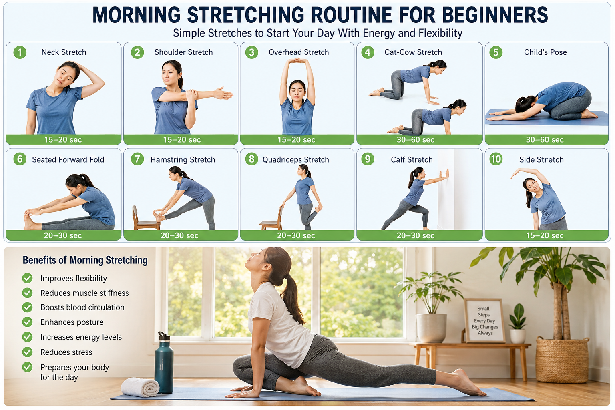
Stretch Comparison Table
| Stretch | Main Muscle | Difficulty | Time |
| Neck Stretch | Neck | Easy | 20 sec |
| Shoulder Stretch | Shoulders | Easy | 20 sec |
| Cat-Cow | Spine | Easy | 1 min |
| Child’s Pose | Back | Easy | 30 sec |
| Hamstring Stretch | Legs | Easy | 20 sec |
| Quad Stretch | Front thighs | Easy | 20 sec |
| Calf Stretch | Lower legs | Easy | 20 sec |
| Butterfly Stretch | Hips | Easy | 30 sec |
| Side Stretch | Core | Easy | 20 sec |
| Wrist Stretch | Wrists | Easy | 20 sec |
Frequently Asked Questions
- How long should beginners stretch every morning?
Five to fifteen minutes is enough.
- Can I stretch every day?
Yes. Daily stretching is safe for most healthy people.
- Should stretching hurt?
No. You should only feel gentle tension.
- Is stretching before breakfast okay?
Yes, if you feel comfortable.
- Can stretching improve posture?
Yes. Regular stretching supports better posture.
- Does stretching burn fat?
Not much. However, it supports an active lifestyle.
- Can seniors follow this routine?
Yes, with gentle movements.
- What should I wear?
Comfortable clothing that allows movement.
- Do I need equipment?
No. A yoga mat is optional.
- Can children stretch too?
Yes, with age-appropriate supervision.
- Should I breathe during stretches?
Yes. Slow breathing helps muscles relax.
- How long before I notice results?
Many people notice improvement within two to four weeks.
- What if I miss one day?
Simply continue the next day.
- Should I stretch after workouts too?
Yes. Stretching after exercise also helps flexibility.
- Is morning better than evening?
Both work well. Morning helps prepare your body for the day.
- Can stretching reduce stiffness?
Yes. Regular stretching often reduces morning stiffness.
- Is stretching safe for beginners?
Yes, when done gently.
- What if I feel pain?
Stop immediately and seek medical advice if pain continues.
- Can stretching improve balance?
Yes. Flexible muscles support better balance.
- What is the biggest secret to success?
Consistency.
Trusted External Resources
For more evidence-based information, visit these trusted organizations:
- American College of Sports Medicine (ACSM)
https://www.acsm.org/
Evidence-based guidance on exercise, stretching, flexibility, and fitness. - Centers for Disease Control and Prevention (CDC) – Physical Activity Basics
https://www.cdc.gov/physical-activity/index.html
Official recommendations for physical activity and healthy movement. - World Health Organization (WHO) – Physical Activity
https://www.who.int/news-room/fact-sheets/detail/physical-activity
Global recommendations for physical activity and its health benefits. - National Institute on Aging (NIA) – Exercise and Physical Activity
https://www.nia.nih.gov/health/exercise-and-physical-activity
Easy-to-follow exercise and stretching advice, especially for older adults. - American Heart Association – Fitness and Physical Activity
https://www.heart.org/en/healthy-living/fitness
Resources on staying active for heart health and overall wellness. - Harvard Health Publishing – Exercise & Fitness
https://www.health.harvard.edu/topics/exercise-and-fitness
Expert articles on stretching, flexibility, posture, and exercise. - Mayo Clinic – Exercise
https://www.mayoclinic.org/healthy-lifestyle/fitness
Reliable information on exercise, stretching, and healthy habits. - National Health Service (NHS) – Fitness
https://www.nhs.uk/live-well/exercise/
Beginner-friendly fitness advice, stretching guides, and exercise tips. - MedlinePlus – Exercise and Physical Fitness
https://medlineplus.gov/exerciseandphysicalfitness.html
Health information from the U.S. National Library of Medicine. - Johns Hopkins Medicine – Health and Wellness
https://www.hopkinsmedicine.org/health/wellness-and-prevention
Articles on mobility, exercise, flexibility, and healthy living.
Conclusion
A morning stretching routine for beginners is one of the easiest and most effective ways to start your day. It does not require expensive equipment, a gym membership, or advanced fitness skills. Instead, it simply asks for a few minutes of your time and a commitment to move your body regularly.
As you have learned throughout this guide, morning stretching can improve flexibility, reduce stiffness, support better posture, boost circulation, and help you feel more energized. In addition, it encourages healthy daily habits that can benefit both your physical and mental well-being.
Remember that progress takes time. You do not need to stretch perfectly on the first day. Instead, focus on moving gently, breathing deeply, and staying consistent. Even short daily sessions can lead to noticeable improvements after a few weeks.
Finally, make your morning stretching routine for beginners a regular part of your lifestyle. Over time, those small efforts can help you move more comfortably, feel stronger, and begin each day with greater confidence and energy.