
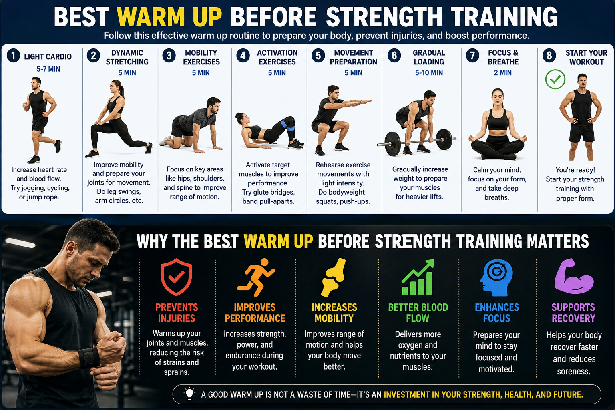
Best warm up before strength training starts with a simple idea: prepare your body before you ask it to work hard.
A good warm-up does not need to take 30 minutes. In fact, most people can prepare well in about 5 to 15 minutes. The goal is to raise body temperature, increase blood flow, move your joints, wake up the muscles you plan to use, and practice the movements you will soon perform.
The National Strength and Conditioning Association explains that a well-designed warm-up can increase blood flow, raise muscle temperature, improve joint movement, and prepare the body for training.
However, warming up does not mean tiring yourself out. You should finish your warm-up feeling ready, not exhausted.
This guide explains best warm up before strength training methods for beginners, regular gym users, and people who train at home. You will also find a complete routine, exercise examples, advantages, disadvantages, real-life examples, case studies, expert advice, a chart, common mistakes, and 20 FAQs.
Why Warm-Ups Matter Before Lifting
First, think about your muscles like a car engine.
You would not start a cold car and immediately drive it at top speed. Instead, you give the engine a little time to get ready.
Your body works in a similar way.
Before lifting weights, your heart, muscles, joints, and nervous system need time to move from rest to exercise. A gradual warm-up helps create that change.
Also, a warm-up gives you time to focus. You can check your posture, breathing, balance, and movement before adding heavy weight.
The goal is simple:
- Raise your body temperature.
- Increase blood flow.
- Move your joints.
- Practice exercise patterns.
- Wake up the muscles you need.
- Prepare your mind.
- Avoid unnecessary fatigue.
Therefore, the best warm up before strength training should prepare you without using too much energy.
What Makes a Warm-Up Effective?
A good warm-up has a clear purpose.
It should slowly increase activity. Then, it should move toward the exercises you plan to perform.
For example, if you plan to squat, you might start with easy walking or cycling. Next, you could perform bodyweight squats. Finally, you could perform several light squat sets before your working weight.
This gradual approach makes sense because the U.S. Physical Activity Guidelines note that warm-ups for muscle-strengthening activity commonly involve using lighter weights.
So, a warm-up should feel easier than your workout.
If you finish it sweating heavily and breathing very hard, you may have done too much.
The Best Warm Up Before Strength Training in Simple Terms
The best warm up before strength training is usually a short routine that moves from general activity to specific exercise preparation.
A simple structure looks like this:
Step 1: Light movement
Step 2: Dynamic mobility
Step 3: Muscle activation
Step 4: Exercise practice
Step 5: Gradual warm-up sets
For example, before a lower-body workout:
- Walk for 3 minutes.
- Perform leg swings.
- Do bodyweight squats.
- Perform glute bridges.
- Practice light squats.
- Start your working sets.
This approach is simple, quick, and easy to adjust.
Start With Five Minutes of Easy Movement
First, begin with easy movement.
You can walk, cycle, use an elliptical machine, or march in place.
Aim for about 3 to 5 minutes.
The pace should feel comfortable. You should be able to talk without struggling.
For example, if you use a treadmill, start slowly. Then, gradually increase the pace for a few minutes.
Likewise, if you use a stationary bike, begin with very light resistance.
This first step helps your body move from sitting or resting toward exercise.
Dynamic Movement Beats Standing Still
Next, use dynamic movements.
Dynamic movements take your joints through controlled ranges of motion while you keep moving. Examples include:
- Arm circles
- Leg swings
- Walking lunges
- Bodyweight squats
- Hip circles
- Shoulder rolls
- Marching
- High-knee walking
The NSCA describes dynamic warm-ups as movement-based preparation that matches the demands of the activity.
Therefore, dynamic movement can fit naturally into a strength workout.
The Best Warm Up Before Strength Training for Beginners
For beginners, the best warm up before strength training should be easy to remember.
You do not need ten different mobility drills.
Instead, start with this:
3 minutes: Easy walking
2 minutes: Arm circles, hip circles, and leg swings
2 minutes: Bodyweight squats and lunges
2 minutes: Exercise-specific practice
1–3 minutes: Light warm-up sets
That gives you about 10 to 12 minutes.
However, you can make it shorter when needed.
The most important thing is that the warm-up prepares you for the workout without making you tired.
How Long Should Your Warm-Up Take?
Most people can use about 5 to 15 minutes.
The NSCA notes that warm-ups commonly fall within a 5- to 15-minute range and often progress from general movement to specific movement.
However, there is no magic number.
A beginner may need more time to learn movement patterns. Someone who has already been walking around and moving may need less.
Also, the weather can matter.
You may need more gradual preparation when you feel cold. On the other hand, you may need less general movement in a hot environment.
Your workout also matters.
A heavy squat session needs more specific preparation than a light arm workout.
The Warm-Up Should Match Your Workout
Your warm-up should look somewhat like your workout.
If you train legs, prepare your hips, knees, ankles, and legs.
If you train shoulders, prepare your shoulders, upper back, and arms.
If you train your whole body, use movements that prepare several areas.
This idea is called specificity.
For example:
Squat day: squats, hip movement, ankle movement
Bench day: shoulder movement, upper-back movement, light pressing
Deadlift day: hip movement, hamstring movement, light hinge practice
Pull day: shoulder movement, upper-back activation, light rows
Therefore, your warm-up should have a reason behind every exercise.
The Best Warm Up Before Strength Training for Squats
The best warm up before strength training for squats should prepare your hips, knees, ankles, and core.
Try this sequence:
- 2–3 minutes of walking
- 10 ankle rocks per side
- 10 leg swings per side
- 10 bodyweight squats
- 10 glute bridges
- 5 slow squats with a pause
- 2–4 light squat sets
Then begin your workout.
Keep the movements smooth.
Do not rush.
Also, do not turn the warm-up into a high-repetition leg workout.
A Simple Bench Press Preparation
Before bench pressing, focus on your upper body.
Start with easy arm circles and shoulder rolls. Next, use light band pull-aparts if they feel comfortable.
Then, practice the bench press with an empty bar or very light weight.
For example:
- Empty bar × 10
- Light weight × 6
- Moderate warm-up weight × 3–5
- Working sets
The exact numbers depend on your strength and workout.
However, the final warm-up set should still feel easy.
Getting Ready for Deadlifts
Deadlifts require careful preparation because they use many muscles at once.
Start with easy movement.
Then, practice the hip hinge.
You can place your hands on your hips and push your hips backward while keeping your chest controlled.
Next, perform glute bridges and light hinge movements.
After that, use several lighter deadlift sets.
For example:
- Empty bar or very light weight × 8
- Light weight × 5
- Moderate weight × 3
- Heavier warm-up weight × 1–2
- Working weight
Do not rush toward your heavy set.
Preparing for Overhead Presses
Overhead pressing requires good shoulder and upper-back movement.
Start with arm circles.
Then, perform gentle shoulder blade movements.
You can also practice the press using a very light dumbbell or empty bar.
Keep your ribs controlled. Also, avoid leaning far backward.
If you feel sharp pain, stop.
A warm-up should help you discover how your body feels that day. It should never force a painful movement.
Use Warm-Up Sets as Practice
Warm-up sets are more than a way to prepare your muscles.
They are also practice.
Every light set gives you a chance to check your technique.
Ask yourself:
- Is my posture good?
- Is the weight moving smoothly?
- Can I control the lowering part?
- Is my breathing steady?
- Does anything hurt?
- Does this weight feel normal today?
This is especially helpful before heavy compound exercises.
So, the best warm up before strength training often includes several light versions of the main exercise.
How Light Should Warm-Up Weight Be?
Warm-up weight should feel easy.
There is no single percentage that works for everyone.
Instead, think about effort.
Your first set should feel very easy. Your next set can feel slightly harder. However, you should still have plenty of energy left.
For a beginner, an empty bar may be enough.
For an experienced lifter, several progressive sets may make more sense.
The key point is this: warm-up sets prepare you for working sets; they should not become working sets.
Mobility Before Strength Training
Mobility means being able to move a joint through a useful range of motion with control.
Before strength training, you may use mobility drills for:
- Ankles
- Hips
- Shoulders
- Upper back
- Wrists
However, you do not need to perform every mobility drill you know.
Choose movements that help the exercises in your workout.
For example, ankle rocks can make sense before squats if your ankles feel stiff.
Similarly, shoulder movements may help before pressing.
Dynamic Stretching vs. Static Stretching
This is one of the most common warm-up questions.
Dynamic stretching involves controlled movement.
Static stretching involves holding one position for a period of time.
Before strength training, dynamic movement often fits better because it keeps you active and prepares you for movement.
The NSCA notes that dynamic stretching has become a preferred option during many warm-up routines, while the role of static stretching before activity depends on the activity and individual needs.
That does not mean static stretching is always bad.
Instead, timing matters.
You may prefer longer static stretching after training or at another time, especially when flexibility is your main goal.
When Static Stretching May Make Sense
Static stretching can still have a place.
For example, someone with a specific flexibility need may include controlled static stretching as part of a broader plan.
However, avoid turning the warm-up into a long stretching session before heavy lifting.
If you hold many stretches for a long time, you may spend too much energy before your workout.
Therefore, use static stretching thoughtfully rather than automatically.
If a specific mobility problem affects your training, a qualified fitness professional or health professional can help you choose a safe approach.
Activate the Muscles You Need
Muscle activation sounds complicated, but the idea is simple.
You want to remind your body which muscles should help during the workout.
For lower-body training, you might use:
- Glute bridges
- Bodyweight squats
- Step-ups
- Controlled lunges
For upper-body training, you might use:
- Light rows
- Band pull-aparts
- Light external rotation
- Easy push-ups
However, activation exercises should stay easy.
They are preparation, not punishment.
The Best Warm Up Before Strength Training for Muscle Growth
The best warm up before strength training for muscle growth should save energy for your actual lifting.
This point matters.
If your workout includes several hard sets, you do not want to perform 100 jumping jacks and 50 burpees first.
Instead, use a short general warm-up followed by exercise-specific preparation.
For example:
3 minutes: Easy cardio
3 minutes: Dynamic movement
2 minutes: Activation
5 minutes: Progressive warm-up sets
Then start your main work.
This gives you preparation without stealing too much energy from your workout.
Warming Up for Heavy Strength Training
Heavy strength training needs careful preparation.
The heavier your first working set, the more useful gradual warm-up sets become.
For example, someone preparing for a heavy squat might use:
- Empty bar × 8
- Light load × 5
- Moderate load × 3
- Heavier load × 1–2
- Working weight
The exact weights should match the person.
Also, rest briefly between heavier warm-up sets.
Do not rush.
Warming Up for a Full-Body Workout
A full-body workout needs a balanced warm-up.
Try:
Minute 1–3: Easy walking or cycling
Minute 4: Arm circles and shoulder rolls
Minute 5: Hip circles and leg swings
Minute 6: Bodyweight squats
Minute 7: Lunges
Minute 8: Push-ups or wall push-ups
Minute 9: Light rows
Minute 10: First exercise warm-up sets
This routine prepares many major movement patterns.
However, adjust it based on your workout.
The Best Warm Up Before Strength Training at Home
You do not need gym equipment for the best warm up before strength training.
At home, you can use:
- Marching in place
- Arm circles
- Hip circles
- Bodyweight squats
- Reverse lunges
- Glute bridges
- Wall push-ups
- Light resistance-band movements
Then, use your first exercise with very light resistance.
For example, if you plan to use dumbbells for squats, start with no weight. Next, use light dumbbells.
This approach costs nothing and works in a small room.
A 10-Minute Complete Warm-Up Routine
Here is a simple routine you can save.
| Time | Activity | Purpose |
| 0–2 min | Easy walking | Raise body temperature |
| 2–3 min | Arm circles | Move shoulders |
| 3–4 min | Hip circles | Move hips |
| 4–5 min | Leg swings | Prepare legs |
| 5–6 min | Bodyweight squats | Practice squat |
| 6–7 min | Reverse lunges | Prepare legs |
| 7–8 min | Glute bridges | Wake up hips |
| 8–10 min | Light exercise sets | Practice workout movement |
This chart provides a starting point rather than a strict rule.
A 15-Minute Warm-Up for Heavy Sessions
For a demanding workout, use a slightly longer routine.
Minutes 1–5: Easy cardio
Minutes 5–8: Dynamic mobility
Minutes 8–10: Activation
Minutes 10–15: Progressive exercise-specific sets
For example, before heavy squats, use easy cycling, ankle rocks, hip movements, bodyweight squats, glute bridges, and several light barbell sets.
However, always watch your energy.
If the warm-up makes your legs tired, reduce the volume.
The Best Warm Up Before Strength Training When You Feel Stiff
Some days you may feel stiff.
In that situation, spend a little more time moving gently.
Start with walking.
Then use controlled joint movements.
Next, perform slow bodyweight exercises.
Finally, test the main movement with very light weight.
Do not force stiff joints into extreme positions.
Also, remember that stiffness can have many causes. Poor sleep, long periods of sitting, hard training, and stress can all affect how you feel.
If stiffness becomes pain or keeps returning, talk with an appropriate health professional.
What If You Have Only Five Minutes?
You can still prepare.
Try this:
1 minute: March in place
1 minute: Arm circles and hip circles
1 minute: Bodyweight squats and lunges
1 minute: Exercise-specific movement
1 minute: Very light warm-up set
Then start your workout.
The best warm up before strength training is not always the longest routine.
A short, focused warm-up can be better than a long routine that wastes time and energy.
What If You Are Already Warm?
Suppose you walked to the gym or spent ten minutes moving around.
You may already have some general warmth.
Therefore, you may not need a long cardio section.
Instead, move directly into mobility and exercise-specific warm-up sets.
For example, after walking to the gym, you might perform a few squats and then begin light squat sets.
Always consider how your body feels.
Common Warm-Up Mistake: Doing Too Much
One of the biggest mistakes is making the warm-up too hard.
People sometimes perform:
- Burpees
- Long runs
- Hard sprints
- High-repetition squats
- Heavy kettlebell swings
before lifting heavy weights.
That can reduce the energy available for strength work.
A warm-up should prepare you.
It should not become another workout.
Common Warm-Up Mistake: Skipping Specific Practice
Another mistake is doing only cardio.
Five minutes on a treadmill can raise your body temperature. However, it does not fully practice the movement you are about to perform.
For example, before a bench press, you still need to prepare the pressing movement.
Therefore, finish your general warm-up with exercise-specific practice.
This is one reason the best warm up before strength training usually moves from general activity toward the exact exercise.
Common Warm-Up Mistake: Using Heavy Weight Too Soon
Some lifters jump from an empty bar to a heavy load.
That creates a large change.
Instead, use gradual steps.
Start light.
Then add weight.
Next, perform fewer repetitions as the load increases.
Finally, begin your working sets.
This approach also gives you time to notice whether your technique feels good.
Common Warm-Up Mistake: Copying Someone Else
Your warm-up does not need to look like a professional athlete’s routine.
A professional may train for a specific sport.
You may simply want stronger legs, bigger muscles, better fitness, or a healthier body.
Therefore, your warm-up should match your goal.
The NSCA emphasizes that warm-ups should fit the athlete, activity, and demands of the session rather than follow one universal routine.
Advantages of a Good Warm-Up
A good warm-up offers several practical benefits.
Better movement
You can move your joints through useful ranges before adding heavy resistance.
Better focus
You get a few minutes to shift your attention toward training.
Better exercise practice
Light sets let you practice technique.
Gradual effort
Your body gets time to move from rest to harder work.
Better workout readiness
You may feel more prepared when your first working set begins.
Research and professional guidance support warm-ups as a way to prepare the body and improve readiness for physical activity.
Disadvantages of Poor Warm-Ups
A warm-up itself is usually not the problem.
The problem comes from using the wrong type or doing too much.
Possible downsides include:
- Wasting workout time
- Creating fatigue
- Making your muscles tired
- Using too many exercises
- Performing movements that do not match your workout
- Turning preparation into cardio training
Therefore, keep your routine focused.
Real-Life Example: A Beginner’s Leg Day
Imagine Sarah, a 30-year-old beginner.
She plans to perform squats, lunges, and Romanian deadlifts.
Previously, she walked into the gym and immediately started squatting.
Her first squat set felt stiff.
Now she changes her routine.
First, she walks for three minutes.
Next, she performs leg swings and hip circles.
Then, she does ten bodyweight squats and ten glute bridges.
After that, she performs several light squat sets.
Finally, she starts her working sets.
Sarah does not need a complicated routine.
Instead, she uses a simple warm-up that matches her workout.
Case Study: Preparing for a Heavy Squat
Consider another example.
Mark has trained for several years. He plans to perform heavy squats.
He does not need 15 minutes of hard cardio.
Instead, he spends a few minutes moving easily. Then, he performs mobility work that helps his squat position.
After that, he uses several progressive squat sets.
His early sets use light weight. His later warm-up sets use more weight but fewer repetitions.
This approach helps him practice his movement without wasting energy.
The lesson is simple: experienced lifters still need preparation, but their preparation can become more specific.
Case Study: Home Dumbbell Training
Now consider Mia.
She trains at home with adjustable dumbbells.
Her workout includes goblet squats, dumbbell rows, shoulder presses, and Romanian deadlifts.
Her warm-up looks like this:
- March in place.
- Perform arm circles.
- Perform hip circles.
- Do bodyweight squats.
- Do glute bridges.
- Practice light dumbbell movements.
- Start the workout.
She does not need a treadmill.
She does not need special equipment.
Therefore, the best warm up before strength training can work just as well at home as it can in a gym.
Expert Advice: Keep Warm-Ups Specific
Strength and conditioning guidance often favors warm-ups that progress from general movement to movements related to the upcoming activity.
That advice is useful for everyday gym users.
For example, if your workout begins with deadlifts, spend more warm-up time preparing the hinge pattern.
If your workout begins with bench presses, spend more time preparing the shoulders, upper back, and pressing movement.
Also, keep your effort low enough that you still feel fresh.
Expert Advice: Do Not Chase a Sweat
Sweating can happen during a warm-up, but sweating should not be your goal.
You do not need to sweat heavily to be ready.
Instead, ask:
- Do I feel warmer?
- Do I move better?
- Does my first exercise feel natural?
- Does my body feel ready?
- Do I still have energy?
If the answer is yes, your warm-up is probably doing its job.
Expert Advice: Let Your Main Lift Guide the Routine
Your first major exercise should influence the warm-up.
If you start with squats, prepare your lower body.
If you start with bench presses, prepare your upper body.
If you start with deadlifts, prepare your hip hinge and full-body movement.
The ACSM’s 2026 resistance-training guidance also emphasizes matching training choices to personal goals and keeping programs practical and sustainable.
That same idea works for warm-ups: keep them useful and personal.
How to Build Your Own Warm-Up
You can create your own routine using four questions.
Question 1: What exercise comes first?
Question 2: Which joints and muscles does it use?
Question 3: Which movement feels stiff or difficult today?
Question 4: How much preparation do I need without creating fatigue?
Then build the routine.
For example:
Main exercise: Squat
General: Walking
Mobility: Ankles and hips
Activation: Glutes
Practice: Bodyweight squats
Specific: Light barbell squats
That is enough for many people.
The Best Warm Up Before Strength Training Checklist
Use this quick checklist before your next session.
General movement
☐ I moved for several minutes.
Mobility
☐ I moved the joints needed for my workout.
Activation
☐ I used easy exercises for important muscles.
Practice
☐ I practiced my main movement.
Warm-up sets
☐ I started with light weight.
Energy
☐ I still feel fresh.
Pain
☐ I did not ignore sharp or unusual pain.
If you can check most of these boxes, you have a solid starting point.
Warm-Up Chart for Different Workouts
| Workout | General Movement | Mobility | Specific Practice |
| Squat day | Walking/bike | Ankles/hips | Light squats |
| Deadlift day | Walking/bike | Hips/hamstrings | Light hinges |
| Bench day | Easy cardio | Shoulders/upper back | Light bench |
| Shoulder day | Marching | Shoulders | Light presses |
| Back day | Easy cardio | Shoulders | Light rows |
| Full body | Walking | Whole body | Light first exercise |
Use this table as a guide, not a strict rule.
Safety Tips Before You Start
A warm-up cannot guarantee that you will never get hurt.
Therefore, use good judgment.
Start gradually.
Use controlled movements.
Do not force painful ranges of motion.
Also, do not try to prove your strength during warm-up sets.
If you have an injury, medical condition, or unusual symptoms, ask a qualified health professional for advice before changing your exercise routine.
For healthy adults, current ACSM guidance emphasizes simple, consistent resistance training rather than unnecessary complexity.
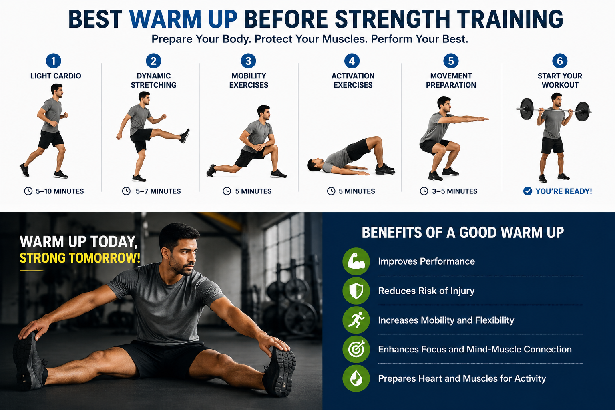
Frequently Asked Questions
What Is the Best Warm Up Before Strength Training?
The best warm up before strength training usually combines a few minutes of easy movement, dynamic mobility, simple activation exercises, and light sets of the exercise you plan to perform.
You do not need a complicated routine.
The key is to prepare without creating fatigue.
How Long Should I Warm Up Before Lifting Weights?
Most people can use about 5 to 15 minutes.
However, your warm-up may be shorter or longer depending on your workout, experience, environment, and how you feel that day. The NSCA commonly describes warm-ups in the 5- to 15-minute range.
Should I Stretch Before Strength Training?
You can use gentle dynamic stretching before strength training.
However, long static stretching is not always necessary before lifting. Dynamic movements often fit better because they prepare you while you keep moving.
Is Walking a Good Warm-Up Before Weight Training?
Yes.
Walking can raise body temperature and increase activity gradually.
However, follow it with movements that match your workout.
For example, add squats before a leg workout or light pressing before a chest workout.
Should I Warm Up Before Every Strength Workout?
Yes, a short preparation routine is a good habit.
However, the exact routine can change.
A hard lower-body session may need more preparation than a light arm workout.
Can I Warm Up Without Cardio Equipment?
Absolutely.
You can march in place, walk around your room, perform bodyweight squats, move your arms, and practice your main exercise.
Therefore, you do not need a treadmill or bike.
Should Beginners Warm Up More Than Experienced Lifters?
Beginners may benefit from more movement practice because they are still learning technique.
However, experienced lifters also need preparation before heavy work.
The difference often comes from how specific the warm-up becomes.
Should I Sweat During My Warm-Up?
No.
Sweating is not the goal.
You should feel warmer and ready, but you should still have plenty of energy.
Should Warm-Up Sets Count as Workout Sets?
Usually, you should think of warm-up sets separately from your main working sets.
Their main purpose is preparation and practice.
However, the exact training plan can vary.
How Many Warm-Up Sets Should I Do?
There is no universal number.
Light exercises may need only one or two preparation sets.
Heavy compound lifts may need several.
As the working weight increases, use fewer repetitions.
Is Dynamic Stretching Better Than Static Stretching?
For many strength workouts, dynamic movement works well as part of the warm-up.
However, static stretching can still have a role when flexibility is a specific goal.
The right choice depends on the person and activity.
Can a Warm-Up Improve Strength Performance?
A well-designed warm-up can help prepare you for physical activity and may support strength and power performance.
The NSCA notes that effective warm-ups can improve readiness and several performance-related factors.
What Should I Do Before Squats?
Start with easy movement.
Then perform ankle and hip mobility, bodyweight squats, and glute-focused movements.
Finally, perform several light squat sets before your working weight.
What Should I Do Before Deadlifts?
Prepare your hips and practice the hip hinge.
Then use glute bridges or other easy movements if they feel useful.
Finally, perform progressive deadlift sets with light weights.
What Should I Do Before Bench Press?
Move your shoulders and upper back.
Then practice pressing with very light resistance.
After that, gradually increase the weight through several warm-up sets.
Can I Do Push-Ups as a Warm-Up?
Yes, if push-ups match your workout and do not make you tired.
Use a small number of easy repetitions.
For example, five to ten controlled push-ups may work better than several hard sets.
Is Five Minutes Enough?
Sometimes, yes.
Five focused minutes can be useful when you have limited time.
However, heavy training may require more exercise-specific warm-up sets.
What Is the Biggest Warm-Up Mistake?
Doing too much is one common mistake.
A warm-up should prepare you, not exhaust you.
Therefore, keep the effort moderate and focused.
Can I Skip Warm-Up If I Feel Fine?
It is better to build a consistent preparation habit.
Even if you feel good, light movement and exercise-specific sets can help you transition into harder work.
Should I Warm Up Differently for Muscle Growth and Strength?
Yes, the warm-up can change slightly.
Heavy strength work usually needs more gradual weight increases.
A muscle-growth workout may use fewer preparation sets if the working weights are moderate.
In both cases, avoid fatigue.
What Is the Best Warm Up Before Strength Training for Home Workouts?
The best warm up before strength training at home can include marching, arm circles, hip circles, bodyweight squats, lunges, glute bridges, and light versions of your planned exercises.
You can do all of this without expensive equipment.
Final Takeaway: Build a Warm-Up You Will Actually Use
The best warm up before strength training does not need to be complicated.
Instead, it should prepare your body for the exact work ahead.
Start with a few minutes of easy movement. Next, use controlled dynamic movements. Then, activate the muscles you plan to use. Finally, practice your main exercise with light weight before moving into your working sets.
Remember these five rules:
- Start easy.
- Move dynamically.
- Match the warm-up to the workout.
- Use progressive warm-up sets.
- Finish feeling ready, not tired.
The National Strength and Conditioning Association supports the idea of moving from general preparation toward activity-specific movements, while current ACSM guidance favors practical and sustainable resistance-training habits.
Most importantly, do not chase the perfect routine.
A simple warm-up that you perform consistently is often more useful than a complicated routine that you skip.
If you train three times each week, create a warm-up that takes about 5 to 10 minutes and fits those sessions. Then adjust it when your workout changes.
Your body does not need a long speech before training.
It needs a clear signal:
We are ready to move.
External Resources
- National Strength and Conditioning Association — Dynamic Warm-Up Guide
- NSCA — Dynamic Warm-Up for Strength and Power Workouts
- American College of Sports Medicine — 2026 Resistance Training Guidelines
- U.S. Physical Activity Guidelines