
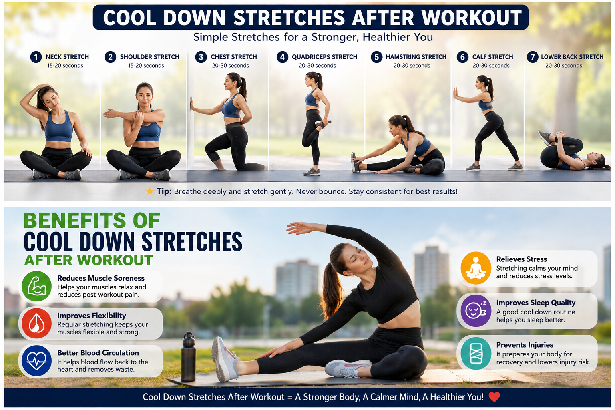
Cool down stretches after workout can be a simple way to end an exercise session with calm, controlled movement. After running, lifting weights, cycling, doing yoga, or completing a hard home workout, your body needs a short period to slow down.
Instead of stopping and sitting down right away, take a few minutes to walk slowly and breathe normally. Then, add gentle stretches that target the muscles you used most.
The good news is that you do not need fancy equipment. You can perform many stretches in your bedroom, living room, gym, park, or driveway.
The NHS recommends gentle stretching after exercise to help you gradually relax, improve flexibility, and slow your heart rate.
However, stretching should feel gentle. You should notice a mild pulling feeling, not sharp pain. The American Heart Association also advises slow, smooth stretching and normal breathing instead of bouncing or forcing a position.
This guide explains 45 useful ideas, mistakes, examples, benefits, limits, expert advice, and simple routines. Therefore, you can build a cool-down plan that fits your workout and fitness level.
Cool Down Stretches After Workout Start With Slow Movement
Do not move straight from a hard workout into a deep stretch.
First, lower the intensity.
For example, if you just finished running, walk slowly for three to five minutes. If you used an exercise bike, pedal gently before stopping. After strength training, walk around the room and shake your arms and legs gently.
This first step gives your body time to move from hard exercise toward rest.
The NHS Couch to 5K program uses a five-minute cool-down walk after each run. It explains that the easy walk gives the heart rate time to return toward normal, followed by stretching.
Cool Down Stretches After Workout Should Feel Gentle
A good stretch should never feel like a contest.
Instead, move slowly until you feel a light pull in the muscle. Then stop there.
Do not push your body farther just because someone next to you can stretch farther. Everyone has a different level of flexibility.
Also, do not bounce while holding a stretch. Bouncing can make your muscles tighten and may increase injury risk. The American Heart Association recommends slow, smooth movements and says sharp or stabbing pain means you should stop.
Cool Down Stretches After Workout Help You Slow Down
A cool-down is more than stretching.
It is also a change in pace.
Your workout may have included fast movements, heavy lifting, jumping, or hard cardio. Therefore, your body may still feel active when you finish.
A few minutes of easy movement followed by gentle stretching creates a clear ending to your workout.
The American Heart Association notes that warming up and cooling down help the heart move gradually between rest and exercise.
Cool Down Stretches After Workout for the Hamstrings
Your hamstrings sit at the back of your thighs.
They work hard during running, walking, cycling, squats, lunges, and many sports.
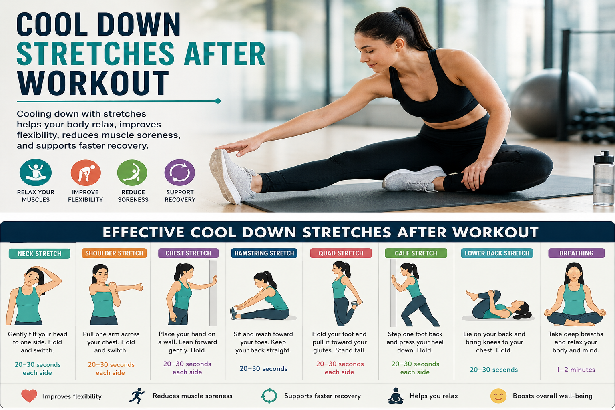
How to stretch your hamstrings
- Lie on your back.
- Bend one knee.
- Slowly raise the other leg.
- Hold behind the thigh.
- Gently bring the leg toward you.
- Keep the movement comfortable.
- Hold for about 15 to 30 seconds.
- Change sides.
The NHS includes a similar lying hamstring stretch and recommends holding it for around 15 to 20 seconds.
Cool Down Stretches After Workout for Tight Calves
Your calf muscles work every time you walk, run, jump, or push a bike pedal.
A simple wall calf stretch can help you gently lengthen them after exercise.
Stand facing a wall. Place both hands on the wall. Move one foot backward. Keep the back heel on the floor while bending the front knee slightly.
Then lean forward slowly.
You should feel the stretch in the calf of the back leg.
Hold it gently and switch sides.
Cool Down Stretches After Workout for the Front Thighs
The quadriceps sit at the front of your thighs.
They work during squats, stairs, running, cycling, and jumping.
For a standing thigh stretch, hold a wall or chair for balance. Bend one knee and bring your heel toward your buttocks. Hold your ankle gently.
Keep your knees close together.
Do not pull your foot hard.
The NHS also recommends a thigh stretch and advises keeping the knees together while gently bringing the heel toward the buttock.
Cool Down Stretches After Workout for Your Hips
Hip muscles can feel tight after sitting, running, cycling, or lower-body strength training.
A simple half-kneeling hip stretch can help.
Place one knee on a soft mat. Put the other foot in front. Keep your upper body tall. Then gently move your hips forward.
Do not arch your lower back.
Hold the position while breathing normally. Then switch sides.
If the movement causes pain, stop.
Cool Down Stretches After Workout for the Inner Thighs
The inner thighs help control your legs during walking, running, jumping, and side-to-side movement.
A seated butterfly stretch is easy for many beginners.
Sit upright. Bring the soles of your feet together. Let your knees move outward. Hold your feet or ankles gently.
Then relax your legs.
Do not push your knees toward the floor.
The NHS includes a similar inner-thigh stretch and suggests holding it for around 15 to 20 seconds.
Cool Down Stretches After Workout for Glutes
Your glutes are powerful muscles used during running, climbing stairs, squatting, jumping, and many strength exercises.
A lying figure-four stretch works well as a gentle option.
Lie on your back. Bend both knees. Place one ankle across the opposite thigh. Then gently pull the supporting leg toward your chest.
You should feel the stretch around the buttock and outer hip.
Hold, breathe, and switch sides.
Cool Down Stretches After Workout for Your Lower Back
The lower back does not always need aggressive stretching.
Instead, focus on comfortable movement.
Try lying on your back with your knees bent. Slowly let both knees move a little toward one side. Return to the middle and repeat on the other side.
Keep the movement small.
If you have back pain, an injury, numbness, weakness, or another medical concern, ask a qualified health professional which exercises are suitable for you.
Cool Down Stretches After Workout for the Upper Back
Your upper back can become tired after rowing, pull-ups, push-ups, weight training, or long periods at a desk.
Try a gentle seated upper-back stretch.
Sit tall. Reach both arms forward. Slowly round your upper back while keeping the movement comfortable.
Take a slow breath.
Then return to a tall position.
This stretch should feel easy rather than forced.
Cool Down Stretches After Workout for Your Shoulders
Shoulder stretches can be useful after upper-body workouts.
Bring one arm across your chest. Use the other arm to gently guide it closer to your body.
Keep your shoulder relaxed.
Do not pull hard.
Hold for about 15 to 30 seconds, then switch sides.
This is especially useful after exercises such as shoulder presses, lateral raises, rows, and chest presses.
Cool Down Stretches After Workout for the Chest
Chest muscles work during push-ups, bench presses, dips, and many upper-body movements.
For a simple chest stretch, stand beside a doorway. Place your forearm against the frame. Then turn your body away slowly.
Stop when you feel a gentle stretch across your chest.
Do not twist your body aggressively.
If your shoulder feels painful, choose a smaller range or skip the stretch.
Cool Down Stretches After Workout for Your Arms
Biceps and triceps may feel tight after lifting weights.
For a triceps stretch, raise one arm overhead. Bend the elbow so your hand moves toward your upper back. Use the opposite hand to guide the elbow gently.
For a biceps stretch, place your hand against a wall with the fingers pointing backward, then slowly turn away.
Keep both movements easy.
Cool Down Stretches After Workout After Running
Running places repeated work on your calves, hamstrings, quadriceps, hips, and glutes.
Therefore, your cool-down should focus on those areas.
A simple running cool-down can look like this:
- Walk slowly for 5 minutes.
- Stretch each calf for 20 seconds.
- Stretch each quadriceps for 20 seconds.
- Stretch each hamstring for 20 seconds.
- Stretch each hip for 20 seconds.
- Finish with relaxed breathing.
The NHS specifically recommends a five-minute cool-down walk after running and says stretching afterward can help muscles feel less tight the next day.
Cool Down Stretches After Workout After Leg Day
Leg day can leave your thighs and hips feeling tired.
Therefore, do not rush into deep stretches.
Start with slow walking. Then work through your calves, quadriceps, hamstrings, glutes, and hips.
If you performed heavy squats or deadlifts, keep the stretches especially gentle.
Your goal is to relax, not to set a flexibility record.
Cool Down Stretches After Workout After Strength Training
Strength workouts can affect different muscle groups depending on your exercises.
After a full-body workout, choose a few stretches instead of trying to stretch every muscle separately.
For example:
Lower body: calf, hamstring, quadriceps, hip, and glute stretches.
Upper body: chest, shoulder, triceps, and upper-back stretches.
Keep your breathing slow and steady.
Cool Down Stretches After Workout After Cycling
Cycling can make your hips, thighs, and calves work for a long time.
After your final hard effort, pedal slowly for several minutes.
Then stretch your calves, quadriceps, hamstrings, and hip flexors.
If you ride for a long time, also give your chest and upper back some attention because cyclists often hold the upper body in one position.
Cool Down Stretches After Workout After HIIT
High-intensity interval training can make your heart rate rise quickly.
Therefore, do not stop suddenly.
Walk slowly first.
Take deep but comfortable breaths. Then use gentle stretches for the muscles that worked hardest.
After HIIT, you may feel tired or shaky. If so, sit or lie down only after your breathing has settled and you feel stable.
If you feel chest pain, severe shortness of breath, faintness, or another concerning symptom, stop exercising and seek appropriate medical help.
Cool Down Stretches After Workout After Yoga
Yoga itself may already include stretching.
However, if your session was strong or fast, you can finish with a few calm poses.
Choose comfortable positions that help you relax.
For example, you could use a gentle seated forward position, a relaxed hip stretch, or a lying figure-four stretch.
Avoid forcing your body into a deeper position simply because the class is ending.
Cool Down Stretches After Workout for Beginners
Beginners often think they need a long routine.
They do not.
Start with five to ten minutes.
Walk slowly for a few minutes. Then choose four or five simple stretches.
Hold each one for around 10 to 30 seconds, depending on your comfort.
The American Heart Association recommends holding flexibility stretches for 10 to 30 seconds and starting closer to 10 seconds if you are new to stretching.
Cool Down Stretches After Workout for Older Adults
Older adults can benefit from regular flexibility work, but comfort and balance matter.
Use a wall, chair, or other stable support when needed.
Avoid quick movements.
Also, do not compare your range of motion with someone younger or more flexible.
The NHS recommends gradual progress with flexibility exercises and notes that gentle routines can support mobility.
Cool Down Stretches After Workout for Home Exercisers
You do not need a gym to cool down.
A small open space is enough.
Keep a yoga mat nearby if you like floor stretches. Otherwise, use a towel or carpet.
You can also do many standing stretches.
For example, a home routine might include calf, quadriceps, hamstring, chest, shoulder, and hip stretches.
Cool Down Stretches After Workout and Breathing
Breathing is an important part of a good cool-down.
Do not hold your breath while stretching.
Instead, breathe naturally.
Try inhaling slowly through your nose and exhaling comfortably. Let your shoulders drop as you breathe out.
The American Heart Association advises regular breathing during exercise and cool-down periods.
Cool Down Stretches After Workout: How Long Should You Stretch?
There is no single perfect number for everyone.
A short routine can still be useful.
For a basic cool-down, try:
| Part | Suggested Time |
| Slow walking | 3–5 minutes |
| Calf stretch | 15–30 seconds each side |
| Hamstring stretch | 15–30 seconds each side |
| Quadriceps stretch | 15–30 seconds each side |
| Hip stretch | 15–30 seconds each side |
| Upper-body stretch | 15–30 seconds each side |
| Relaxed breathing | 1–2 minutes |
The NHS provides a five-minute post-exercise stretching routine, while the AHA gives a 10-to-30-second range for individual flexibility stretches.
Cool Down Stretches After Workout: Static or Dynamic?
Static stretching means holding a position.
Dynamic stretching means moving through a controlled range.
After a workout, gentle static stretches often fit well because you are no longer preparing for explosive movement.
Before exercise, many people use movement-based warm-ups instead.
The AHA recommends stretching after endurance or strength exercise when flexibility work is part of the session.
Cool Down Stretches After Workout and Flexibility
Flexibility means your joints can move through a useful range of motion.
Stretching can support flexibility when you practice it regularly.
However, one long stretching session will not suddenly make you flexible.
Instead, consistency matters.
The AHA explains that flexibility exercises can help the body move and bend more easily.
Cool Down Stretches After Workout and Muscle Tightness
Many people stretch because their muscles feel tight after exercise.
A gentle stretch can feel good and may help you work on flexibility over time.
Still, tightness can have many causes.
You may have done too much exercise, changed your routine, stayed in one position for too long, or simply be adapting to a new activity.
Persistent or severe pain deserves more attention than a normal post-workout stretch.
Cool Down Stretches After Workout and Injury Prevention
Stretching is often described as an injury-prevention tool.
However, it is important not to make promises that stretching alone can prevent all injuries.
A complete exercise plan should include suitable training, gradual progression, rest, proper technique, and recovery.
The NHS says warming up can help reduce injury risk and recommends gradually increasing exercise.
Therefore, think of stretching as one part of a larger plan.
Cool Down Stretches After Workout: Five-Minute Routine
Here is a simple routine for busy days.
Minute 1: Slow walking
Walk around your room or gym.
Minute 2: Calves
Hold a wall calf stretch on each side.
Minute 3: Front thighs
Use a gentle standing quadriceps stretch.
Minute 4: Hamstrings
Use a seated or lying hamstring stretch.
Minute 5: Hips and breathing
Finish with a comfortable hip stretch and slow breathing.
This routine is short enough to use after many normal workouts.
Cool Down Stretches After Workout: Ten-Minute Routine
If you have more time, try this:
Minutes 1–3: Slow walking.
Minute 4: Calves.
Minute 5: Quadriceps.
Minute 6: Hamstrings.
Minute 7: Glutes.
Minute 8: Hip flexors.
Minute 9: Chest and shoulders.
Minute 10: Relaxed breathing.
You can adjust the routine based on your workout.
For example, after upper-body training, spend more time on your shoulders and chest.
Cool Down Stretches After Workout: Full-Body Sequence
A full-body sequence can follow this order:
- Slow walk.
- Calf stretch.
- Hamstring stretch.
- Quadriceps stretch.
- Hip stretch.
- Glute stretch.
- Inner-thigh stretch.
- Chest stretch.
- Shoulder stretch.
- Gentle breathing.
This order moves from large lower-body muscles toward the upper body.
However, you can change the order if another sequence feels more natural.
Cool Down Stretches After Workout: Common Mistakes
Several mistakes can reduce the value of a cool-down.
Mistake 1: Stopping suddenly
Give your body a few minutes to slow down.
Mistake 2: Stretching too hard
A stretch should not hurt.
Mistake 3: Bouncing
Use slow, smooth movements.
Mistake 4: Holding your breath
Keep breathing normally.
Mistake 5: Copying someone else
Your flexibility may be different.
Mistake 6: Stretching an injured area without advice
Ask a qualified professional when you have an injury or medical concern.
Cool Down Stretches After Workout: Advantages
A regular cool-down can offer several practical advantages.
- It creates a gradual transition
Your body does not have to move instantly from intense activity to complete rest.
- It supports flexibility
Regular stretching can improve your ability to move comfortably.
- It helps you relax
Slow movement and calm breathing can make the end of a workout feel less rushed.
- It is easy to follow
You need little or no equipment.
- It creates a useful habit
A consistent ending can make your workout routine feel complete.
The NHS specifically recommends post-exercise stretching as part of a cool-down routine.
Cool Down Stretches After Workout: Disadvantages and Limits
Stretching also has limits.
It takes extra time
Even five minutes may feel difficult on a busy day.
It can be uncomfortable
Some people dislike stretching, especially when they are very tired.
It can be done incorrectly
Forcing a stretch can cause pain.
It does not replace recovery
Stretching cannot replace sleep, rest, proper food, hydration, or sensible training.
It cannot fix every injury
Pain from an injury may need professional assessment.
Therefore, use stretching as one part of recovery rather than the entire recovery plan.
Cool Down Stretches After Workout: Expert Advice
The American Heart Association says the best time to perform flexibility exercises is when muscles are already warm. It also recommends slow movement, normal breathing, and avoiding painful stretching.
The NHS gives similar practical advice. Its post-exercise routine includes buttock, hamstring, inner-thigh, calf, and thigh stretches.
The NHS also advises people with injuries, medical conditions, pregnancy, or other concerns to get professional advice about suitable exercises.
So, the expert message is simple: keep it gentle, stay controlled, and listen to your body.
Cool Down Stretches After Workout: Real-Life Running Example
Consider a beginner named Alex who starts a three-day running plan.
During the first week, Alex finishes each run and immediately sits down.
After learning about cool-down habits, Alex changes the routine.
Instead of stopping suddenly, Alex walks slowly for five minutes. Then Alex performs calf, quadriceps, hamstring, and hip stretches.
This example follows the same basic structure used in the NHS Couch to 5K approach, which ends runs with a five-minute cool-down walk followed by stretching.
The lesson is not that stretching guarantees a specific result. Instead, the lesson is that a simple routine can make the end of exercise more organized.
Cool Down Stretches After Workout: Case Study From Couch to 5K
The NHS Couch to 5K program provides a useful real-world example.
The program gradually introduces running and includes a five-minute cool-down walk at the end of each run. It then recommends stretching to help the muscles recover and reduce feelings of tightness the next day.
This approach shows why a cool-down does not need to be complicated.
A beginner can simply:
- Reduce speed.
- Walk.
- Breathe.
- Stretch gently.
- Finish calmly.
That structure works well because it is easy to remember.
Cool Down Stretches After Workout: What to Drink?
Water is usually a simple choice for hydration.
If you sweat heavily or exercise for a long time, your hydration needs may be higher.
However, hydration depends on exercise length, temperature, sweat rate, and other factors.
Do not treat stretching as a replacement for proper hydration.
If you exercise outdoors in hot weather, pay attention to warning signs such as dizziness, weakness, nausea, or unusual symptoms. The American Heart Association recommends stopping activity and cooling down when signs of heat illness appear.
Cool Down Stretches After Workout: When to Stop
Stop a stretch if you feel sharp pain.
Also stop exercising if you feel unwell.
A mild pulling sensation can be normal during a gentle stretch. However, pain in a joint, sudden stabbing pain, numbness, or unusual weakness should not be ignored.
The AHA advises slow stretching and says sharp or stabbing pain is a sign that you are stretching too far.
Cool Down Stretches After Workout for Busy People
You do not need 20 minutes.
If you only have five minutes, use five minutes.
Try this quick plan:
60 seconds: Walk slowly.
30 seconds: Right calf.
30 seconds: Left calf.
30 seconds: Right thigh.
30 seconds: Left thigh.
30 seconds: Right hamstring.
30 seconds: Left hamstring.
30 seconds: Right hip.
30 seconds: Left hip.
30 seconds: Breathe slowly.
That is enough to create a simple cool-down habit.
Cool Down Stretches After Workout: Gym-Friendly Routine
At the gym, you can use a wall, mat, bench, or stable machine for support.
After cardio, walk slowly around the gym.
After leg training, focus on the lower body.
After chest and shoulder training, focus on the upper body.
After a full-body workout, select one stretch for each major area.
Most importantly, avoid blocking walkways or stretching beside moving equipment.
Cool Down Stretches After Workout: How Often?
You can use a cool-down after many workouts.
The exact routine does not have to be identical every day.
For example:
Monday: Lower-body stretches.
Tuesday: Upper-body stretches.
Wednesday: Full-body light routine.
Thursday: Lower-body stretches.
Friday: Full-body routine.
Weekend: Gentle walking and mobility.
The AHA notes that flexibility exercises can form part of a balanced exercise program along with strength, endurance, and balance activities.
Cool Down Stretches After Workout: A Simple Weekly Plan
Here is a beginner-friendly weekly plan:
| Day | Workout Type | Cool-Down Focus |
| Monday | Strength | Full body |
| Tuesday | Walking | Calves and hips |
| Wednesday | Upper body | Chest, shoulders, arms |
| Thursday | Running | Legs and hips |
| Friday | Strength | Full body |
| Saturday | Cycling | Legs and lower back |
| Sunday | Rest | Gentle mobility if desired |
You do not need to follow this exact plan.
Instead, use it as a starting point.
Cool Down Stretches After Workout: Your Final Checklist
Before you finish your next workout, ask yourself:
- Did I slow down gradually?
- Did I breathe normally?
- Did I stretch the muscles I used?
- Did I avoid bouncing?
- Did I stop before pain?
- Did I drink enough water?
- Did I give myself enough recovery time?
- Did I avoid stretching an injured area without advice?
If you can answer yes to most of these questions, your cool-down routine is likely simple and sensible.
Frequently Asked Questions
- Are cool down stretches after workout necessary?
They can be a useful part of an exercise routine, especially when you want to gradually slow down and work on flexibility. However, you do not need a complicated stretching session after every workout.
Start with a few minutes of easy movement and then use gentle stretches.
- How long should I cool down after exercise?
A short cool-down may take around five minutes, while a longer routine can take 10 minutes or more.
The NHS provides a five-minute post-exercise stretching routine, while its separate cool-down video lasts about 10 minutes.
- Should I stretch immediately after a workout?
You can begin with slow movement first.
For example, walk slowly for several minutes after running. Then perform gentle stretches while your muscles are still warm.
The AHA recommends flexibility exercises when muscles are already warm.
- Can stretching reduce muscle soreness?
Stretching may feel good when muscles feel tight, but you should not expect it to remove all soreness.
Post-workout soreness can have several causes. Therefore, stretching is only one part of recovery.
Rest, sleep, hydration, nutrition, and sensible training also matter.
- Should I stretch before or after exercise?
It depends on the type of stretching.
For flexibility work, muscles are easier to stretch when warm. The AHA recommends stretching after endurance or strength exercise when it is part of your routine.
Before harder exercise, use an appropriate warm-up.
- How long should I hold each stretch?
A useful starting point is about 10 to 30 seconds.
If you are new to stretching, start closer to 10 seconds. Over time, you can gradually increase the duration as long as the stretch remains comfortable.
- Should stretching hurt?
No.
A gentle pulling feeling can be normal. Sharp, stabbing, or joint pain is a warning to stop.
Never force a stretch simply because you want faster flexibility gains.
- Can I stretch every day?
Many people can include gentle flexibility work regularly.
However, the right routine depends on your activity, fitness level, mobility, and health.
If you have an injury or medical condition, ask a qualified professional for personal guidance.
- What are the best stretches after running?
Good options include calf, quadriceps, hamstring, hip, and glute stretches.
Also, walk slowly for several minutes before starting your stretching routine.
The NHS uses a five-minute cool-down walk in its Couch to 5K program.
- What are the best stretches after leg day?
Try gentle calf, hamstring, quadriceps, glute, inner-thigh, and hip stretches.
However, you do not need to do all of them.
Choose the areas that received the most work.
- What are the best stretches after strength training?
Choose stretches based on the muscles you trained.
After chest exercises, stretch the chest and shoulders.
After back exercises, focus on the upper back and shoulders.
After leg training, focus on the lower body.
- Should I bounce while stretching?
No.
Use slow and controlled movement instead.
The American Heart Association advises against jerky or bouncing stretching because it can make muscles tighten and may increase injury risk.
- Can stretching improve flexibility?
Yes, regular flexibility exercises can help you move and bend more easily.
However, progress takes time.
The AHA explains that flexibility exercises can improve freedom of movement for exercise and everyday activities.
- Do I need equipment for stretching?
No.
You can do many stretches with just your body.
A wall, chair, towel, or yoga mat can make some exercises easier, but these items are not always required.
- Is five minutes enough for a cool-down?
Yes, five minutes can be a practical starting point.
The NHS provides a short post-exercise stretching routine that takes about five minutes.
You can add more time if your workout was long or you enjoy stretching.
- Should I stretch after HIIT?
Yes, you can include gentle stretching after HIIT.
However, first reduce the workout intensity gradually.
Walk slowly and let your breathing settle before moving into static stretches.
- Can beginners do these stretches?
Yes, most basic stretches can be adapted for beginners.
Start with short holds and small movements.
Also, use a wall or chair for balance when needed.
- What if I have an injury?
Do not assume a normal stretching routine is safe for an injury.
The NHS recommends getting professional advice if you have an injury, medical condition, recent health event, pregnancy, or concerns about whether an exercise is suitable.
- What should I do if I feel dizzy after exercise?
Stop exercising and move to a safe place.
Do not force yourself to continue stretching.
If dizziness is severe, keeps happening, or comes with other concerning symptoms, seek appropriate medical advice.
The AHA advises stopping exercise and seeking medical evaluation when concerning symptoms such as lightheadedness or chest pressure occur.
- What is the easiest cool-down routine for beginners?
Start with five minutes.
Walk slowly for two or three minutes. Then stretch your calves, thighs, hamstrings, and hips. Finish with slow breathing.
Keep every movement gentle.
As you become more comfortable, you can add upper-body stretches.
Real-Life Lessons You Can Apply Today
A good cool-down does not need to look like a professional athlete’s routine.
Imagine three people.
Person one finishes a 30-minute run and immediately sits down. Their workout ends quickly, but they skip the transition.
Person two finishes the same run and walks for five minutes. Then they perform four gentle stretches.
Person three spends 20 minutes forcing deep stretches even though their muscles feel tired.
The second person has the most balanced approach.
Why?
They slow down first, keep the stretching simple, and avoid turning recovery into another hard workout.
That is the main lesson behind a good post-exercise routine.
A Beginner’s 10-Minute Cool-Down You Can Save
If you want one routine to remember, use this:
Step 1: Slow movement — 3 minutes
Walk slowly.
Let your breathing become more comfortable.
Step 2: Calf stretch — 30 seconds each side
Keep your heel down and lean forward gently.
Step 3: Quadriceps stretch — 30 seconds each side
Hold a stable surface if needed.
Step 4: Hamstring stretch — 30 seconds each side
Keep the movement smooth.
Step 5: Hip stretch — 30 seconds each side
Keep your back comfortable.
Step 6: Shoulder stretch — 20 seconds each side
Keep the shoulder relaxed.
Step 7: Chest stretch — 20 seconds
Use a doorway or wall.
Step 8: Quiet breathing — 1 minute
Stand or sit comfortably.
Breathe slowly.
This routine does not need to feel difficult.
In fact, the easier it feels, the better it may fit the purpose of a cool-down.
External Resources
For readers who want trusted exercise information, these sources are useful:
- NHS: How to stretch after exercising — Includes simple post-workout stretches for the hamstrings, calves, thighs, buttocks, and inner thighs.
- NHS: Cool-down video — Provides a general 10-minute cool-down routine and safety information.
- American Heart Association: Flexibility Exercise and Stretching — Explains stretching, timing, breathing, duration, and safe technique.
- NHS: Couch to 5K Running Plan — Shows how a beginner running program uses a five-minute cool-down walk and post-run stretching.
- NHS: How to improve strength and flexibility — Covers strength and flexibility exercises and their role in everyday movement.
- NHS: How to warm up before exercising — Explains why a gradual warm-up matters before harder exercise.
Final Thoughts
A workout does not have to end the moment you put down your weights or stop running.
A few minutes of slow movement can help you transition out of exercise. Then, gentle stretching can give you time to work on flexibility and relax your body.
The best routine is usually the one you can follow consistently.
You do not need complicated poses. You do not need expensive equipment. You do not need to spend 30 minutes stretching.
Start small.
Walk slowly. Breathe normally. Stretch the muscles you used. Keep every movement comfortable. Most importantly, stop if something hurts.
Over time, this simple habit can become a natural part of your workout routine.
Remember: stretching should support your exercise routine, not become another hard workout. If you have an injury, medical condition, recent health event, or other concern, get advice from a qualified health professional before starting a new stretching routine.