
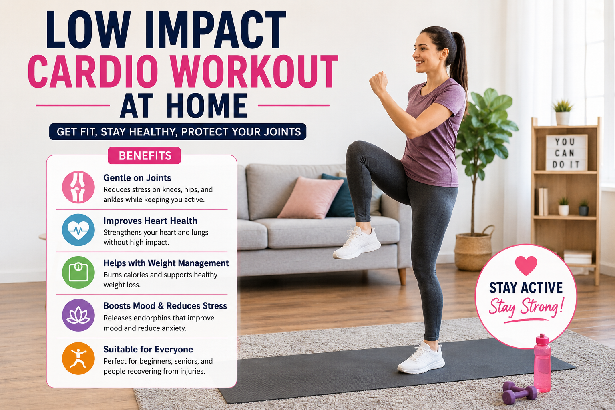
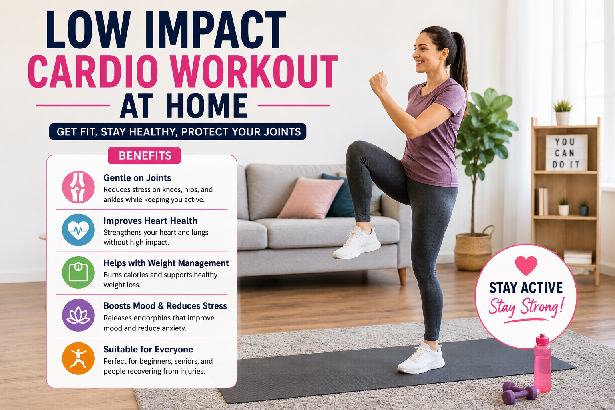
Low impact cardio workout at home routines can help you get your heart moving without jumping, running, or using a gym. These workouts are simple, gentle, and easy to change for your fitness level.
Moreover, you do not need expensive equipment. A small open space, comfortable clothes, supportive shoes, and a little time can be enough.
If you have been away from exercise for a while, starting gently can also make exercise feel less scary. Instead of trying to finish a hard workout on your first day, you can begin with five or ten minutes. Then, slowly add more time.
The Centers for Disease Control and Prevention notes that walking, cycling, dancing, and stationary biking are examples of low-impact activities with relatively low injury rates.
This guide explains how to build a safe and useful home cardio routine. You will learn what low-impact cardio means, which exercises work best, how long to exercise, how to make a workout harder, and how to avoid common mistakes.
You will also find a complete workout plan, a weekly schedule, advantages and disadvantages, expert advice, real-life examples, case studies, and 20 frequently asked questions.
Important: This article provides general fitness information. If you have a heart or lung condition, a recent injury, severe joint pain, dizziness, or another medical concern, speak with a qualified health professional before starting a new exercise program.
What Makes a Workout Low Impact?
Low-impact exercise means your body does not repeatedly absorb hard landing forces. Usually, at least one foot stays on the floor during standing exercises.
For example, walking is low impact. Marching in place can also be low impact. Step touches, gentle dancing, seated marching, and stationary cycling are other useful choices.
However, low impact does not mean low effort.
You can raise your heart rate with smooth movements. You can also make an easy exercise harder by moving your arms, increasing your pace, adding resistance, or exercising for longer.
Therefore, think of “low impact” as a description of how your body meets the floor, not as a promise that the workout will feel easy.
Why Home Cardio Is Worth Your Time
A home workout removes many common barriers.
You do not need to drive to a gym. You do not need to wait for a machine. You also do not need to worry about bad weather.
Instead, you can exercise when you have a free block of time.
For example, you could move for 10 minutes before breakfast. Then, you could take another 10-minute movement break after lunch.
Small blocks can add up.
The U.S. physical activity guidelines recommend adults work toward at least 150 minutes of moderate aerobic activity each week, along with muscle-strengthening activity on at least two days.
That does not mean you must start at 150 minutes. Your starting point should match your current ability.
Low Impact Cardio Workout at Home for Beginners
A low impact cardio workout at home works especially well for beginners because you can control the speed.
Start with movements that feel natural.
Try:
- Marching in place
- Step touches
- Side steps
- Heel taps
- Toe taps
- Gentle dancing
- Seated marching
- Standing knee lifts
- Slow front steps
- Easy shadow boxing
At first, work for 20 to 30 seconds and rest when needed.
Then, repeat the movements.
You should not feel that you must race through the workout. Instead, focus on steady movement and good control.
How Your Heart Responds to Gentle Movement
Your heart pumps blood faster when your muscles need more oxygen.
During cardio, your breathing becomes quicker and your heart rate rises. Over time, regular aerobic activity can help improve your endurance.
That means everyday tasks may feel easier.
For instance, climbing stairs, walking through a store, cleaning your home, or playing with your children may become less tiring.
Furthermore, regular movement can support overall health, mood, and physical fitness.
The Arthritis Foundation explains that aerobic exercise can improve endurance, reduce fatigue, and support heart and lung fitness.
Low Impact Cardio Workout at Home and Joint Comfort
Many people choose low-impact exercise because they want to move without a lot of pounding.
Walking, cycling, swimming, and similar activities can provide cardio while placing less impact on the body than running.
For people with arthritis, regular exercise can also help improve movement and reduce symptoms. The Arthritis Foundation recommends aerobic, strengthening, range-of-motion, and balance activities as parts of a well-rounded approach.
Still, everyone is different.
A movement that feels comfortable for one person may bother another person’s knee, hip, ankle, or back.
So, pay attention to how your body responds.
The Best Space for Your Workout
You do not need a large room.
A small clear area beside your bed, sofa, dining table, or desk can work.
Before you begin, remove:
- Loose rugs
- Toys
- Bags
- Cords
- Small furniture
- Anything that could make you trip
Also, make sure you have enough room to move your arms.
If balance is a concern, exercise near a sturdy surface that you can use for light support.
However, do not pull hard on unstable furniture.
A Five-Minute Warm-Up That Gets You Ready
A warm-up helps you move from rest into exercise.
Try this five-minute sequence:
Minute 1: Walk slowly around the room.
Minute 2: March gently in place.
Minute 3: Add easy arm movements.
Minute 4: Perform alternating heel taps.
Minute 5: Use gentle side steps.
Keep the pace comfortable.
The Arthritis Foundation recommends warming up before exercise, especially for people managing joint concerns.
After your warm-up, your body should feel ready rather than tired.
Marching in Place Without Jumping
Marching is one of the simplest cardio exercises.
Stand tall with your feet about hip-width apart.
Lift one foot slightly. Put it down. Then lift the other foot.
Continue at a steady rhythm.
For more effort, swing your arms.
For less effort, make smaller steps.
You can also perform the movement while sitting in a strong chair if standing feels uncomfortable.
Try 30 seconds at first.
Then rest.
Step Touches for Easy Side-to-Side Movement
Step touches are simple and useful.
Step your right foot to the right. Bring your left foot toward it.
Then step your left foot to the left. Bring your right foot toward it.
Repeat.
Keep your knees soft.
You can move your arms from side to side.
This exercise works well because you can easily change the speed.
If you feel unsteady, make the steps smaller.
Heel Taps for a Simple Rhythm
Stand upright.
Place one heel in front of you. Bring it back.
Then place the other heel forward.
Continue switching sides.
Add gentle arm swings if you feel comfortable.
Heel taps do not require much space, so they are useful for small rooms.
They also work well between harder movements because they let you keep moving without jumping.
Low Impact Cardio Workout at Home With Side Steps
A low impact cardio workout at home becomes more interesting when you mix directions.
Side steps can raise your heart rate while keeping one foot on the floor.
Try 30 seconds of side steps.
Then perform 30 seconds of marching.
Next, return to side steps.
Continue for several rounds.
If you want more challenge, move your arms overhead.
If that bothers your shoulders, keep your arms around chest level.
Gentle Knee Lifts for More Energy
Knee lifts can make your workout feel more active.
Stand tall.
Lift your right knee toward your waist without forcing the height.
Lower it.
Then lift the left knee.
Keep alternating.
You do not need to bring your knees high.
In fact, a smaller movement may work better if you have tight hips or knee discomfort.
Keep your upper body relaxed.
Seated Cardio for Days When Standing Feels Hard
Seated exercise is not a second-rate workout.
A sturdy chair can give you a useful way to move your arms and legs.
Sit toward the front of the chair with your feet on the floor.
March your feet.
Then add arm punches.
Next, tap your heels.
After that, move your arms up and down.
You can build a full seated cardio session from these simple movements.
This option can also help people who cannot stand for long periods.
Low Impact Cardio Workout at Home With Dancing
Dancing can turn exercise into something fun.
You do not need perfect dance skills.
Simply play music and move your body.
Try:
- Side steps
- Heel taps
- Gentle turns
- Arm swings
- Marching
- Small knee lifts
Avoid jumping if you want to keep the workout low impact.
You can also choose slower songs on days when your energy is low.
The CDC physical activity guidelines include dancing among activities that can provide aerobic movement.
Easy Shadow Boxing Without the Jumping
Shadow boxing can raise your heart rate quickly.
Stand with one foot slightly ahead of the other.
Keep your knees soft.
Punch gently toward the air.
Alternate your arms.
Do not lock your elbows.
You can also punch at chest level instead of shoulder level.
Try 20 seconds.
Then rest for 20 seconds.
Repeat several times.
If shoulder pain appears, stop and choose another exercise.
Toe Taps to Build a Steady Pace
Place one foot slightly forward.
Tap your toes.
Return the foot.
Switch sides.
Continue alternating.
You can use a low, stable step only if you already feel comfortable and safe using one.
Otherwise, simply tap the floor.
Keep your movement controlled.
This exercise can fit nicely into a beginner cardio circuit.
Low Impact Cardio Workout at Home With a Chair
A chair can make certain exercises easier.
Place a sturdy chair nearby.
You can use it for balance during gentle leg movements.
Try:
- Marching beside the chair.
- Side stepping.
- Heel taps.
- Gentle knee lifts.
- Standing toe taps.
- Seated marching.
However, do not use a rolling office chair for support.
A stable chair works better.
How Long Should a Beginner Exercise?
There is no single perfect starting time.
If you have not exercised recently, begin with five to 10 minutes.
After a few sessions, try 15 minutes.
Then move toward 20 minutes.
Eventually, you may be able to exercise for 30 minutes or more.
The important point is progression.
You do not need to go from zero to a long workout overnight.
Moreover, the CDC physical activity guidance supports building activity toward weekly goals rather than treating one workout as the only measure of success.
How Hard Should Your Workout Feel?
Use the talk test.
During moderate activity, you should usually be able to talk, although singing a full song may feel difficult.
If you cannot speak comfortably, slow down.
If you can speak easily and feel almost no change in breathing, you can gradually increase your pace.
However, beginners should not chase exhaustion.
Your goal is to finish the workout feeling that you could have done a little more.
A Simple Effort Scale for Home Exercise
You can use a scale from 1 to 10.
1–2: Very easy
3–4: Easy
5–6: Moderate
7–8: Hard
9–10: Very hard
For many beginners, an effort around 3 to 5 can provide a comfortable starting point.
Later, you can work at a moderate level for longer periods.
Your exact effort should depend on your fitness, age, experience, and health.
Low Impact Cardio Workout at Home: 15-Minute Plan
Here is a simple routine.
Warm-up — 3 minutes
- Slow march
- Arm swings
- Heel taps
Main workout — 10 minutes
Perform each movement for 45 seconds.
- Marching
- Step touches
- Heel taps
- Knee lifts
- Gentle dancing
- Side steps
- Shadow boxing
- Toe taps
- Marching with arm swings
- Easy dance steps
Rest for 15 seconds when needed.
Cool-down — 2 minutes
Walk slowly.
Then take relaxed breaths.
This routine gives you a simple starting point without requiring a machine.
A 20-Minute Beginner Routine
When 15 minutes feels comfortable, try this plan.
Minutes 1–4: Warm-up
Minutes 5–7: Marching
Minutes 8–10: Side steps
Minutes 11–13: Heel taps
Minutes 14–16: Gentle dancing
Minutes 17–18: Knee lifts
Minutes 19–20: Slow walking and breathing
You can repeat the workout two or three times per week.
Low Impact Cardio Workout at Home: 30-Minute Routine
A low impact cardio workout at home can also become a complete 30-minute session.
Minutes 1–5: Warm-up
March slowly and move your arms.
Minutes 6–10: March and step
Alternate marching and side steps.
Minutes 11–15: Cardio circuit
Use heel taps, knee lifts, and toe taps.
Minutes 16–20: Dance block
Choose music you enjoy.
Minutes 21–25: Boxing block
Use gentle punches and side steps.
Minutes 26–28: Easy cardio
Return to marching.
Minutes 29–30: Cool-down
Slow your pace.
Breathe normally.
A 30-Minute Chart You Can Save
| Time | Exercise | Effort | Equipment |
| 0–5 min | Warm-up march | Easy | None |
| 5–8 min | Side steps | Easy | None |
| 8–11 min | Heel taps | Easy | None |
| 11–14 min | Knee lifts | Easy-moderate | None |
| 14–18 min | Dancing | Moderate | Music |
| 18–21 min | Shadow boxing | Moderate | None |
| 21–24 min | Toe taps | Moderate | None |
| 24–27 min | Marching | Moderate | None |
| 27–29 min | Slow side steps | Easy | None |
| 29–30 min | Cool-down | Very easy | None |
This chart gives you a simple structure.
However, you can shorten any section if you need more rest.
Weekly Plan for New Exercisers
A weekly plan can help you stay consistent.
| Day | Workout | Time |
| Monday | Beginner cardio | 15–20 min |
| Tuesday | Easy walk or movement | 10–20 min |
| Wednesday | Beginner cardio | 15–20 min |
| Thursday | Rest or gentle mobility | 5–15 min |
| Friday | Cardio circuit | 20–25 min |
| Saturday | Dancing or walking | 15–30 min |
| Sunday | Rest | — |
You can change this schedule based on your life.
Consistency matters more than making every session perfect.
How to Make Cardio Harder Without Jumping
You do not need jumping to increase intensity.
Instead, try these methods:
Move faster.
Increase your pace slightly.
Use your arms.
Large arm movements require more work.
Increase workout time.
Add five minutes.
Reduce rest time.
Take shorter breaks when you feel ready.
Add resistance.
A stationary bike can use more resistance, for example.
Use larger steps.
Move farther from side to side if your space allows it.
Progress slowly.
Low Impact Cardio Workout at Home for Weight Management
A low impact cardio workout at home can support weight management because physical activity uses energy.
However, exercise alone does not guarantee weight loss.
Food choices, sleep, stress, daily activity, body size, and many other factors also affect body weight.
Therefore, avoid promising a certain number of pounds from a specific workout.
Instead, focus on building a routine you can keep.
For example, 20 minutes of movement three days a week is more useful than one exhausting workout that makes you quit.
Can Low Impact Exercise Improve Stamina?
Yes.
When you exercise regularly, your body can adapt to the work.
Over time, you may notice that you can:
- Walk farther
- Exercise longer
- Recover faster
- Move with less effort
- Complete daily tasks more easily
The change usually happens gradually.
Therefore, do not judge your fitness from one session.
Compare your progress across several weeks.
Low Impact Cardio Workout at Home for Older Adults
A low impact cardio workout at home can be adjusted for older adults.
For example, you can use:
- Seated marching
- Slow standing marches
- Heel taps
- Gentle side steps
- Toe taps
- Light dancing
- Supported knee lifts
Balance deserves special attention.
If you feel unstable, use a safe setup and consider getting guidance from a qualified professional.
The Arthritis Foundation recommends a mix of aerobic, strengthening, balance, and flexibility work for a well-rounded exercise routine.
Cardio Options for People With Sensitive Joints
If your joints dislike jumping, choose smooth movements.
Walking is often a good option.
Stationary cycling is another useful choice.
The Arthritis Foundation describes stationary biking as a low-impact activity that can strengthen muscles and provide cardiovascular exercise.
Water exercise can also reduce the pressure of body weight on joints.
However, your best option depends on the joint involved and your health history.
What If Your Knees Hurt During Exercise?
Do not simply push through sharp or worsening pain.
First, stop the movement.
Then, check whether a smaller movement feels comfortable.
For example, replace deep knee lifts with gentle toe taps.
You can also try seated movement.
If pain keeps returning, seek advice from a doctor or physical therapist.
The Arthritis Foundation notes that physical therapists can assess movement and help choose exercises that fit individual needs.
What If You Have Back Discomfort?
Keep movements controlled.
Avoid twisting quickly.
Avoid forcing your range of motion.
Try gentle marching or seated movements.
Also, keep your posture comfortable rather than trying to make your back perfectly straight.
If exercise repeatedly causes back pain, get professional advice.
A personalized plan may work better than copying a general workout online.
Low Impact Cardio Workout at Home and Recovery
Recovery matters.
Your body needs time to adapt to exercise.
You may feel mild muscle tiredness after a new routine.
However, strong pain, swelling, dizziness, faintness, chest pain, or unusual shortness of breath should not be treated as normal workout discomfort.
Stop exercising and seek appropriate medical help when symptoms are concerning.
Also, avoid increasing exercise time and intensity at the same time.
Change one thing first.
Real-Life Example: A Gentle Movement Routine
Consider a beginner named Maya.
Maya works at a desk and rarely exercises.
On Monday, she starts with 10 minutes of marching, side steps, and heel taps.
She feels fine.
On Wednesday, she repeats the session.
On Friday, she adds five minutes of gentle dancing.
After several weeks, she can exercise for 25 minutes without feeling overwhelmed.
This example shows an important lesson:
Progress does not need to be dramatic to matter.
A small routine can become a regular habit.
Case Study: Tai Chi and Finding Sustainable Movement
The Arthritis Foundation has shared the story of Matthew Bosman, who turned to tai chi after back surgery and while dealing with arthritis. He found the slower, flowing style easier to continue and reported that he enjoyed the calming nature of the practice.
This example highlights a useful fitness lesson.
The “best” workout is often one you can safely repeat.
You do not have to copy another person’s routine.
Instead, find movement that fits your body and lifestyle.
Case Study: Walking as a Long-Term Habit
Walking provides another useful example.
The Arthritis Foundation’s Walk With Ease program uses walking as a structured way to build activity and can be adjusted as fitness improves.
Walking is simple because you need little equipment.
You can walk indoors, around your home, through a mall, or outside when conditions allow.
You can also split walking into shorter periods.
That flexibility can make a habit easier to maintain.
Expert Advice on Choosing the Right Exercise
Physical therapist Jessica Schwartz describes stationary biking as a useful low-impact option for people with arthritis, while noting that resistance can increase gradually.
Physical therapist Maura Daly Iversen also recommends choosing exercises based on a person’s needs and movement limits.
The key lesson is simple:
Do not force your body into someone else’s workout.
Choose movements that match your current ability.
Then progress slowly.
Advantages of Low Impact Cardio
Low-impact cardio has several useful advantages.
It needs little equipment
Many exercises require nothing.
It works in small spaces
You can march beside your bed.
It is easy to modify
You can slow down or sit down.
It can support heart fitness
Regular aerobic activity helps train your cardiovascular system.
It can improve stamina
You may become less tired during daily tasks.
It can support mood
Movement can be a useful part of a healthy lifestyle.
It can reduce pounding
Low-impact movements usually avoid repeated hard landings.
It can be convenient
You can exercise without traveling to a gym.
Disadvantages and Limits to Consider
Low impact does not mean risk-free.
You can still overdo exercise.
You may also use poor form.
Other possible problems include:
- Boredom
- Repeating the same movement too often
- Exercising too hard too soon
- Lack of strength training
- Poor balance
- Limited motivation
- Not enough progression
Also, cardio alone does not cover every part of fitness.
Adults should include muscle-strengthening activity as part of a complete weekly routine.
Therefore, combine cardio with strength, mobility, and balance work when appropriate.
Common Mistakes Beginners Should Avoid
Mistake 1: Starting too hard
Going from no exercise to 45 minutes can be a shock.
Mistake 2: Skipping the warm-up
Begin gently.
Mistake 3: Chasing sweat
Sweat does not determine whether a workout was successful.
Mistake 4: Ignoring pain
Pain can be a reason to stop and reassess.
Mistake 5: Never progressing
Once your body adapts, gradually increase time or effort.
Mistake 6: Doing only cardio
Add strength and mobility work when suitable.
Mistake 7: Comparing yourself with others
Your starting point is your own.
Low Impact Cardio Workout at Home: Safety Checklist
Before exercising, ask:
- Is my floor clear?
- Are my shoes secure?
- Do I have enough space?
- Do I feel well enough to exercise?
- Do I have water nearby?
- Is my exercise surface stable?
- Do I know how to reduce the movement?
- Am I willing to stop if something feels wrong?
If the answer is yes, start slowly.
Remember that more exercise is not always better.
Better exercise is safe, suitable, and consistent.
Frequently Asked Questions
Is Low Impact Cardio Workout at Home Good for Beginners?
Yes. A low impact cardio workout at home can be an excellent starting point because you can control the pace, movement size, and workout length.
Start with five to 15 minutes if you are new.
Then build gradually.
What Is the Easiest Cardio Exercise at Home?
Marching in place is one of the easiest choices.
You can also try seated marching, heel taps, side steps, or gentle dancing.
Choose the exercise that feels natural and safe for you.
Can I Do Low Impact Cardio Every Day?
You can include gentle movement on many days, but your exact schedule should match your fitness and health.
You do not need a hard workout every day.
Instead, alternate easier and more challenging days.
Can I Lose Weight With Home Cardio?
Cardio can increase energy use and support weight management.
However, weight change depends on many factors.
A healthy eating pattern, regular movement, sleep, and long-term consistency all matter.
Is Walking Low Impact?
Yes.
Walking is generally considered a low-impact aerobic activity.
The CDC lists walking among activities with relatively low injury rates compared with higher-impact activities such as running.
Is Low Impact Cardio Better Than Running?
Neither is automatically better.
Running can provide vigorous exercise, while low-impact activities may feel more comfortable for people who dislike repeated impact.
Your best choice depends on your goals, fitness, preferences, and physical condition.
Can I Do Low Impact Cardio With Knee Pain?
Some people with knee problems can exercise comfortably with low-impact movements.
However, pain varies from person to person.
Start gently and avoid movements that increase your symptoms.
If pain continues, consult a qualified health professional.
Is Stationary Cycling Low Impact?
Yes.
Stationary cycling is a low-impact cardio option because the pedals support a smooth cycling motion.
The Arthritis Foundation highlights stationary biking as an option that can provide cardiovascular and muscle benefits while placing less impact on joints.
Can Seniors Do Home Cardio?
Many older adults can perform modified cardio exercises.
Seated marching, gentle walking, heel taps, and supported movements can be useful choices.
However, people with balance or health concerns should get suitable professional guidance.
How Many Minutes Should I Exercise?
There is no single starting number for everyone.
Beginners can start with five to 10 minutes.
Then gradually increase the time.
The long-term goal for many adults is to build toward 150 minutes of moderate aerobic activity each week, along with muscle-strengthening work.
Do I Need Equipment?
No.
You can create an effective beginner routine using body movements.
A chair, exercise mat, stationary bike, or resistance band can add options, but these items are not required.
Can I Do Cardio in a Small Apartment?
Yes.
Choose exercises such as marching, heel taps, toe taps, side steps, and seated movements.
Avoid jumping if noise or impact is a concern.
Can I Exercise Without Sweating?
Yes.
Sweat is not the goal.
Your breathing and effort level matter more than how much you sweat.
A comfortable workout can still contribute to your weekly activity.
Can Low Impact Cardio Strengthen My Legs?
It can help your legs work and may improve endurance.
However, cardio does not replace dedicated strength training.
Add suitable squats, sit-to-stands, resistance-band work, or other strength exercises when appropriate.
Is Dancing Low Impact?
Dancing can be low impact when you keep at least one foot on the floor and avoid jumps.
You can make dancing as gentle or energetic as your fitness level allows.
What Should I Do If I Feel Tired?
Slow down or rest.
Beginners should not feel pressure to finish every workout at the planned pace.
Your workout plan should serve your body, not the other way around.
What Should I Do If Exercise Causes Sharp Pain?
Stop the exercise.
Do not try to push through sharp or worsening pain.
If the problem continues, speak with a doctor or physical therapist before returning to the movement.
Can I Do Cardio Before Breakfast?
Some people enjoy morning exercise.
Others prefer exercising later.
The best time is often the time you can follow consistently.
Drink water and choose a routine that fits your needs.
Should I Stretch Before Cardio?
Start with gentle movement to warm your body.
A slow walk, march, arm movement, or easy range-of-motion exercise can prepare you.
For people with joint concerns, the Arthritis Foundation recommends a warm-up before exercise.
Can I Do This Workout With Arthritis?
Many people with arthritis can benefit from appropriate low-impact activity.
The Arthritis Foundation notes that exercise can improve pain, stiffness, strength, balance, and overall function for people with arthritis.
Still, your workout should match your condition.
A physical therapist can help you choose suitable movements.
How Can I Stay Motivated?
Make exercise easy to start.
Put your shoes near your workout space.
Choose music you enjoy.
Set a small goal.
Track the days you move.
Most importantly, do not demand perfection.
A short workout is better than skipping movement because you could not complete a long workout.
Your Simple 4-Week Progress Plan
Now that you know the basic movements, you can build a four-week habit.
Week 1: Learn the movements
Exercise for 10 to 15 minutes.
Focus on control.
Do not worry about speed.
Week 2: Add time
Move for 15 to 20 minutes.
Add one or two extra minutes to your favorite movements.
Week 3: Increase the pace
Keep the same exercises but move slightly faster.
You can also add larger arm movements.
Week 4: Build a complete session
Try 25 to 30 minutes.
Use a warm-up, cardio circuit, and cool-down.
At the end of four weeks, assess how you feel.
If the routine feels comfortable, you can slowly increase your weekly activity.
How to Create Your Own Workout
You can build a workout from five movement groups.
Group 1: Marching
Choose marching or seated marching.
Group 2: Side movement
Choose side steps or step touches.
Group 3: Forward movement
Choose heel taps or toe taps.
Group 4: Upper-body movement
Choose arm swings or gentle punches.
Group 5: Fun movement
Choose dancing.
Combine one movement from each group.
Then repeat.
This method prevents boredom because you can change the exercises without changing the basic structure.
A Sample 40-Minute Advanced Beginner Session
If 30 minutes feels easy, try this longer routine.
5 minutes: Warm-up
5 minutes: Marching
5 minutes: Side steps and heel taps
5 minutes: Dancing
5 minutes: Knee lifts and toe taps
5 minutes: Shadow boxing
5 minutes: Easy walking
5 minutes: Cool-down
Take short breaks whenever needed.
Do not treat 40 minutes as a requirement.
It is simply another option.
How Music Can Make Exercise Easier
Music can make repetitive movement feel more enjoyable.
Choose songs with a comfortable beat.
Start slowly.
Then, use slightly faster songs during the middle of your session.
Finally, choose a slower song for your cool-down.
You can also create a playlist before exercising.
That removes one small decision from your routine.
How to Track Your Progress
You do not need a complicated fitness app.
Write down:
- Workout date
- Workout time
- Exercises
- Effort level
- How you felt afterward
For example:
Monday: 15 minutes, easy, felt good.
Wednesday: 18 minutes, easy-moderate, needed one short break.
Friday: 20 minutes, moderate, finished comfortably.
After several weeks, you can see your progress.
Signs That You Are Improving
Fitness progress does not always show on a scale.
You may notice:
- You walk farther.
- You recover faster.
- Your breathing feels easier.
- You can exercise longer.
- You feel more confident.
- You enjoy movement more.
- Daily tasks feel easier.
These changes matter.
Fitness is about what your body can do, not only how it looks.
When You Should Reduce Your Workout
Some days are harder than others.
If you slept poorly, feel unusually tired, or have mild stiffness, reduce your workout.
For example, change 30 minutes into 10 minutes.
Change standing movements into seated movements.
Reduce your pace.
A flexible workout plan is easier to maintain.
However, if you feel seriously unwell, skip exercise and seek appropriate medical advice.
Why Consistency Beats Extreme Workouts
One huge workout does not create long-term fitness by itself.
A repeated habit can.
Think about brushing your teeth.
You do not brush for three hours once a month.
You do it regularly.
Exercise works in a similar way.
A manageable routine that you repeat can become part of your life.
Therefore, choose a workout that you can imagine doing next week, next month, and later in the year.
Low Impact Cardio Workout at Home for Busy People
A low impact cardio workout at home does not need a full hour.
Try three 10-minute blocks.
Morning
10 minutes of marching and heel taps.
Afternoon
10 minutes of side steps and dancing.
Evening
10 minutes of walking around the home and gentle movement.
Together, those blocks give you 30 minutes of activity.
This approach can be useful when work, family, or other duties make long workouts difficult.
How to Combine Cardio With Strength
Cardio and strength serve different purposes.
Cardio trains your heart and endurance.
Strength training helps your muscles produce force.
A balanced week can include both.
For example:
Monday: Cardio
Tuesday: Strength
Wednesday: Cardio
Thursday: Rest or mobility
Friday: Cardio and light strength
Saturday: Walking or dancing
Sunday: Rest
You can change the schedule to fit your life.
How to Combine Cardio With Mobility
Mobility exercises help you move your joints through comfortable ranges.
You can add five minutes of gentle mobility after cardio.
Try:
- Shoulder circles
- Ankle circles
- Gentle knee movements
- Hip movements
- Easy arm reaches
Do not force a stretch.
Move smoothly.
Low Impact Cardio Workout at Home for Beginners Over 40
Age alone does not decide whether you can exercise.
However, your current fitness level matters.
If you have been inactive for years, start slowly.
Choose walking, marching, side steps, cycling, or seated movements.
Then build your routine over time.
The goal is not to exercise like you did at 20.
The goal is to build the strongest and healthiest routine that fits your body today.
Low Impact Cardio Workout at Home for Beginners Over 50
People over 50 can still build endurance.
Start with manageable sessions.
Pay attention to balance.
Use supportive footwear.
Also, include strength and balance work as part of your broader fitness plan.
If you have a health condition or take medicines that affect exercise tolerance, ask your healthcare professional for individual guidance.
Low Impact Cardio Workout at Home Without a Jumping Exercise
Some people believe cardio must include jumping.
It does not.
You can raise your heart rate with:
- Marching
- Fast walking
- Dancing
- Side steps
- Knee lifts
- Shadow boxing
- Stationary cycling
Therefore, you can build a challenging cardio session without repeated jumps.
The Best Beginner Exercise Is One You Will Repeat
There is no magic movement.
The best routine is one that fits your body and your life.
If you hate marching, try dancing.
If standing bothers you, try seated cardio.
If indoor exercise feels boring, walk outside.
If you enjoy cycling, use a stationary bike.
Enjoyment can help you stay consistent.
The Arthritis Foundation also emphasizes choosing activities that people enjoy because enjoyment can support long-term exercise habits.
External Resources for Safe Exercise
For more evidence-based information, these resources are useful:
- CDC Physical Activity Guidelines — General guidance on physical activity, safety, and exercise.
- U.S. Physical Activity Guidelines for Americans — Federal guidance on weekly activity goals.
- Arthritis Foundation Exercise Resources — Exercise information for people who need joint-friendly options.
- Arthritis Foundation: Exercise and Strength Training — Guidance on combining cardio, strength, balance, and mobility.
These resources can help you learn more, but they should not replace personal medical advice.
A Quick Printable Workout
Here is a simple routine you can save.
Warm-up — 5 minutes
- 1 minute slow marching
- 1 minute arm swings
- 1 minute heel taps
- 1 minute side steps
- 1 minute easy marching
Main workout — 20 minutes
Repeat twice:
- 2 minutes marching
- 2 minutes side steps
- 2 minutes heel taps
- 2 minutes knee lifts
- 2 minutes gentle dancing
Cool-down — 5 minutes
- Slow walking
- Gentle shoulder movements
- Easy breathing
- Slow marching
Total: 30 minutes
If 30 minutes is too much, cut the main workout in half.
Final Takeaway: Make Movement Simple
A low impact cardio workout at home can be simple, useful, and easy to fit into everyday life.
You do not need a gym membership.
You do not need expensive machines.
You do not need to jump.
You do not even need a long workout when you are starting.
Instead, begin with movements such as marching, side steps, heel taps, knee lifts, dancing, and seated cardio. Then, gradually increase your time or effort as your fitness improves.
Most importantly, listen to your body.
A good workout should challenge you without making you feel like you must suffer.
For many adults, the long-term goal is to build toward at least 150 minutes of moderate aerobic activity each week, while also adding muscle-strengthening activities.
However, you can build toward that goal one small session at a time.
Start with five minutes today.
Then try 10 minutes.
After that, work toward 15, 20, or 30 minutes.
The goal is not to find the hardest workout. The goal is to find a workout you can safely keep doing.