
Beginner dumbbell workout plan sessions can make strength training feel simple, affordable, and less stressful. You do not need a large gym, expensive machines, or a complicated routine to get started. With one pair of dumbbells, enough space to move, and a sensible plan, you can train most of your major muscle groups at home.
More importantly, beginners do not need to chase perfect workouts. The American College of Sports Medicine’s 2026 resistance-training guidance highlights a simple idea: consistency matters more than complicated training methods. It also notes that home-based training and basic equipment can work well for healthy adults.
This guide gives you a practical beginner dumbbell workout plan that you can follow for several weeks. It covers exercises, sets, repetitions, warm-ups, rest, weight selection, progression, common mistakes, advantages, disadvantages, real-life examples, case studies, expert advice, and a complete weekly chart.
Safety note: This guide is for generally healthy adults. If you have an injury, medical condition, unusual pain, or you are unsure whether exercise is suitable for you, speak with a qualified health professional before starting. Stop an exercise if you feel sharp or unusual pain.
What Makes a Beginner Dumbbell Workout Plan Different?
A beginner routine should teach you how to move before asking you to lift heavy.
Therefore, your first goal should not be the biggest dumbbells in the room. Instead, your goal should be learning good movement, building a habit, and slowly becoming stronger.
A good beginner dumbbell workout plan usually includes movements that train:
- Legs
- Glutes
- Chest
- Back
- Shoulders
- Arms
- Core
You can train these areas with basic exercises such as squats, rows, presses, lunges, curls, and dead-bug movements.
The U.S. Physical Activity Guidelines recommend that adults include muscle-strengthening activity involving all major muscle groups on at least two days each week.
So, you do not need to lift every day.
Why Dumbbells Are Great for First-Time Lifters
Dumbbells are small, simple, and easy to store.
Also, each hand holds its own weight. That means your stronger side cannot completely take over for your weaker side as easily as it might with some bar-based movements.
Dumbbells also allow many movement choices.
For example, you can use them for:
- Goblet squats
- Romanian deadlifts
- Chest presses
- Shoulder presses
- One-arm rows
- Reverse lunges
- Biceps curls
- Triceps extensions
- Farmer carries
ACSM notes that free weights can help improve strength, muscle size, endurance, power, and bone strength when used properly. It also stresses the importance of learning technique and using sensible safety steps.
The Main Goal of Your First Four Weeks
Your first month should be about learning.
Do not worry if you cannot lift much weight. In fact, starting light can help you understand the exercises.
A useful first-month goal is:
Learn → Practice → Repeat → Progress
You should finish most workouts feeling that you worked hard but still had control.
You should not need to crawl away from every session.
Instead, aim for steady improvement.
Maybe you perform eight good squats during your first workout. A few weeks later, you may perform twelve with the same weight. That is progress.
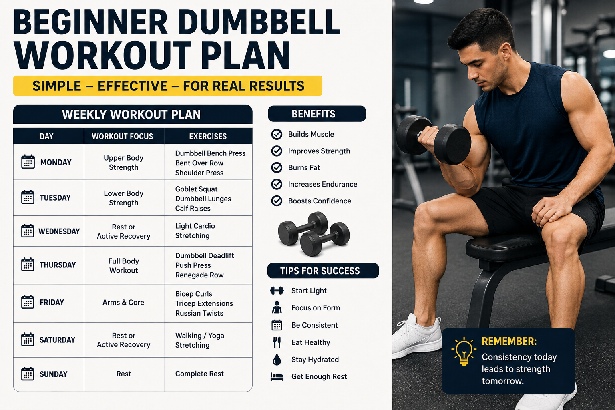
Beginner Dumbbell Workout Plan: Your Weekly Schedule
Here is a simple three-day schedule.
| Day | Workout | Main Focus | Time |
| Monday | Workout A | Full body | 35–45 min |
| Tuesday | Rest or easy walk | Recovery | 20–30 min |
| Wednesday | Workout B | Full body | 35–45 min |
| Thursday | Rest | Recovery | — |
| Friday | Workout A | Full body | 35–45 min |
| Saturday | Easy activity | Walking or mobility | 20–40 min |
| Sunday | Rest | Recovery | — |
The following week, you can switch the order:
| Day | Workout |
| Monday | Workout B |
| Wednesday | Workout A |
| Friday | Workout B |
This approach gives your muscles time to recover.
It also fits well with the general recommendation to perform muscle-strengthening activity on at least two days per week.
Beginner Dumbbell Workout Plan: Workout A
Workout A uses seven basic movements.
Exercise 1: Goblet Squat
Sets: 2
Reps: 8–12
Rest: 60–90 seconds
Hold one dumbbell close to your chest.
Then:
- Stand with your feet around shoulder width.
- Keep your chest comfortable and tall.
- Push your hips slightly back.
- Bend your knees.
- Lower under control.
- Push through your feet to stand.
The goblet squat trains your legs and glutes while teaching you how to control a squat.
Beginner tip
Start without a dumbbell if the movement feels strange.
Then add a light dumbbell when you feel comfortable.
Dumbbell Romanian Deadlift
Sets: 2
Reps: 8–12
Rest: 60–90 seconds
Hold a dumbbell in each hand.
Keep the weights close to your legs.
Next, push your hips backward while keeping your back in a comfortable neutral position.
Lower the weights until you feel tension in the back of your legs.
Then squeeze your glutes and stand tall.
This exercise works the hamstrings, glutes, and back muscles that help you control your hips.
Common mistake
Do not turn the movement into a deep squat.
The main action should come from your hips moving backward.
Dumbbell Floor Press
Sets: 2
Reps: 8–12
Rest: 60–90 seconds
Lie on the floor with your knees bent.
Hold the dumbbells above your chest.
Lower the weights slowly until your upper arms gently touch the floor.
Then press them upward.
This movement trains the chest, shoulders, and triceps.
A floor press can also feel more controlled for beginners because the floor limits how far your arms travel.
One-Arm Dumbbell Row
Sets: 2
Reps: 8–12 per side
Rest: 60 seconds
Place one hand on a stable chair or bench.
Hold the dumbbell with your other hand.
Pull the dumbbell toward your hip.
Pause briefly.
Then lower it slowly.
This exercise trains your upper back and arms.
Most importantly, do not twist your whole body to move the weight.
Keep your torso stable.
Dumbbell Shoulder Press
Sets: 2
Reps: 8–10
Rest: 60–90 seconds
Start with the dumbbells near shoulder height.
Keep your feet stable.
Press the weights overhead.
Then lower them slowly.
Use a lighter weight than you might expect.
Shoulder exercises can become difficult quickly, especially for new lifters.
Therefore, control matters more than weight.
Dumbbell Biceps Curl
Sets: 2
Reps: 10–12
Rest: 45–60 seconds
Stand tall.
Keep your elbows close to your body.
Curl the dumbbells toward your shoulders.
Then lower them slowly.
Do not swing your back to move the weights.
If you must swing, the dumbbells are probably too heavy.
Dumbbell Dead Bug
Sets: 2
Reps: 6–10 per side
Rest: 45–60 seconds
For this version, lie on your back.
You can hold very light dumbbells above your chest, or perform the movement without weights.
Move one leg and the opposite arm slowly.
Then return to the starting position.
Switch sides.
This exercise teaches you to control your trunk while your arms and legs move.
Beginner Dumbbell Workout Plan: Workout B
Workout B changes several movements while keeping the same simple structure.
Exercise 1: Dumbbell Reverse Lunge
Sets: 2
Reps: 8–10 per leg
Hold light dumbbells at your sides.
Step backward.
Lower your body with control.
Then push through your front foot and return to standing.
Reverse lunges may feel easier to control than forward lunges for some beginners.
However, balance can still be challenging.
Use a wall or sturdy support if needed.
Dumbbell Sumo Squat
Sets: 2
Reps: 10–12
Stand with your feet slightly wider than shoulder width.
Point your toes slightly outward.
Hold one dumbbell with both hands.
Lower your hips.
Then stand tall.
Keep your knees moving in the same general direction as your toes.
Do not force a very deep squat.
Your comfortable range matters more than depth.
Supported Dumbbell Row
Sets: 2
Reps: 10–12 per side
Use a stable surface for support.
Place one hand on it.
Keep your back comfortable.
Pull the dumbbell toward your hip.
Lower it slowly.
This movement is useful because the support can make balance easier for a beginner.
Dumbbell Chest Press
Sets: 2
Reps: 8–12
If you have a safe bench, lie on it and press the dumbbells upward.
If you do not have a bench, use the floor press from Workout A.
Keep your wrists straight.
Lower the weights under control.
Then press without bouncing.
Dumbbell Lateral Raise
Sets: 2
Reps: 10–15
Use very light dumbbells.
Stand tall.
Raise your arms out toward your sides.
Stop around shoulder height or earlier if that feels better.
Lower slowly.
This exercise targets the side portion of the shoulders.
Because the movement uses a long lever, even small dumbbells can feel heavy.
Hammer Curl
Sets: 2
Reps: 10–12
Hold the dumbbells with your palms facing each other.
Curl the weights upward.
Keep your elbows close to your sides.
Lower slowly.
The neutral hand position often feels natural for beginners.
Dumbbell Farmer Carry
Sets: 2
Time: 20–40 seconds
Hold one dumbbell in each hand.
Stand tall.
Walk slowly across a clear space.
Keep your shoulders relaxed.
Do not lean from side to side.
This simple exercise trains your grip and challenges your body to stay stable while you move.
How Heavy Should Your Dumbbells Be?
This question worries almost every new lifter.
The answer is simple:
Choose a weight you can control.
Your final repetitions should feel challenging, but your form should remain steady.
For example, if your plan calls for 10 repetitions, you should not struggle to complete repetition five.
On the other hand, if you can perform 20 easy repetitions when the target is 10, the weight may be too light for that particular exercise.
The correct weight differs from person to person.
Your squat weight may be much heavier than your shoulder-raise weight.
That is normal.
The “Could I Do More?” Test
A simple method can help you select your starting weight.
After a set, ask:
“Could I do two or three more clean repetitions?”
If yes, the weight may be suitable.
If you could do ten more easily, consider a slightly heavier weight next time.
If you cannot maintain good form, reduce the weight.
This idea matches practical strength-training guidance that encourages people to increase resistance gradually while maintaining proper form.
Beginner Dumbbell Workout Plan: How Many Days?
For most beginners, two or three strength sessions per week work well.
You do not need to train seven days a week.
In fact, rest helps you return to your next workout with more energy.
A simple pattern is:
Monday → Strength
Wednesday → Strength
Friday → Strength
On other days, you can walk, stretch gently, or simply recover.
The broader adult activity guidelines also encourage regular movement throughout the week, with aerobic activity and strength work serving different but complementary roles.
Why Rest Days Matter
Exercise gives your body a reason to adapt.
Rest gives your body time to recover.
Therefore, beginners should not treat rest as laziness.
Rest is part of training.
If your muscles remain very sore, take an easier day.
If you feel tired before every workout, check your sleep, food, stress, and total activity.
You may simply be doing too much too soon.
A Five-Minute Warm-Up Before Lifting
Before your first working set, spend about five minutes getting ready.
Try:
- Marching in place — 60 seconds
- Arm circles — 30 seconds
- Bodyweight squats — 10 repetitions
- Hip hinges — 10 repetitions
- Easy shoulder movements — 30 seconds
- Light walking — 60 seconds
Then perform a few easy repetitions of your first exercise.
A warm-up should prepare you for movement.
It should not exhaust you.
Beginner Dumbbell Workout Plan: Simple Form Rules
Good form does not mean every movement must look identical.
However, several basic rules help.
Rule 1: Move slowly enough to control the weight
Do not throw the dumbbells around.
Rule 2: Keep your breathing natural
Generally, breathe out during the harder part of the lift and breathe in during the easier part.
Rule 3: Use a comfortable range of motion
You do not need to force a position that causes pain.
Rule 4: Keep your feet stable
Unless an exercise involves stepping, avoid unnecessary movement.
Rule 5: Stop when form breaks down
One clean repetition is more useful than several messy ones.
How Long Should Each Workout Take?
A beginner session can take around 30–45 minutes.
You can make it shorter if needed.
For example:
- Warm-up: 5 minutes
- Seven exercises: 25–35 minutes
- Easy cool-down: 5 minutes
You do not need a two-hour gym session.
The best workout is one that fits your real life.
Beginner Dumbbell Workout Plan for Small Spaces
You can train in a bedroom, living room, garage, or small home gym.
You mainly need enough room to:
- Stand
- Bend
- Lie down
- Step backward
- Walk several steps
Keep the floor clear.
Remove loose rugs if they create a slipping risk.
Also, keep pets and children away from the exercise area while you lift.
What Dumbbells Should a Beginner Buy?
You have several choices.
Fixed dumbbells
These are simple.
You pick up the weight and start training.
Adjustable dumbbells
These save space because you can change the resistance.
Light and medium pairs
These can work well if you want different weights for different movements.
You do not need a huge collection.
Start with weights that match your current ability.
ACSM’s free-weight guidance emphasizes choosing equipment that feels comfortable and selecting a load suited to your strength level.
Advantages of a Beginner Dumbbell Workout Plan
There are many benefits.
Affordable
You can start with a small amount of equipment.
Convenient
You can train at home.
Flexible
You can change exercises as your strength improves.
Easy to store
Dumbbells take far less space than many gym machines.
Full-body potential
One pair can train almost every major muscle group.
Good for learning
Dumbbells can help you learn basic lifting patterns.
Easy to scale
You can increase or decrease the load as needed.
ACSM’s latest guidance also stresses that you do not need complicated equipment or advanced methods to make progress.
Disadvantages You Should Know
Dumbbells are useful, but they are not perfect.
Limited weight
A beginner may eventually outgrow light dumbbells.
Balance demands
Some movements require more control than machines.
Grip fatigue
Your hands may tire before the target muscle.
Space concerns
Some exercises need enough room for safe movement.
Technique matters
Poor form can reduce the quality of your training.
Therefore, dumbbells work best when you respect your current skill level.
Beginner Dumbbell Workout Plan: How to Progress
Progress does not always mean adding weight.
You can improve in several ways.
Method 1: Add repetitions
If you perform 8 repetitions comfortably, try 9 next time.
Method 2: Add a small amount of weight
When all your target repetitions feel easy, increase the load slightly.
Method 3: Improve control
Slow down the lowering portion.
Method 4: Improve range of motion
Only do this when your current range feels comfortable.
Method 5: Add a set
After several weeks, you may add another set to selected exercises.
The 2026 ACSM guidance supports gradual adjustment based on the person’s goal and emphasizes that consistent training matters greatly.
A Simple Four-Week Progression
Use this basic structure.
| Week | Main Goal | Sets | Reps |
| 1 | Learn technique | 2 | 8–10 |
| 2 | Build consistency | 2 | 9–12 |
| 3 | Add small challenge | 2 | 10–12 |
| 4 | Increase selected weights | 2–3 | 8–12 |
Do not increase everything at once.
For example, you might increase your squat weight while keeping your shoulder press weight unchanged.
That is completely fine.
Beginner Dumbbell Workout Plan: When to Add Weight
Add weight when three things happen:
- You reach the top of your repetition range.
- Your form remains controlled.
- The final repetitions still feel easier than expected.
For example, suppose you perform 12 goblet squats with excellent control.
If the set feels easy, you can try a slightly heavier dumbbell next session.
However, do not increase the weight just because the calendar says so.
Your body decides when you are ready.
How to Track Your Workouts
Use a notebook or phone note.
Write:
Exercise — Weight — Reps — Sets
Example:
- Goblet squat — 20 lb — 10, 10
- Row — 15 lb — 10, 10
- Floor press — 15 lb — 10, 9
- Curl — 10 lb — 12, 12
After a few weeks, you can look back.
That record makes progress easier to see.
Real-Life Example: Sarah Starts at Home
Imagine Sarah, a fictional 35-year-old office worker.
She has not lifted weights before.
She owns two adjustable dumbbells.
During week one, she performs two sets of each exercise.
Her first goal is simply to finish three workouts.
She does not chase heavy weights.
By week four, she performs more repetitions with better control.
She also feels more confident setting up her workouts.
The lesson is simple: progress starts with showing up.
Case Study: A Busy Beginner With 30 Minutes
Consider another fictional example.
Mark works long hours and says he cannot spend an hour at the gym.
Instead, he trains at home on Monday, Wednesday, and Friday.
He uses:
- Goblet squats
- Rows
- Floor presses
- Romanian deadlifts
- Shoulder presses
- Curls
He keeps the sessions short.
After four weeks, his biggest improvement is not a huge change in weight.
Instead, he has built a reliable exercise habit.
That matters because long-term consistency often beats short bursts of extreme effort.
Case Study: The Beginner Who Started Too Heavy
Now consider James.
James wants fast results.
So, he picks weights that are too heavy.
During his first workout, he struggles with his rows and curls.
His back moves around.
His arms swing.
He finishes feeling exhausted.
Instead of quitting, he reduces the weight.
During the next workout, he focuses on smooth repetitions.
The lesson is important:
Heavy is not automatically better.
Good training starts with control.
Expert Advice: Keep the First Month Simple
The latest ACSM resistance-training guidance gives beginners an encouraging message: complicated methods are not required for most healthy adults. Consistency and gradual progress matter much more.
That means you do not need:
- Fancy machines
- Dozens of exercises
- Advanced lifting techniques
- Extremely long workouts
- Training to complete failure every session
Instead, learn a small number of movements.
Practice them often.
Then gradually improve.
Beginner Dumbbell Workout Plan: What About Muscle Growth?
Dumbbells can support muscle growth when you train consistently and provide enough challenge.
However, muscle growth takes time.
You should not expect major changes after two or three workouts.
Instead, look for gradual progress over weeks and months.
The 2026 ACSM position stand notes that training volume can be adjusted for muscle-growth goals and gives roughly 10 weekly sets per muscle group as a useful higher-volume reference for hypertrophy.
Beginners do not need to jump straight into that level.
Start smaller.
Build your capacity.
What About Fat Loss?
Strength training can be part of a fat-loss plan.
However, dumbbells alone do not determine fat loss.
Your overall food intake, daily movement, sleep, and activity level also matter.
For general health, adults are encouraged to combine muscle-strengthening work with regular aerobic activity.
Therefore, you can combine your strength sessions with walking, cycling, swimming, or another activity you enjoy.
Beginner Dumbbell Workout Plan and Cardio
You do not have to choose between weights and cardio.
They can work together.
For example:
Monday: Dumbbell workout
Tuesday: 25-minute walk
Wednesday: Dumbbell workout
Thursday: Easy walk
Friday: Dumbbell workout
Saturday: Longer walk
Sunday: Rest
The U.S. guidelines recommend 150–300 minutes of moderate aerobic activity each week for substantial health benefits, along with muscle-strengthening work on at least two days.
Start where you are.
Then build gradually.
Common Mistake: Doing Too Many Exercises
Beginners sometimes search for the longest workout possible.
That is not necessary.
Seven well-chosen movements can be enough for a strong session.
More exercises can create more fatigue.
More fatigue can make it harder to recover.
Therefore, keep your routine focused.
Common Mistake: Changing the Program Every Week
A new workout can feel exciting.
However, changing everything every week makes progress harder to measure.
If you keep the same main exercises for several weeks, you can see whether your strength improves.
You can always add variety later.
Common Mistake: Copying Advanced Lifters
You may see people online lifting very heavy dumbbells.
Do not compare yourself with them.
They may have years of training experience.
Your body needs time to learn.
Instead, compare today’s performance with your own performance from a few weeks ago.
Common Mistake: Ignoring Recovery
Beginners sometimes think soreness proves a workout worked.
That is not always true.
A workout can be useful without making you extremely sore.
Therefore, do not chase pain.
Chase progress.
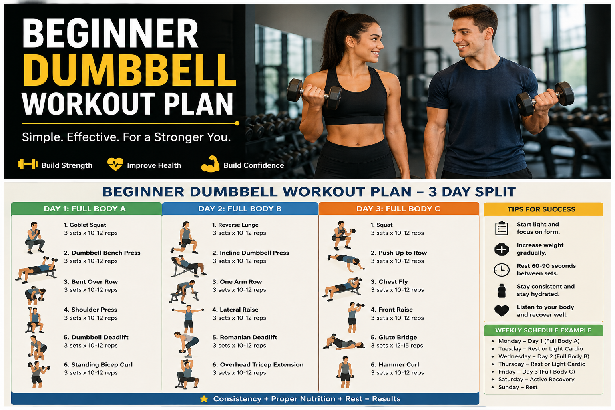
Beginner Dumbbell Workout Plan: Complete Chart
Here is the full weekly plan in one place.
| Exercise | Workout A | Workout B | Sets | Reps |
| Goblet squat | ✓ | — | 2 | 8–12 |
| Romanian deadlift | ✓ | — | 2 | 8–12 |
| Floor press | ✓ | — | 2 | 8–12 |
| One-arm row | ✓ | — | 2 | 8–12 |
| Shoulder press | ✓ | — | 2 | 8–10 |
| Biceps curl | ✓ | — | 2 | 10–12 |
| Dead bug | ✓ | — | 2 | 6–10/side |
| Reverse lunge | — | ✓ | 2 | 8–10/leg |
| Sumo squat | — | ✓ | 2 | 10–12 |
| Supported row | — | ✓ | 2 | 10–12 |
| Chest press | — | ✓ | 2 | 8–12 |
| Lateral raise | — | ✓ | 2 | 10–15 |
| Hammer curl | — | ✓ | 2 | 10–12 |
| Farmer carry | — | ✓ | 2 | 20–40 sec |
A 30-Minute Version for Busy Days
Sometimes you have less time.
That is okay.
Use this shortened routine:
- Goblet squat — 2 × 10
- Romanian deadlift — 2 × 10
- Dumbbell row — 2 × 10
- Floor press — 2 × 10
- Shoulder press — 2 × 8
- Farmer carry — 2 × 30 seconds
Rest about 45–75 seconds between sets.
This can fit into a busy day.
More importantly, it keeps the habit alive.
A Beginner-Friendly 45-Minute Version
When you have more time, use the full workout.
Start with five minutes of warm-up.
Then perform six or seven exercises.
Finish with a few minutes of easy walking and relaxed movement.
You do not need an exhausting finisher.
The goal is to finish feeling capable of returning for your next session.
How Beginners Can Stay Motivated
Motivation changes.
Therefore, build a routine that does not depend on feeling excited.
Put your dumbbells somewhere visible.
Choose fixed workout days.
Keep your workout notes nearby.
Prepare your exercise area before starting.
Also, celebrate small wins.
Examples include:
- Completing all three weekly sessions
- Adding one repetition
- Improving your balance
- Using better form
- Increasing a dumbbell by a small amount
Small wins become big changes when they happen repeatedly.
Beginner Dumbbell Workout Plan: Nutrition Basics
Exercise works best alongside sensible eating.
You do not need a perfect diet.
Try to build meals around simple foods such as:
- Vegetables
- Fruits
- Beans
- Whole grains
- Eggs
- Fish
- Lean meats
- Dairy or suitable alternatives
- Nuts and seeds
Drink enough fluids.
Also, avoid believing that one food or supplement can replace good habits.
If your goal involves major weight change or a special diet, consider speaking with a registered dietitian or other qualified professional.
Sleep and Strength Progress
Sleep matters because your body needs recovery time.
If you constantly sleep too little, workouts can feel harder.
Therefore, protect your sleep routine when possible.
A consistent bedtime can help.
So can reducing unnecessary screen time before bed.
Remember, exercise is only one part of your health routine.
What Should You Feel During a Workout?
You may feel:
- Muscle effort
- Mild burning
- Heavier breathing
- Fatigue near the end of a set
- General tiredness after the session
However, sharp pain is different.
Stop if something feels wrong.
Do not try to “push through” unusual pain simply because you want faster results.
When Should You Stop a Workout?
Stop and seek appropriate medical advice if you experience concerning symptoms such as severe chest pain, fainting, serious shortness of breath, or another unusual or severe symptom.
For normal training, also stop an exercise if you cannot maintain safe control.
There is no prize for finishing a dangerous set.
How to Make Your Home Workout Safer
Before every workout:
- Check your dumbbell handles.
- Make sure weights are secure.
- Clear the floor.
- Use stable furniture only.
- Wear shoes that give you suitable grip.
- Keep enough space around you.
- Avoid lifting near slippery surfaces.
ACSM specifically emphasizes technique and safety when using free weights because they allow more freedom of movement than machines.
Beginner Dumbbell Workout Plan: Women and Men
The same basic training ideas can work for women and men.
Your starting weight may differ.
Your exercise history may differ.
Your goals may differ.
However, the core principles remain similar:
Good technique + suitable resistance + consistency + recovery.
Do not assume that women need only tiny weights or that men must lift heavy.
Choose the load based on your actual strength.
Can Older Beginners Use Dumbbells?
Many older adults can benefit from resistance training.
However, exercise choices should match individual ability.
Balance, joint comfort, previous injuries, and medical conditions may affect the best starting point.
For older beginners, supported exercises and lighter weights may provide a comfortable entry point.
The CDC also provides strength-training resources that emphasize gradual progression and controlled repetitions.
Can Beginners Train Every Muscle in One Workout?
Yes.
A full-body session can train major muscle groups in one workout.
That is one reason full-body training works well for beginners.
You can squat for the legs.
You can row for the back.
You can press for the chest and shoulders.
You can curl for the arms.
You can add a core exercise.
This gives you broad coverage without requiring many separate gym days.
Beginner Dumbbell Workout Plan: How to Handle Soreness
Some muscle soreness can happen after a new workout.
If you are very sore, reduce your next session’s intensity.
You can also walk gently.
Do not automatically train the sore muscles hard again.
Over time, your body often becomes more comfortable with the same exercises.
How to Know Your Program Is Working
Do not judge progress only by body weight.
Look at:
- Repetitions
- Weight used
- Form
- Balance
- Workout consistency
- Energy
- Confidence
- Daily movement
For example, going from 10-pound curls for 8 controlled repetitions to 10-pound curls for 12 controlled repetitions is real progress.
Beginner Dumbbell Workout Plan: Your First 12 Weeks
Weeks 1–4
Focus on learning.
Use two sets.
Keep weights manageable.
Weeks 5–8
Increase repetitions or small amounts of weight.
Add a third set to selected movements if recovery is good.
Weeks 9–12
Continue gradual progression.
You may add more weekly volume if your goals require it.
You can also introduce new exercises.
The key is still consistency.
What to Do After the First Three Months
After three months, ask yourself:
What is my main goal now?
If you want general fitness, keep a balanced full-body routine.
If you want muscle growth, gradually increase training volume.
If you want strength, focus on heavier controlled sets.
If you want fat loss, combine strength training with suitable nutrition and regular activity.
The latest ACSM guidance explains that resistance training should be adjusted to the person’s goal rather than forcing everyone into the same style.
Beginner Dumbbell Workout Plan: Quick Reference
Before training:
- Warm up.
- Check your space.
- Choose suitable weights.
- Keep water nearby.
- Review your exercises.
During training:
- Control the weights.
- Breathe naturally.
- Stop when form breaks down.
- Rest between sets.
- Do not chase exhaustion.
After training:
- Record your workout.
- Drink fluids.
- Eat normally.
- Allow recovery time.
- Prepare for your next session.
Frequently Asked Questions
- Is a beginner dumbbell workout plan good for someone who has never lifted weights?
Yes. A simple routine can teach basic movements while allowing you to control the weight. Start light and focus on technique.
- How many days a week should a beginner lift dumbbells?
Two or three strength sessions per week can be a practical starting point. Adults are generally advised to perform muscle-strengthening activity involving all major muscle groups at least two days per week.
- How heavy should my first dumbbells be?
Choose a weight that allows you to complete your planned repetitions with good control. The right weight varies by exercise and person.
- Can I build muscle with dumbbells at home?
Yes. Dumbbells can provide resistance for many effective exercises. ACSM’s current guidance also supports home-based resistance training as an effective option.
- Should I train every day?
No. Beginners generally benefit from recovery days between demanding strength sessions.
- How long should a beginner workout last?
Around 30–45 minutes is enough for many beginners. A shorter workout can also work when your schedule is busy.
- Should I do cardio before or after dumbbells?
Either can work. If strength is your main goal, many people prefer doing their resistance exercises before longer cardio.
- What if I cannot do all the repetitions?
Reduce the weight or stop the set when your form becomes poor. Then try again with a suitable load next time.
- Can dumbbells help with weight loss?
They can be part of a weight-management program. However, food intake and total activity also play important roles.
- Should beginners train to failure?
You do not need to train to complete muscle failure every set. Current ACSM guidance says advanced methods such as training to momentary failure are often optional for average healthy adults.
- How quickly can I increase my dumbbell weight?
There is no fixed schedule. Increase it when your current load feels manageable and you can maintain good technique.
- What should I do if my muscles are sore?
Allow recovery and use gentle movement if it feels comfortable. Avoid forcing a hard workout on very sore muscles.
- Are adjustable dumbbells worth buying?
They can be useful because one pair can provide several resistance levels. However, simple fixed dumbbells can work perfectly well.
- Can I do this workout in a small apartment?
Yes. Most exercises need very little space. You mainly need a clear, stable area.
- Do I need a bench?
No. A floor press can replace a bench press for many beginners.
- Can women follow this routine?
Yes. The exercises can work for women and men. Simply choose weights based on your current ability.
- Can older adults use dumbbells?
Many can, but exercise selection should match individual needs and health status. Beginners with balance or health concerns should consider professional guidance.
- What if I miss one workout?
Simply return to the next scheduled session. Do not try to punish yourself with an extra-long workout.
- Is soreness proof that my workout was effective?
No. Progress can happen without extreme soreness.
- What is the most important rule for beginners?
Stay consistent, use manageable weights, and improve gradually. ACSM’s 2026 guidance strongly emphasizes consistency over unnecessary complexity.
External Resources for Better Training
For readers who want reliable information beyond this guide, these sources are useful:
- American College of Sports Medicine — Resistance Training Guidelines
- ACSM — Free-Weight Exercise Safety and Use
- U.S. Physical Activity Guidelines
- CDC Physical Activity Resources
- Resources can help you understand general activity recommendations, resistance training, and safe exercise practices.
Final Takeaway: Start Simple and Keep Going
A beginner dumbbell workout plan does not need to be complicated to be useful.
You can start with two or three workouts each week.
You can train your whole body with a small collection of basic exercises.
You can use light weights while learning.
Then, as your confidence grows, you can add repetitions, resistance, or sets.
The biggest mistake is waiting for the perfect routine.
Instead, start with a simple routine that you can repeat.
Your first workout may feel awkward.
Your second may feel easier.
After several weeks, movements that once seemed difficult can become normal.
That is what progress looks like.
The latest ACSM resistance-training position stand reinforces this message: moving from no resistance training to regular resistance training can provide meaningful benefits, while complicated methods are not required for most healthy adults.
So, keep your expectations realistic.
Lift with control.
Rest when needed.
Track your progress.
And most importantly, show up consistently.
A strong body is not built in one workout. It is built through many simple workouts repeated over time.