
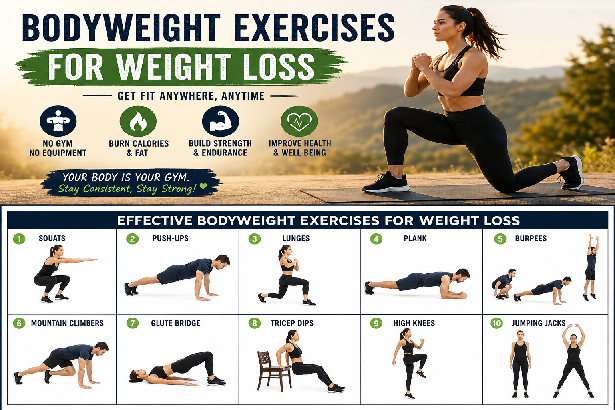
Bodyweight exercises for weight loss can help you build strength, move more, and create a workout habit without buying expensive gym equipment. In fact, you can train your legs, arms, chest, back, core, and whole body with little more than floor space.
Moreover, bodyweight training works well for beginners because you can make many exercises easier or harder. You can start with a chair squat, wall push-up, or short workout. Then, as you become stronger, you can move toward regular squats, push-ups, lunges, and harder movements.
However, exercise alone does not guarantee weight loss. Your food choices, daily movement, sleep, stress, and overall routine also matter. Weight loss usually happens when your body uses more energy than you take in over time. The National Institute of Diabetes and Digestive and Kidney Diseases explains that healthy eating and regular physical activity can support weight loss and help people maintain a healthier weight.
Therefore, the best plan is not the hardest workout. Instead, the best plan is one you can repeat week after week.
This guide explains how to use bodyweight exercises for weight loss, which movements to choose, how many repetitions to do, how to build a weekly plan, common mistakes, advantages, disadvantages, expert advice, real-life examples, and 20 frequently asked questions.
Why Bodyweight Exercises for Weight Loss Are Worth Trying
Bodyweight exercises for weight loss are simple because your body provides the resistance.
For example, a squat makes your legs work against your body weight. A push-up makes your chest, shoulders, arms, and core work together. A plank challenges your core without requiring a machine.
Most importantly, you can do these exercises almost anywhere.
You can train:
- At home
- In a bedroom
- In a living room
- At a park
- In a hotel room
- In a small apartment
- During a travel break
- In a backyard
Furthermore, you do not need to spend money on a gym membership.
The American College of Sports Medicine notes that bodyweight exercises and home-based resistance training can be effective options for healthy adults. It also recommends training major muscle groups at least twice a week and building gradually.
How Bodyweight Exercises for Weight Loss Work
Bodyweight exercises for weight loss work by helping you become more active while also challenging your muscles.
During a workout, your body needs energy. As you move, you use calories. However, the number of calories you burn depends on several things, including your body size, exercise choice, workout length, pace, and fitness level.
Therefore, do not focus too much on one exact calorie number.
Instead, focus on consistency.
For example, a person might start with 15 minutes of exercise three days a week. After a few weeks, that person may increase the workout to 25 or 30 minutes.
Meanwhile, adding walking can increase total daily movement.
The CDC’s Physical Activity Guidelines explain that some adults may need more than 150 minutes of moderate activity each week to support weight loss or weight maintenance.
The Real Goal Behind Bodyweight Exercises for Weight Loss
The real goal is not simply to make yourself tired.
Instead, aim to:
- Move more often.
- Build stronger muscles.
- Improve fitness.
- Support healthy eating.
- Create a repeatable routine.
- Reduce long periods of sitting.
- Become more comfortable with exercise.
Additionally, regular physical activity can support mood, sleep, heart health, and overall quality of life.
So, even if the scale does not change quickly, your workout can still provide useful health benefits.
Squats: A Strong Start for Your Legs
Squats are one of the easiest places to begin.
Stand with your feet about shoulder-width apart. Keep your chest lifted. Then push your hips back and bend your knees as if you are sitting in a chair.
Next, lower yourself only as far as you can comfortably control.
Then push through your feet and stand tall.
Start with:
- 2 sets
- 8 to 12 repetitions
- 45 to 60 seconds of rest
As you get stronger, try 3 sets of 12 to 20 repetitions.
However, do not rush the movement. Good control matters more than speed.
Chair Squats for Complete Beginners
If regular squats feel difficult, try chair squats.
Place a sturdy chair behind you. Then slowly lower your hips toward the chair. Lightly touch it and stand again.
This variation gives beginners a simple target.
Moreover, chair squats can help people learn the basic squat pattern.
Try:
- 2 sets
- 8 to 10 repetitions
- Slow movement
Eventually, you can use less support and move toward normal squats.
Reverse Lunges for Better Balance
Reverse lunges work your legs and hips while also challenging balance.
Start standing tall. Step one foot backward. Lower your body until both knees bend comfortably.
Then push through the front foot and return to the starting position.
Switch sides.
Try 6 to 10 repetitions per leg at first.
Because balance can take time to develop, hold a wall or chair if needed.
Glute Bridges for the Back of Your Body
Lie on your back with your knees bent and your feet flat on the floor.
Next, tighten your stomach gently and squeeze your glutes. Lift your hips until your body forms a comfortable line from your shoulders toward your knees.
Pause briefly.
Then lower your hips slowly.
Glute bridges can strengthen your hips and glutes while keeping the movement simple.
Try:
- 2 to 3 sets
- 10 to 15 repetitions
Wall Push-Ups for a Gentle Upper-Body Start
Regular push-ups can feel hard for beginners.
Fortunately, wall push-ups offer an easier option.
Stand a short distance from a wall. Place your hands on the wall at about chest height.
Then bend your elbows and move your chest toward the wall.
Next, push yourself away.
Keep your body straight as you move.
Start with 8 to 12 repetitions.
As you improve, try countertop push-ups. Later, you can move to knee push-ups or regular push-ups.
Push-Ups for Full-Body Strength
Push-ups are more than a chest exercise.
They also challenge your shoulders, arms, and core.
Place your hands slightly wider than your shoulders. Keep your body in a straight line. Lower your chest with control.
Then push back up.
If regular push-ups are too difficult, use an easier variation.
For example:
Wall → Counter → Knee → Full push-up
This simple progression lets you improve without rushing.
Step-Ups for a Simple Cardio Boost
Step-ups can raise your heart rate while working your legs.
Use a stable, low step. Step onto it with one foot. Bring the other foot up. Then step down carefully.
Alternate legs.
Start slowly because balance and control matter.
Try:
- 30 seconds
- Rest 30 seconds
- Repeat 4 to 6 times
Do not use a high or unstable surface.
Mountain Climbers for a Faster Workout
Mountain climbers add a faster pace to your workout.
Start in a high plank position. Bring one knee toward your chest. Return it. Then bring the other knee forward.
Continue by alternating sides.
However, you do not need to move very fast.
Beginners can perform slow mountain climbers.
That approach lets you focus on good form while still increasing movement.
Bodyweight Exercises for Weight Loss Using Jumping Jacks
Jumping jacks are easy to understand and require almost no space.
Stand with your feet together. Jump your feet apart while raising your arms. Then return to the starting position.
Repeat at a comfortable pace.
If jumping feels uncomfortable, use step jacks instead.
For step jacks, step one foot out at a time while moving your arms.
Therefore, you can still get your body moving without high-impact jumping.
High Knees for a Quick Energy Burst
High knees can make a short workout feel more active.
Stand tall and lift one knee toward your waist. Then switch sides.
You can move slowly at first.
Later, increase your speed if your joints feel comfortable.
Try 20 to 30 seconds.
Then rest.
Repeat several rounds.
Bodyweight Exercises for Weight Loss With Burpees
Burpees are challenging, so beginners should not feel pressured to perform the hardest version.
A simple version looks like this:
- Stand tall.
- Bend down.
- Place your hands on the floor.
- Step your feet back.
- Step them forward.
- Stand up.
You can skip the jump.
Later, you can add a jump if you want more intensity.
Because burpees can be demanding, use them sparingly.
Planks for a Stronger Core
Planks train your core muscles.
Start on your elbows and knees if needed. Keep your body in a straight line.
Then tighten your stomach gently.
Hold for 10 to 20 seconds.
As you improve, work toward 30 seconds or more.
Remember, longer is not always better.
A short plank with good form is more useful than a long plank with a painful or sagging back.
Dead Bugs for Controlled Core Training
Dead bugs provide a slower core exercise.
Lie on your back. Raise your arms and bend your knees.
Then slowly lower one arm and the opposite leg.
Return to the starting position.
Switch sides.
This movement encourages control rather than speed.
Try 6 to 10 repetitions per side.
Bird Dogs for Balance and Core Control
Start on your hands and knees.
Extend one arm and the opposite leg.
Pause briefly.
Then return both limbs to the starting position.
Switch sides.
Keep your hips as steady as possible.
Bird dogs are especially useful when you want a slower exercise between harder movements.
Bodyweight Exercises for Weight Loss and Walking
Walking deserves a place in your plan.
Although walking may look simple, it can add a lot of movement across the week.
For example, you could:
- Walk for 20 minutes after breakfast.
- Take a short walk after lunch.
- Walk around your neighborhood after dinner.
- Use stairs when practical.
- Take short movement breaks during work.
NIDDK recommends gradually working toward at least 150 minutes of moderate activity each week for adults, while noting that even shorter periods can count.
Therefore, do not ignore easy movement.
How to Build Bodyweight Exercises for Weight Loss Into a Week
A weekly plan does not need to look complicated.
Here is a simple example:
| Day | Workout | Time |
| Monday | Full-body bodyweight routine | 25 min |
| Tuesday | Brisk walking | 30 min |
| Wednesday | Full-body bodyweight routine | 25 min |
| Thursday | Easy walking | 20–30 min |
| Friday | Full-body bodyweight routine | 25 min |
| Saturday | Walking or fun activity | 30–45 min |
| Sunday | Rest or gentle movement | 10–20 min |
This plan combines strengthening with aerobic movement.
However, beginners can start with less.
The important part is gradual progress.
A Beginner Bodyweight Exercises for Weight Loss Circuit
Try this beginner circuit:
Round 1
- 10 chair squats
- 8 wall push-ups
- 10 glute bridges
- 8 reverse lunges per side
- 15-second plank
- 30 seconds of marching
Rest for 60 to 90 seconds.
Then repeat the circuit two or three times.
As your fitness improves, increase the repetitions or reduce the rest period.
Do not increase everything at once.
A 20-Minute Bodyweight Exercises for Weight Loss Workout
Here is another easy plan.
Warm-up: 3 minutes
- March in place
- Arm circles
- Easy side steps
- Gentle knee lifts
Main workout: 14 minutes
Work for 40 seconds and rest for 20 seconds.
Complete:
- Squats
- Wall or regular push-ups
- Reverse lunges
- Glute bridges
- Mountain climbers
- Step-ups
- Plank
Repeat the sequence twice.
Cool-down: 3 minutes
Walk slowly.
Then take a few deep breaths and gently stretch.
A 30-Minute Bodyweight Exercises for Weight Loss Workout
Once you become comfortable with basic movements, try this longer session.
Warm-up — 5 minutes
March, walk, step side to side, and move your arms.
Strength circuit — 15 minutes
Complete three rounds:
- 12 squats
- 10 push-ups
- 10 reverse lunges per leg
- 15 glute bridges
- 20-second plank
Cardio block — 5 minutes
Alternate:
- 30 seconds high knees
- 30 seconds easy marching
Cool-down — 5 minutes
Walk slowly and stretch gently.
This workout gives you a mix of strength and faster movement.
Bodyweight Exercises for Weight Loss for Busy People
You do not need one long workout.
Instead, break your movement into smaller blocks.
For example:
Morning: 5 minutes of squats, push-ups, and marching.
Lunch: 10-minute walk.
Evening: 10-minute bodyweight circuit.
Together, those short sessions create 25 minutes of movement.
NIDDK explains that physical activity does not have to happen in one long session. Short periods can count toward your weekly activity.
Therefore, a busy schedule does not always mean you must skip exercise.
How Many Reps Should You Do?
There is no single perfect number for everyone.
Beginners can often start around 6 to 12 controlled repetitions for many strength exercises.
Then, they can gradually increase.
For easier movements, 12 to 20 repetitions may work well.
For harder movements, fewer repetitions may be enough.
The key is to stop before your form breaks down.
How Long Should a Workout Last?
A workout can be useful even when it is short.
For beginners, 10 to 20 minutes can provide a good starting point.
Later, you may move toward 20 to 40 minutes.
However, more exercise is not automatically better.
If a 20-minute workout fits your life and you do it four times each week, it may be more useful than a 60-minute workout that you rarely complete.
Consistency wins.
How Often Should You Do Bodyweight Exercises for Weight Loss?
A good beginner target is two or three strength-focused sessions each week.
Leave time for recovery.
On other days, you can walk, cycle, dance, swim, or enjoy another activity.
Current ACSM guidance recommends training all major muscle groups at least twice per week and building your training gradually.
Therefore, you do not need to train hard every day.
Bodyweight Exercises for Weight Loss and Food Choices
Exercise works best alongside sensible eating.
You do not need to remove every food you enjoy.
Instead, focus on simple habits such as:
- Eating more vegetables
- Choosing fruit
- Adding protein-rich foods
- Drinking water regularly
- Watching portion sizes
- Limiting sugary drinks
- Choosing whole grains more often
- Eating slowly
NIDDK notes that a healthy eating plan and physical activity can work together to support weight management.
So, think of exercise and food as partners.
Why Protein Matters During Weight Loss
Protein helps you build and maintain muscle.
Good choices can include:
- Eggs
- Fish
- Chicken
- Beans
- Lentils
- Greek yogurt
- Milk
- Tofu
- Cottage cheese
- Other protein-rich foods
However, your exact needs depend on your body, health, activity level, and diet.
If you have a medical condition or special nutrition needs, ask a qualified health professional for personal guidance.
Hydration During Bodyweight Exercises for Weight Loss
Drink enough fluids throughout the day.
You may need more fluid when you sweat or exercise in hot weather.
However, you do not need to force huge amounts of water.
A simple approach is to drink regularly and pay attention to thirst.
Also, consider the weather.
Hot and humid conditions can make workouts feel much harder.
Sleep and Bodyweight Exercises for Weight Loss
Sleep often gets ignored.
However, a healthy routine includes rest.
When you sleep poorly, you may feel tired and find exercise harder.
You may also struggle with food choices when you are exhausted.
Therefore, create a simple evening routine.
Try to:
- Keep a regular sleep schedule.
- Reduce late-night screen time.
- Keep your bedroom comfortable.
- Avoid making your hardest workouts right before bed if they disturb your sleep.
Weight management involves more than exercise alone. NIDDK lists sleep and other lifestyle factors among the many things that can affect weight.
How to Make Bodyweight Exercises for Weight Loss Harder
You do not need weights to keep progressing.
Instead, change one part of the exercise.
You can:
- Add repetitions.
- Add another set.
- Slow down the lowering phase.
- Reduce rest.
- Use a harder variation.
- Increase your range of motion.
- Add a pause.
- Increase workout frequency carefully.
For example, move from wall push-ups to countertop push-ups.
Then move from countertop push-ups to knee push-ups.
Finally, try full push-ups.
This gradual path helps you improve without making every workout extreme.
How to Make Bodyweight Exercises for Weight Loss Easier
You should also know how to reduce difficulty.
Try:
- Fewer repetitions
- Longer rest
- Wall push-ups
- Chair squats
- Supported lunges
- Step-back instead of jumping
- Marching instead of running
- Shorter workout sessions
There is no shame in choosing an easier version.
In fact, choosing the right level helps you stay consistent.
Common Mistakes That Slow Progress
Many beginners make the same mistakes.
Mistake 1: Going too hard
A very hard first workout can leave you sore for days.
Mistake 2: Ignoring form
Fast repetitions can become sloppy.
Mistake 3: Exercising only when motivated
Motivation changes.
A schedule is more reliable.
Mistake 4: Expecting quick scale changes
Body weight can change from water, food, and other factors.
Mistake 5: Eating back every workout calorie
Exercise does not give you a free pass to overeat.
Mistake 6: Doing only one exercise
Your body benefits from variety.
Mistake 7: Forgetting walking
Daily movement matters too.
Advantages of Bodyweight Exercises for Weight Loss
Here are the main advantages:
| Advantage | Why It Helps |
| Low cost | You need little or no equipment |
| Convenient | You can train at home |
| Beginner-friendly | Many movements have easier versions |
| Flexible | You can change sets and repetitions |
| Portable | You can exercise while traveling |
| Full-body options | Many exercises train several muscles |
| Easy to repeat | You can build simple routines |
| Space-friendly | Many exercises need little room |
Additionally, bodyweight training can help improve strength and function.
ACSM’s 2026 resistance-training guidance specifically recognizes bodyweight and home-based training as useful options.
Disadvantages of Bodyweight Exercises for Weight Loss
There are some limits too.
Limited resistance
After a while, regular squats may become easy.
Harder progression
Adding resistance with weights can be easier than creating advanced bodyweight variations.
Some exercises need skill
Moves such as advanced push-ups or single-leg exercises can require practice.
Not ideal for every goal
If your main goal is maximum muscle size or very high strength, you may eventually want other forms of resistance.
Joint discomfort can happen
Jumping exercises may bother some people.
Therefore, choose movements that fit your current ability.
Bodyweight Exercises for Weight Loss vs. Gym Workouts
You do not have to choose one forever.
Bodyweight training can be an excellent starting point.
A gym can offer machines, dumbbells, barbells, and other tools.
However, the best option depends on your goals, budget, schedule, and personal preference.
If you enjoy home workouts, stay with them.
If you enjoy the gym, use it.
The best workout is the one you can perform safely and consistently.
Real-Life Example: A Beginner’s Eight-Week Plan
Consider a fictional beginner named Maya.
Maya works at a desk and rarely exercises.
During week one, she starts with three 15-minute workouts.
Her routine includes:
- Chair squats
- Wall push-ups
- Glute bridges
- Marching
- Short planks
She also walks for 10 minutes after dinner.
During weeks three and four, Maya moves to 20-minute sessions.
She replaces some chair squats with normal squats and some wall push-ups with countertop push-ups.
By weeks seven and eight, she completes three 25-minute workouts and walks more during the week.
The lesson is simple.
Maya does not need a perfect start.
She needs a repeatable start.
Note: This is an illustrative example, not a clinical case study or a promise of a specific amount of weight loss.
Case Study: Why Small Changes Can Matter
Consider another fictional example.
Daniel starts with a goal of exercising for one hour every day.
After four days, he feels tired and quits.
Instead, he changes his plan.
He now exercises for 20 minutes on Monday, Wednesday, and Friday. He also takes short walks on several other days.
This plan feels easier.
After several weeks, Daniel adds five minutes to some workouts.
The important change was not a secret exercise.
It was creating a plan he could actually repeat.
Again, this is an illustrative case study rather than a medical research result.
Expert Advice for Safer Progress
The ACSM recommends simple, progressive resistance training rather than assuming complicated methods are required. Its current guidance says that bodyweight exercises can provide an effective training option and emphasizes gradual progress.
NIDDK also recommends starting slowly, adding activity over time, tracking progress, staying hydrated, and talking with a health professional if you have a health problem or injury.
Therefore, use this simple rule:
Start easy → repeat → improve → recover → repeat.
That approach is far better than trying to destroy yourself in every workout.
Bodyweight Exercises for Weight Loss Progress Chart
Use the following chart as a simple guide.
| Level | Workout Time | Strength Days | Main Goal |
| Beginner | 10–20 min | 2 days | Learn form |
| Early progress | 20–25 min | 2–3 days | Build consistency |
| Intermediate | 25–35 min | 3 days | Increase work |
| Active | 30–45 min | 3–4 days | Build fitness |
| Advanced | 35–50 min | 3–4 days | Improve strength and endurance |
Do not rush from one level to the next.
Move forward when your current routine feels manageable.
How to Track Bodyweight Exercises for Weight Loss
The scale is only one measurement.
Instead, track several things.
Write down:
- Workout days
- Exercise names
- Repetitions
- Sets
- Walking time
- Workout duration
- How the workout felt
- Waist measurement if useful
- Energy level
- Sleep quality
For example:
Week 1: 8 squats
Week 4: 15 squats
Week 8: 20 squats
That is progress.
Even if your weight changes slowly, your strength may improve.
What to Do When Weight Loss Stops
Plateaus can happen.
First, do not panic.
Check your routine.
Are you still exercising regularly?
Are portions larger than before?
Are sugary drinks becoming common?
Are you sleeping poorly?
Are you moving less outside workouts?
Are your workouts still challenging?
However, do not respond by starving yourself or exercising for hours.
NIDDK recommends realistic weight-loss goals and healthy habits rather than extreme promises.
If you have concerns about your weight or health, speak with a qualified health professional.
Safety Tips Before Starting Bodyweight Exercises for Weight Loss
Safety comes first.
Start with a warm-up.
Use a stable surface.
Wear comfortable clothing.
Keep enough space around you.
Move with control.
Stop if you feel sharp pain, severe dizziness, unusual chest pain, or serious breathing problems.
If you have a health condition, an injury, or major concerns about exercise, ask a health professional what type and amount of activity is right for you. NIDDK recommends professional guidance when health problems or injuries affect physical activity.
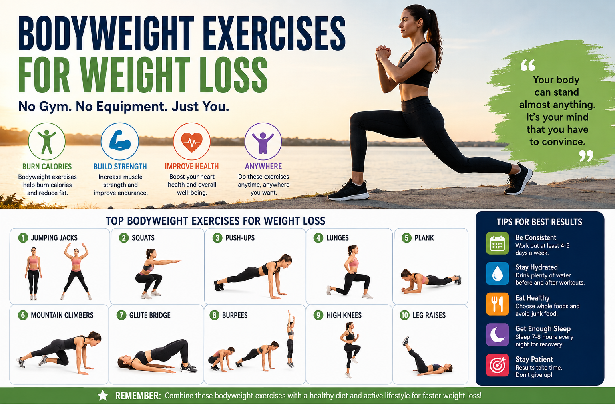
FAQs About Bodyweight Exercises for Weight Loss
1: Can bodyweight exercises help with weight loss?
Yes. Bodyweight exercises for weight loss can increase physical activity and help you build muscle and fitness. However, food intake and total daily activity also affect weight change.
2: Can I lose weight with bodyweight exercises alone?
You may lose weight with a suitable overall calorie balance, but exercise works best with healthy eating and regular daily movement.
3: How many days a week should I do bodyweight workouts?
Beginners can start with two or three strength-focused sessions each week. Then, they can add activity gradually.
4: What is the best bodyweight exercise for weight loss?
There is no single best exercise. Squats, lunges, push-ups, step-ups, mountain climbers, and other movements can all have a place in a balanced routine.
5: Are squats good for losing weight?
Squats work large leg and hip muscles and can help build strength. However, they should form part of a complete activity plan.
6: Are push-ups good for weight loss?
Push-ups strengthen the chest, shoulders, arms, and core. They can support a full-body fitness routine.
7: Can beginners do bodyweight exercises?
Absolutely. Beginners can start with easier variations such as chair squats and wall push-ups.
8: How long should a bodyweight workout be?
A beginner can start with 10 to 20 minutes. Later, the workout can become longer if needed.
9: Do bodyweight exercises burn belly fat?
No exercise can guarantee fat loss from one specific body area. Overall fat loss happens as part of your body’s total weight-loss process.
10: Can I do bodyweight workouts every day?
You can move every day, but hard strength workouts need recovery. Therefore, alternate harder sessions with easier movement.
11: Do bodyweight exercises build muscle?
Yes. Bodyweight movements can build and maintain muscle, especially when you progressively make them more challenging.
12: Do I need gym equipment?
No. You can perform many effective exercises without gym equipment.
13: Can I do these exercises at home?
Yes. Most beginner movements need only a small amount of floor space.
14: Should I exercise before or after eating?
There is no universal best time. Choose a time when you feel comfortable and can perform well.
15: Should I walk along with bodyweight training?
Yes. Walking can add useful aerobic activity to your weekly routine.
16: How quickly will I see results?
Results differ from person to person. Fitness improvements can appear before major changes on the scale.
17: Can I lose weight without jumping?
Yes. You can use squats, lunges, push-ups, bridges, planks, walking, and many other low-impact exercises.
18: Are bodyweight exercises good for older adults?
Many bodyweight movements can be adapted for different fitness levels. However, older adults with health concerns should choose exercises appropriate for their ability and ask a health professional when needed.
19: What should I do if an exercise hurts?
Stop the movement and check your form. If pain continues or seems serious, seek appropriate professional advice.
20: What is the biggest secret to successful bodyweight training?
Consistency is the biggest piece.
A simple workout performed regularly can be more useful than an extreme workout performed once.
A Simple 12-Week Bodyweight Exercises for Weight Loss Roadmap
Finally, here is a simple way to build your routine.
Weeks 1–2: Learn
Exercise two days per week.
Use:
- Chair squats
- Wall push-ups
- Glute bridges
- Marching
- Short planks
Keep workouts around 10 to 15 minutes.
Weeks 3–4: Repeat
Move toward three sessions if you feel ready.
Increase some exercises to 10 to 12 repetitions.
Add easy walking.
Weeks 5–6: Build
Try regular squats.
Use countertop push-ups.
Add reverse lunges.
Increase your plank time slightly.
Weeks 7–8: Improve
Perform three full-body sessions.
Add a few faster movements, such as step-ups or mountain climbers.
However, keep good form.
Weeks 9–10: Progress
Add one extra set to selected exercises.
Or make a few exercises harder.
Do not increase everything at once.
Weeks 11–12: Maintain
Create a routine you can keep long term.
For example:
- Monday: Strength
- Tuesday: Walk
- Wednesday: Strength
- Thursday: Walk
- Friday: Strength
- Saturday: Fun activity
- Sunday: Rest
This gives you structure without making exercise your entire life.
The Bottom Line on Bodyweight Exercises for Weight Loss
Bodyweight exercises for weight loss offer a simple way to become stronger, move more, and create a regular exercise habit without expensive equipment.
You can start with basic movements such as squats, wall push-ups, glute bridges, lunges, step-ups, planks, and marching. Then, as your fitness improves, you can increase repetitions, add sets, reduce rest, or choose harder variations.
However, remember that exercise is only one part of weight management. Your eating pattern, sleep, daily movement, stress, and other lifestyle factors also matter. NIDDK recommends combining healthy eating with regular physical activity for healthy weight management.
Moreover, you do not need to chase extreme workouts.
Start small.
Stay consistent.
Build slowly.
And give your body time to adapt.
For general adult activity guidance, the CDC and U.S. health agencies recommend working toward at least 150 minutes of moderate aerobic activity each week, along with muscle-strengthening activity on at least two days. Some people may need more activity for weight loss or weight maintenance.
Most importantly, choose exercises you enjoy enough to repeat.
That is what turns a short workout into a lasting habit.
External Resources
- NIDDK: Treatment for Overweight & Obesity — Useful information about healthy weight loss, physical activity, and lifestyle changes.
- NIDDK: Keep Active & Eat Healthy — Practical guidance on activity, healthy eating, and weight management.
- CDC: Physical Activity Guidelines — General physical activity guidance for adults.
- American College of Sports Medicine — Professional guidance on resistance training and exercise.